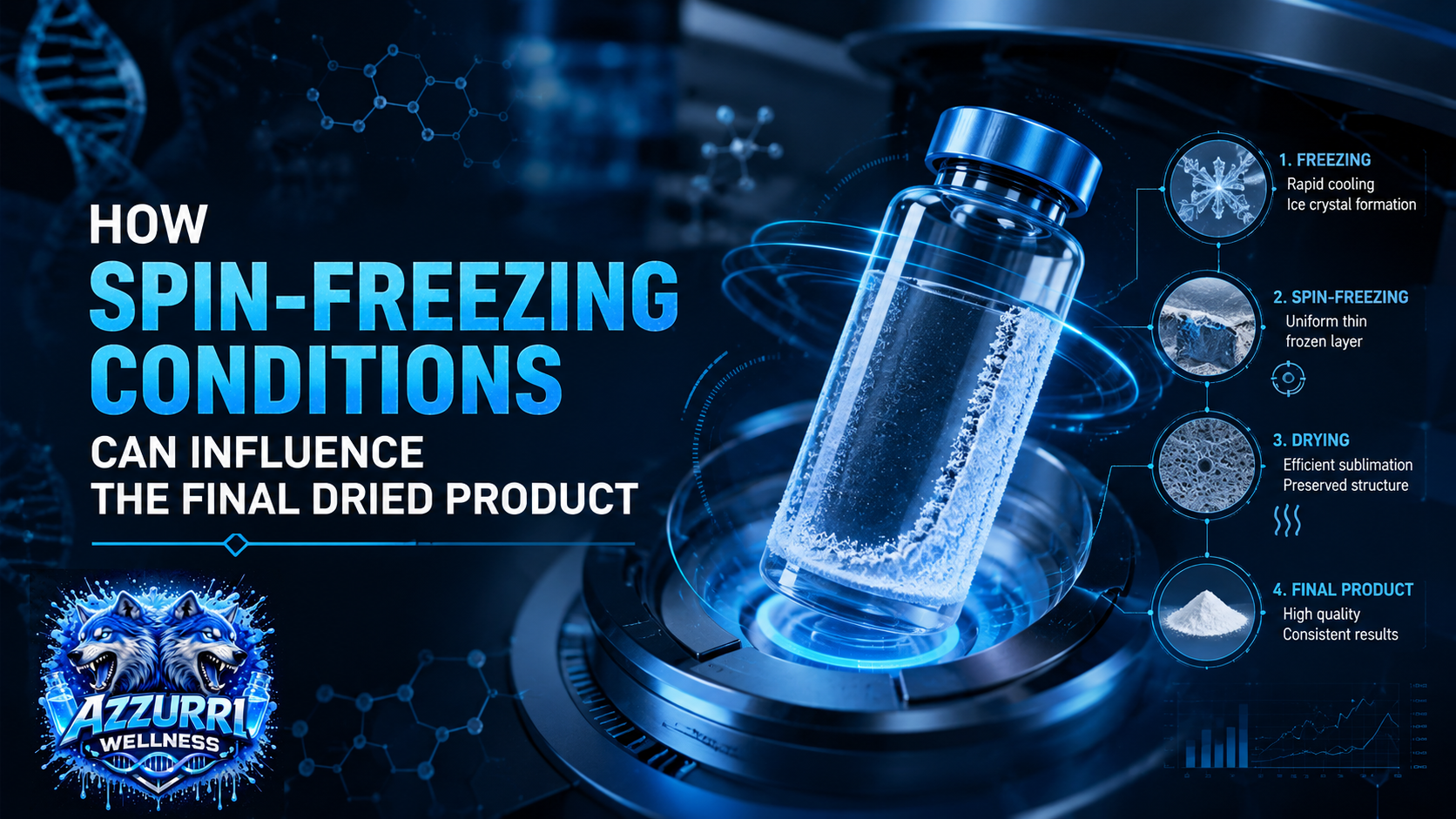
Freeze-drying does not begin with drying. The freezing stage establishes the structure through which water must later escape.
In continuous spin-freeze-drying, a vial rotates while the liquid freezes against its inner wall. The resulting frozen layer can influence heat transfer, water-vapour movement, drying time, and the appearance of the final dried material.
A study published in 2025 examined how spin-freezing parameters and formulation composition affected drying efficiency and selected attributes of a model peptide formulation.
1. Why the Frozen Structure Matters
As water freezes, ice crystals form throughout the formulation. During primary drying, those crystals are removed through sublimation, leaving behind pores.
The size and arrangement of those pores influence how easily vapour travels out of the frozen material. A more open structure may support faster drying, while a denser structure may create greater resistance.
Because freezing conditions affect crystal formation, they can influence the later drying stage even though no water has yet been removed.
2. The Role of Rotation and Cooling
Spin-freezing spreads the formulation into a thin layer. Rotation speed, cooling conditions, fill volume, and formulation ingredients can all affect the thickness and uniformity of that layer.
The researchers evaluated the relationship between spin-freezing settings, drying efficiency, and measured product characteristics. Their results showed that freezing conditions should be considered part of the complete process rather than treated as a simple preparation step.
3. Formulation Composition Also Matters
Equipment settings are only one part of the process. Excipients and formulation composition can influence the way a material freezes, dries, and forms its final structure.
A setting that performs well for one formulation may not produce the same result with another. This is why process development generally evaluates the formulation and manufacturing conditions together.
4. What Should Be Monitored?
A well-documented spin-freeze-drying study may evaluate:
- Product temperature
- Frozen-layer thickness
- Drying duration
- Residual moisture
- Cake appearance
- Peptide concentration
- Aggregation or monomer measurements
No single measurement describes the entire process. A visually intact cake, for example, does not by itself establish moisture level or molecular condition.
5. From Observation to Process Understanding
Process optimization is not simply about achieving the shortest drying time. The objective is to identify conditions that provide repeatable performance while maintaining the selected specifications.
Continuous spin-freeze-drying may provide new monitoring and control opportunities, but each formulation still requires appropriate evaluation.
At Azzurri Wellness, we believe clear scientific communication should explain both the result and the conditions that produced it.
The final product begins with the freezing process.
Reference
Schaal Z, Van Bockstal PJ, Lammens J, et al. Optimization of continuous spin-freeze-drying: The role of spin-freezing on quality attributes and drying efficiency of a model peptide formulation. European Journal of Pharmaceutical Sciences. 2025;204:106963.
Disclaimer: This article is intended for general educational information only. It does not provide medical advice, product-use directions, or claims about the suitability of any specific material.