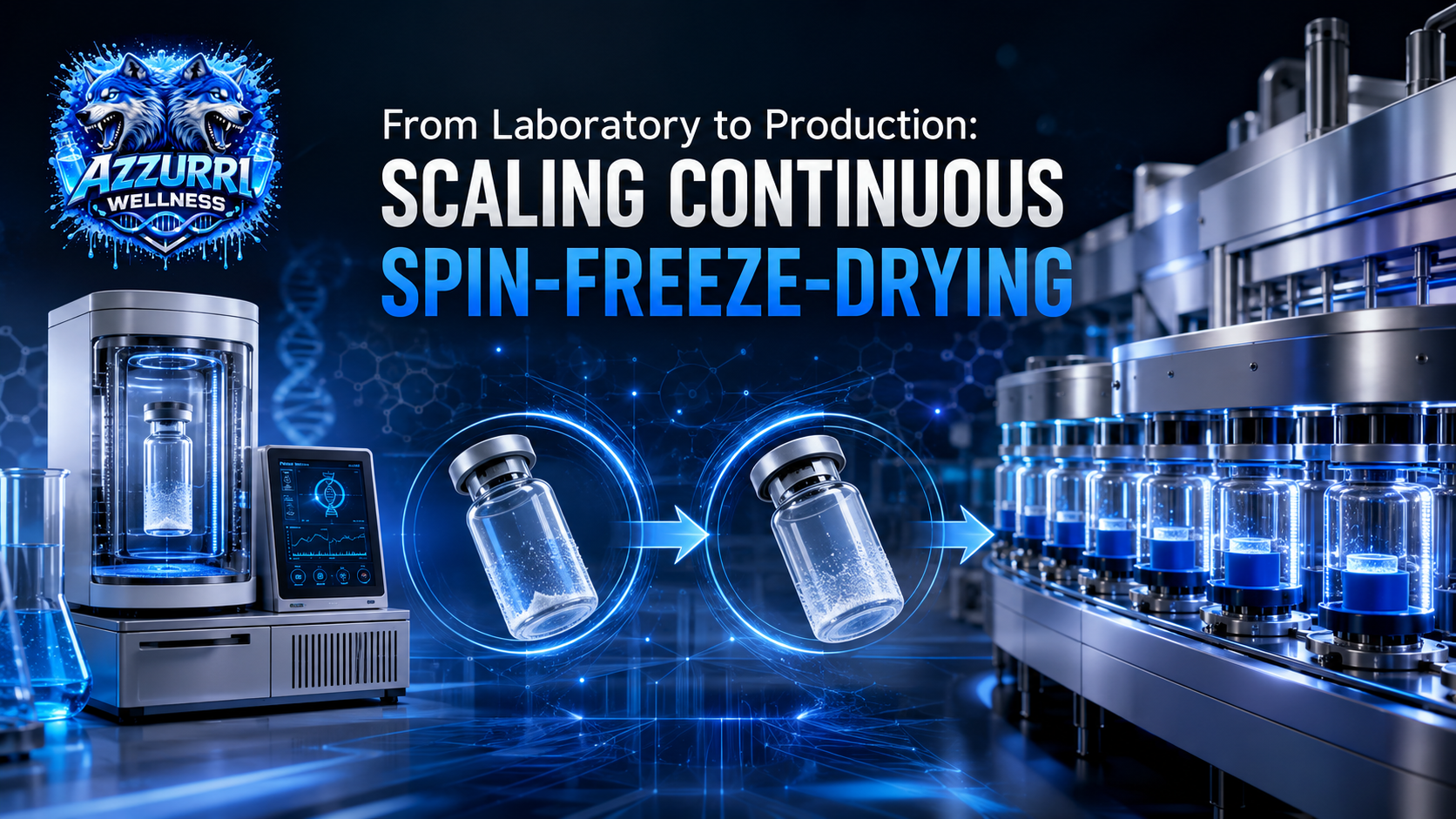
Freeze-drying is widely used to remove water from sensitive formulations. Traditional freeze-drying generally processes many vials together inside a large chamber, but newer technologies are exploring a more continuous and individually controlled approach.
A 2026 study investigated whether continuous spin-freeze-drying could be transferred from a laboratory-scale system to a larger, manufacturing-compatible prototype without significantly changing the tested formulation’s characteristics.
1. What Is Continuous Spin-Freeze-Drying?
In continuous spin-freeze-drying, each vial rotates during freezing. This creates a thin frozen layer along the inner wall of the container.
The larger exposed surface area can support faster movement of water vapour during drying. Each vial can also move through the process individually rather than remaining inside one large stationary batch.
The technology is designed to provide greater control at the individual-vial level, although performance still depends on formulation composition, equipment settings, and process conditions.
2. Moving Beyond the Laboratory
The 2026 study transferred a model PEGylated peptide formulation from a single-vial development unit to a larger GMP-compatible prototype line.
The researchers applied matching freezing and drying settings on both platforms. They then compared:
- Product-temperature profiles
- Dried-cake appearance
- Residual moisture
- Peptide concentration
- Monomer levels
The temperature profiles were closely aligned between the two systems, indicating that the formulation experienced comparable thermal conditions during the tested process.
3. What Did the Study Find?
The dried samples maintained intact cake structures without visible collapse. Residual-moisture results remained within the study’s predefined range, and no timing-related trend was observed during the larger production run.
The researchers also reported consistent peptide concentration and monomer measurements under the conditions they evaluated. These findings suggest that the process could be transferred between the two tested platforms while maintaining comparable results.
The findings apply to the specific formulation, equipment, and operating conditions used in the study. They should not be treated as proof that every peptide or formulation will behave in the same way.
4. Why Scale-Out Matters
A successful laboratory process is only an early step. Larger-scale manufacturing also requires reproducibility, equipment control, documented operating conditions, and consistent monitoring.
Scale-out studies help determine whether a process behaves similarly when more units are produced. They can also reveal whether temperature, drying rate, or product characteristics change during technology transfer.
At Azzurri Wellness, scientific information is most useful when the process conditions, measurements, and limitations are presented clearly.
Better manufacturing knowledge begins with measurable evidence.
Reference
Schaal Z, Leys L, Van Bockstal PJ, et al. From R&D to production: Scale-out of continuous spin-freeze-drying for a PEGylated peptide formulation. International Journal of Pharmaceutics. 2026;700:127077.
Disclaimer: This article is provided for general educational information only. It does not provide medical advice, usage instructions, or guarantees regarding any individual product.