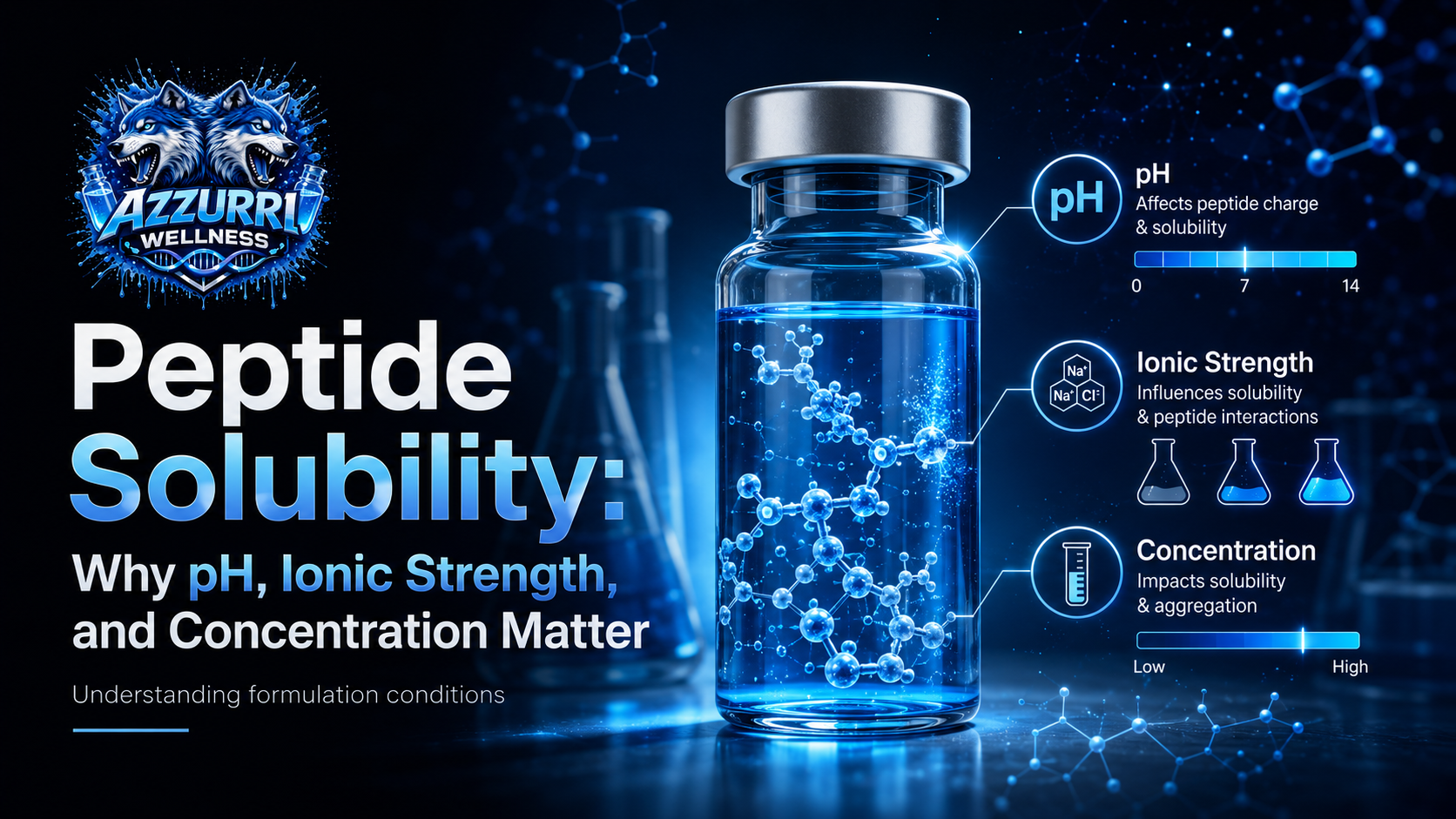
Peptide Solubility: Why pH, Ionic Strength, and Concentration Matter
July 23, 2026 Azzurri Wellness Team
Peptide solubility is not a fixed property that can be understood from the sequence name alone. The same peptide may behave differently as pH, salt concentration, temperature, solvent composition, and overall concentration change.
Why pH Matters
Peptides contain ionizable groups that can gain or lose charge depending on the surrounding pH. Those charge changes affect how strongly peptide molecules attract or repel one another. Near a point where the net charge is low, intermolecular association may become more likely, which can reduce apparent solubility or promote aggregation.
Ionic Strength Can Change Interactions
Dissolved salts can screen electrostatic interactions between charged groups. In some systems this may improve behavior, while in others it can reduce repulsion between molecules and encourage association. Because the effect depends on the peptide and the formulation, salt concentration should be evaluated rather than assumed to be universally helpful.
Concentration Is Part of the Equation
A peptide that appears clear at a low concentration may become difficult to dissolve at a higher concentration. As more molecules occupy the same volume, the probability of intermolecular contact increases. This can lead to cloudiness, precipitation, or aggregation even when the solvent and pH remain unchanged.
What Transparent Documentation Should Show
The solvent or buffer used
The pH and relevant salt concentration
The peptide concentration tested
The temperature and observation period
Whether the sample remained clear or showed visible change
Any analytical method used to evaluate aggregation or loss of material
Solubility statements are most useful when the conditions are clearly stated. A broad claim such as "soluble in water" may not describe behavior at every pH, concentration, or storage condition.
A More Complete Quality Picture
At Azzurri Wellness, scientific information should include the conditions behind the result. Clear formulation details help readers understand what was actually observed and avoid treating one test condition as a universal rule.
Science over hype. Context over assumptions.
References
1. Zapadka KL, Becher FJ, Gomes dos Santos AL, Jackson SE. Factors affecting the physical stability (aggregation) of peptide therapeutics. Interface Focus. 2017;7(6):20170030. Source
2. Nugrahadi PP, Hinrichs WLJ, Frijlink HW, Schöneich C, Avanti C. Designing formulation strategies for enhanced stability of therapeutic peptides in aqueous solutions: a review. Pharmaceutics. 2023;15(3):935. Source
3. Hauser CAE, Deng R, Mishra A, et al. Structural characteristics of short peptides in solution. Chemical Reviews. 2013;113(11):8320-8347. Source
Disclaimer: This article is for educational and informational purposes only. It does not provide medical advice or product-specific preparation instructions.
Looking for premium peptides? Third-party lab tested, fast USA shipping.