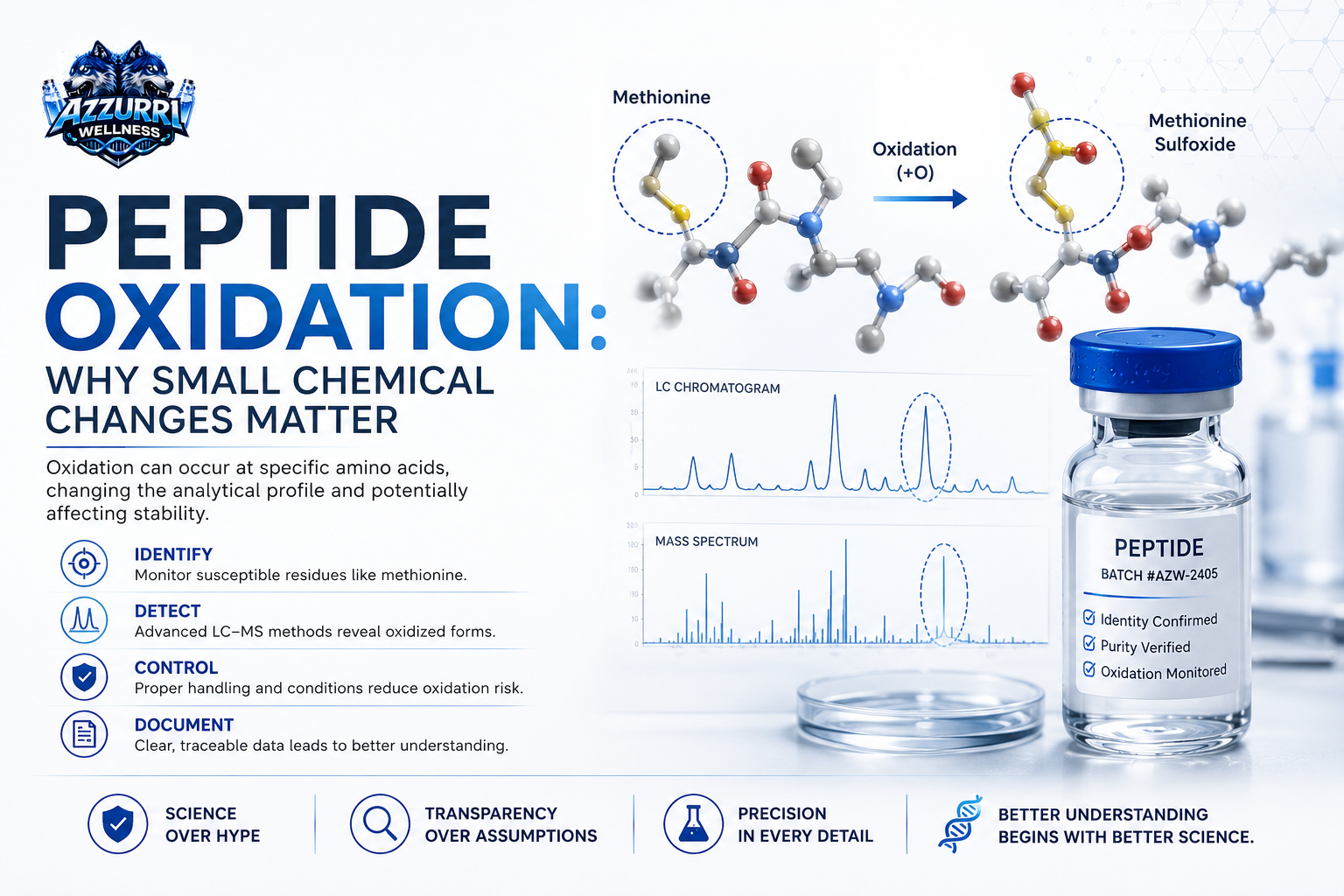
Peptide oxidation is a chemical change that can occur when certain amino-acid residues react with oxygen-containing species. The change may be small at the molecular level, but it can alter the analytical profile of a sample.
Oxidation does not affect every peptide in the same way. The sequence, formulation, temperature, light exposure, dissolved oxygen, trace metals, and handling conditions can all influence whether oxidation occurs and how quickly it develops.
1. Which Residues Are Commonly Monitored?
Methionine is one of the residues most frequently discussed in oxidation studies because it can form methionine sulfoxide. Other residues may also be susceptible under particular conditions, so the complete sequence and formulation must be considered.
2. Why the Analytical Profile Can Change
Oxidation adds oxygen to a susceptible site and changes molecular mass. It may also change polarity, retention behavior, or conformation. These differences can produce additional chromatographic peaks or mass-spectrometric signals.
A new peak does not explain itself. Analysts still need to determine whether it represents oxidation, another chemical change, a process-related component, or an artifact introduced during sample preparation.
3. Testing Must Control for Artifacts
Oxidation can sometimes occur during preparation or analysis rather than being present in the original sample. For that reason, suitable controls, carefully selected containers, clean reagents, and documented preparation times are important.
Research has also shown that residual metals can contribute to variability in methionine-oxidation measurements. This illustrates why analytical conditions must be controlled before comparing results across samples or laboratories.
4. Common Analytical Approaches
- Liquid chromatography coupled with mass spectrometry
- Peptide mapping to locate the modified residue
- Chromatographic comparison against an unmodified profile
- Spectroscopic methods when appropriately validated
- Time-point studies under defined storage conditions
No single technique automatically provides the complete explanation. Orthogonal methods can help distinguish molecular identity, relative abundance, and structural effects.
5. What Clear Documentation Should Include
- The batch or sample identifier
- The preparation and storage conditions
- The analytical method and instrument settings
- How oxidized forms were identified
- Whether sample-preparation artifacts were evaluated
- The date and basis of the reported result
6. The Main Takeaway
Peptide oxidation is a reminder that molecular quality cannot be reduced to one headline number. Meaningful interpretation depends on the sequence, the conditions, the method, and the controls used.
At Azzurri Wellness, clarity means explaining what was measured and how the conclusion was reached.
References
- Ghesquière B, Gevaert K. Proteomics methods to study methionine oxidation. Mass Spectrometry Reviews. 2014;33(2):147–156. View source
- Zang L, Carlage T, Murphy D, et al. Residual metals cause variability in methionine oxidation measurements in protein pharmaceuticals using LC-UV/MS peptide mapping. Journal of Chromatography B. 2012;895–896:71–76. View source
- Balakrishnan G, Barnett GV, Kar SR, Das TK. Detection and identification of vibrational markers for the quantification of methionine oxidation in therapeutic proteins. Analytical Chemistry. 2018;90(10):6959–6966. View source
- Nugrahadi PP, Hinrichs WLJ, Frijlink HW, Schöneich C, Avanti C. Designing formulation strategies for enhanced stability of therapeutic peptides in aqueous solutions: a review. Pharmaceutics. 2023;15(3):935. View source
Disclaimer: This article is provided for general educational information only. It does not provide medical advice, product-use instructions, or guarantees regarding any individual material.