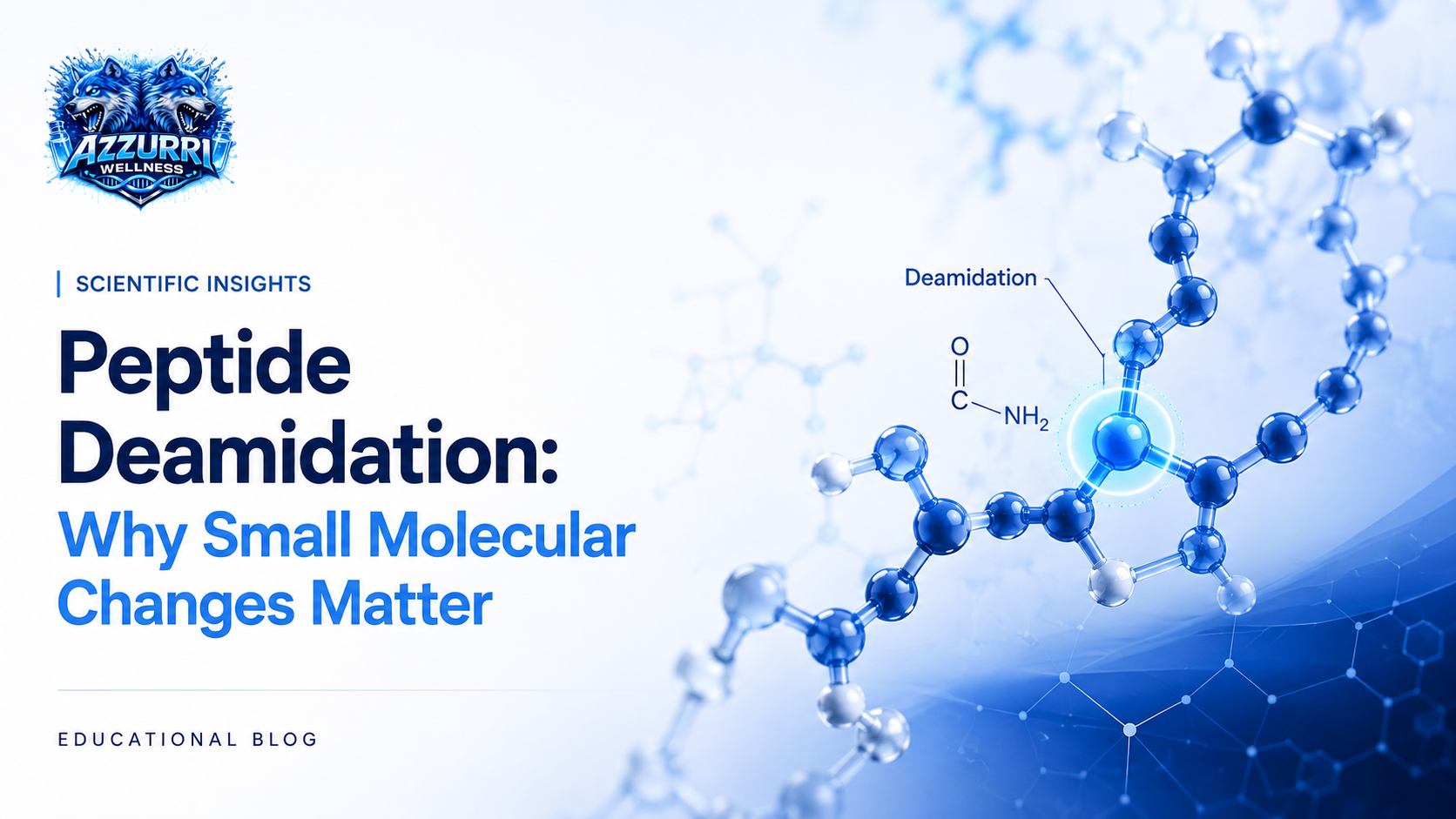
Deamidation is most commonly associated with asparagine and, under some conditions, glutamine residues. The rate at which the process occurs is not identical for every peptide. Sequence, molecular structure, pH, temperature, moisture, and surrounding chemical conditions can all influence the reaction.
Research has shown that nearby amino acids and peptide conformation can substantially affect deamidation rates. This means that two peptides containing the same susceptible residue may behave differently because their surrounding sequences and structures are different.
What Happens During Deamidation?
For an asparagine-containing sequence, deamidation may proceed through a cyclic intermediate before producing related products such as aspartate or isoaspartate forms.
These products are particularly interesting from an analytical perspective because they can be chemically very similar to the original peptide.
A conventional molecular-mass measurement may therefore provide useful information without completely resolving every related structure.
Modern analytical research has demonstrated how deamidation and isoaspartate formation may occur during peptide analysis, purification, and storage while also showing why tandem mass spectrometry can provide additional structural information.
Why Sequence Matters
Deamidation should not be treated as a fixed characteristic that applies equally to all peptide sequences.
Important variables can include:
- The amino acid immediately following an asparagine residue
- Neighboring amino acids
- Peptide conformation
- Temperature
- pH
- Moisture
- Processing time
- Storage environment
Experimental work with model peptides has demonstrated that neighboring residues can meaningfully influence deamidation behavior, particularly in solid-state systems.
This sequence dependence is why general statements about peptide stability need supporting analytical context.
Why Moisture Can Matter
Removing bulk water does not necessarily eliminate every chemical reaction.
Research using lyophilized model peptides has found that changes in moisture and formulation conditions can influence deamidation rates. This illustrates an important analytical principle: a dry appearance alone does not establish that a peptide will remain chemically unchanged indefinitely.
The relationship between water and chemical stability can also depend on the physical environment surrounding the peptide.
How Deamidation Can Be Investigated
A complete analytical strategy may combine several techniques rather than relying on one measurement.
These can include:
- High-performance liquid chromatography
- Liquid chromatography–mass spectrometry
- Tandem mass spectrometry
- Peptide mapping
- Comparison with appropriate reference materials
- Stability studies conducted at defined time points
Chromatography can reveal changes in a sample profile, while mass spectrometry can provide molecular information about individual components.
MS/MS can provide another level of information by fragmenting selected peptide ions and examining where a modification may be located.
This does not mean every spectrum automatically provides an unambiguous structural answer. Interpretation depends on fragmentation quality, separation, reference information, instrument conditions, and the chemical structures being compared.
Documentation Matters
When evaluating a deamidation result, useful documentation may include:
- Sample or lot identifier
- Peptide sequence
- Analytical method
- Storage conditions
- Preparation conditions
- Testing date
- Identified related forms
- Method used to assign those forms
- Relevant controls or reference materials
A percentage or molecular-mass value becomes much more useful when the testing conditions behind it are clearly documented.
The Main Takeaway
Peptide deamidation demonstrates why peptide characterization often requires more than confirming molecular weight or reporting one purity percentage.
Sequence, environment, processing, and analytical methodology all influence how a result should be interpreted.
At Azzurri Wellness, meaningful quality information begins with understanding what was measured, how it was measured, and what the result can actually demonstrate.
References
- Erckes V, Chamera Rendueles L, Misiek A, Steuer C. Revealing deamidation and isoaspartate formation during peptide analysis, purification and storage by tandem mass spectrometry. RSC Medicinal Chemistry. 2026.
- Bischoff R, Kolbe HV. Deamidation of asparagine and glutamine residues in proteins and peptides: structural determinants and analytical methodology. Journal of Chromatography B. 1994.
- Wright HT. Sequence and structure determinants of the nonenzymatic deamidation of asparagine and glutamine residues in proteins. Protein Engineering. 1991.
- Lai MC, Hageman MJ, Schowen RL, et al. Chemical stability of peptides in polymers: effects of water on peptide deamidation. Journal of Pharmaceutical Sciences.
Disclaimer: This article is provided for general educational and scientific-information purposes only. It does not provide medical advice, product-use instructions, or guarantees regarding any individual material.