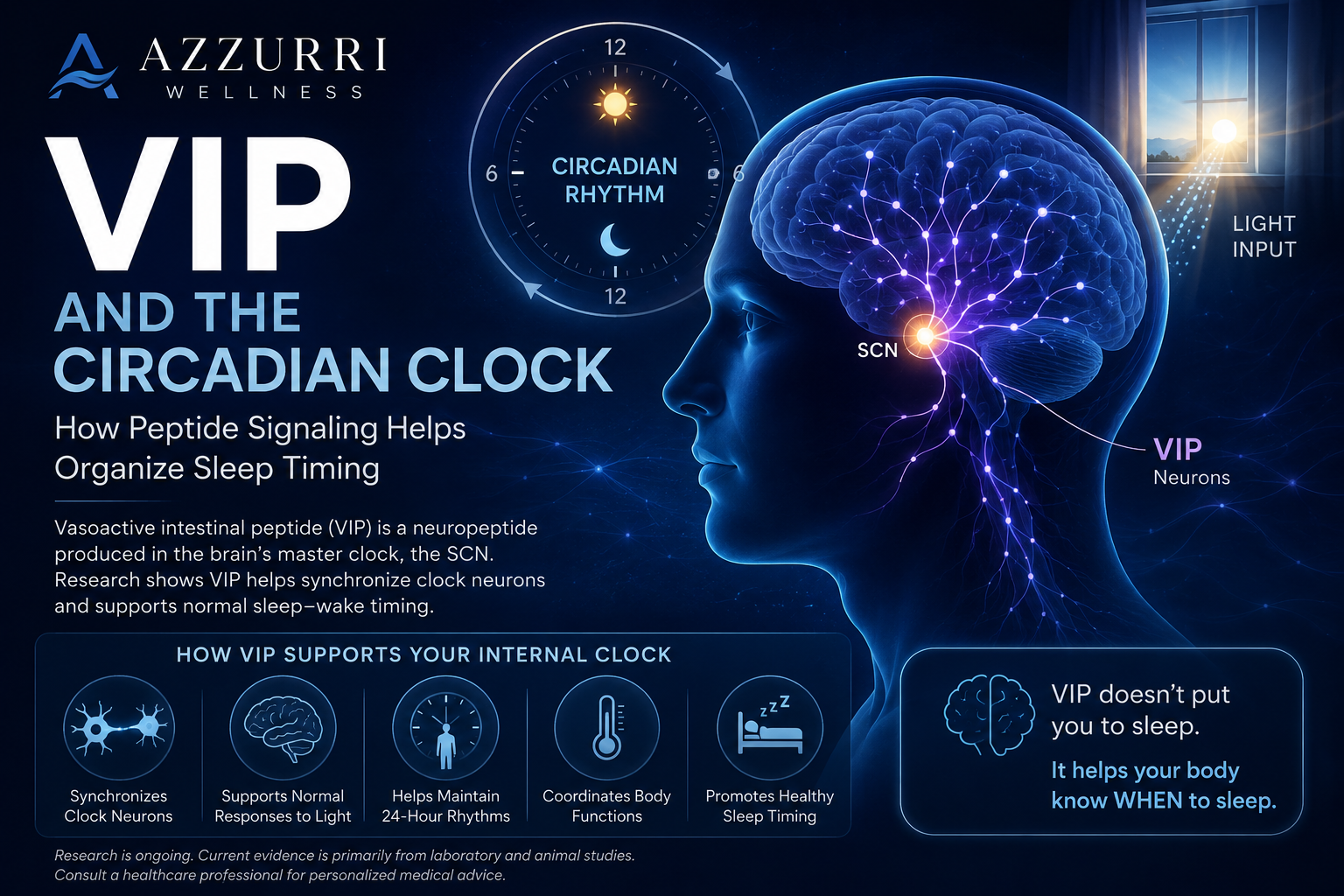
A good night’s sleep depends on more than feeling tired. The body must also know when to become sleepy, when to wake, and how to coordinate temperature, hormone release, alertness, and metabolism across the day.
One peptide involved in this timing system is vasoactive intestinal peptide, commonly called VIP. Despite its name, VIP is not limited to the digestive system. It also acts as a signaling molecule in the brain, including within the central biological clock.
Research suggests that VIP helps groups of clock neurons communicate with one another and maintain a coordinated daily rhythm. This makes it scientifically relevant to sleep timing, jet lag, shift work, and circadian disruption, but it should not be described as a conventional sleep-inducing peptide.
What Is Vasoactive Intestinal Peptide?
VIP is a naturally occurring peptide found in the nervous system and several organs. It participates in multiple physiological processes, including neural communication, smooth-muscle activity, immune signaling, and circadian regulation.
Within sleep science, VIP is especially important because it is produced by a population of neurons inside the suprachiasmatic nucleus, or SCN. The SCN is a small region of the hypothalamus that functions as the body’s primary circadian clock.
Rather than directly putting the brain to sleep, the SCN helps determine when sleep and wakefulness should occur.
The Difference Between Sleep Pressure and Circadian Timing
Two major systems work together to regulate sleep.
The first is sleep pressure. The longer someone remains awake, the stronger the biological drive to sleep generally becomes.
The second is the circadian timing system. This internal clock creates approximately 24-hour patterns in alertness, body temperature, hormone release, digestion, and sleep readiness.
A person can therefore feel exhausted while still struggling to sleep if their circadian clock is signaling wakefulness. This commonly occurs after travel across time zones, overnight work, irregular schedules, or exposure to bright light late at night.
VIP research primarily relates to this timing system rather than to sedation.
How VIP Helps Clock Neurons Stay Synchronized
The SCN contains thousands of individual neurons. Many of these cells possess their own molecular clocks, but they must communicate to produce one stable rhythm for the entire organism.
VIP acts as one of the signals that helps these clock cells remain synchronized. Laboratory studies indicate that disrupting VIP signaling can weaken coordination among SCN neurons and produce irregular circadian rhythms.
This synchronization is important because the body does not operate as a collection of completely independent clocks. The brain, liver, muscles, digestive tract, and endocrine system must remain coordinated with the external light-dark cycle.
VIP can therefore be understood as part of the communication network that keeps biological time organized.
VIP and Responses to Light
Light is the strongest environmental signal for resetting the human circadian clock.
Specialized cells in the eye detect environmental light and send timing information to the SCN. VIP-producing neurons within the SCN participate in processing and distributing this information.
Experimental research in animals found that SCN VIP neurons display daily patterns in activity and contribute to normal clock resetting in response to light. When these neurons were disrupted, the circadian system responded abnormally to changes in the light-dark schedule.
This does not mean that VIP alone controls light responses. Instead, it is one component of a larger network involving retinal signals, multiple neuropeptides, clock genes, and downstream brain regions.
What Laboratory Studies Have Found
Much of the strongest VIP evidence comes from cellular and animal research.
Scientists have found that manipulating VIP or its receptors can alter:
- Synchronization among SCN neurons
- The timing of circadian activity
- The length of the internal circadian period
- Responses to changes in environmental light
- The stability of daily behavioral rhythms
For example, chronic stimulation of a hypothalamic VIP receptor lengthened the circadian period in animal models. Other research found that VIP could produce persistent changes in electrical activity within circadian clock tissue.
These studies help explain how the clock works, but they are not equivalent to evidence that administering VIP improves sleep in people.
Does VIP Improve Sleep Quality?
Current research does not justify claiming that VIP reliably improves sleep duration, deep sleep, or insomnia symptoms.
VIP appears to influence the organization and timing of biological rhythms. That is different from directly increasing sleep or producing sedation.
A person’s sleep quality depends on many factors beyond circadian synchronization, including:
- Stress and anxiety
- Sleep apnea
- Pain
- Medication
- Caffeine and alcohol
- Bedroom conditions
- Hormonal changes
- Mental-health conditions
- Inconsistent schedules
VIP-related mechanisms may contribute to sleep timing, but they cannot explain every form of sleep disturbance.
VIP Is Not the Same as Melatonin
Melatonin is released by the pineal gland at night and acts as a hormonal signal of biological darkness. VIP works primarily within neural clock circuits and helps synchronize circadian neurons.
The two systems interact with the broader circadian network, but they are not interchangeable.
Melatonin communicates information about nighttime. VIP helps coordinate the cells responsible for generating and resetting daily rhythms.
This distinction is important because a substance involved in circadian biology should not automatically be marketed as a sleep aid.
Why Human Research Remains Limited
Several gaps prevent strong conclusions about VIP and everyday sleep improvement:
- Much of the evidence comes from rodents or isolated brain tissue.
- Human intervention studies examining normal sleep outcomes are limited.
- VIP acts in many tissues, making its systemic effects complex.
- Circadian timing depends heavily on dose, location, timing, and receptor activity.
- A change in a biological clock marker does not necessarily improve how a person feels or sleeps.
Research should therefore be described as mechanistic and exploratory rather than as proof of a therapeutic sleep effect.
Practical Ways to Support Circadian Alignment
The strongest established methods for supporting healthy sleep timing involve environmental and behavioral signals.
- Receiving bright natural light shortly after waking
- Keeping a consistent wake time
- Reducing bright light late in the evening
- Avoiding large shifts in weekend sleep schedules
- Exercising regularly
- Timing meals consistently
- Keeping the bedroom dark during sleep
- Limiting caffeine later in the day
These habits work with the circadian system rather than attempting to isolate one peptide pathway.
Final Takeaway
VIP is an important neuropeptide within the brain’s central circadian clock. Research indicates that it helps synchronize clock neurons and supports normal responses to environmental light.
Its significance lies primarily in helping scientists understand when the body sleeps, not in proving that VIP directly induces or improves sleep.
The evidence is scientifically valuable, but claims about treating insomnia or guaranteeing better sleep would go beyond the available research.
Research References
- Vosko AM, et al. Vasoactive intestinal peptide and the mammalian circadian system. View research
- Ono D, et al. Roles of neuropeptides VIP and AVP in the mammalian central circadian clock. View research
- Jones JR, et al. SCN VIP neurons are essential for normal light-mediated resetting of the circadian system. View research
- Kudo T, et al. Vasoactive intestinal peptide produces long-lasting changes in circadian clock activity. View research
- Pantazopoulos H, et al. Chronic stimulation of the hypothalamic VIP receptor lengthens circadian period. View research