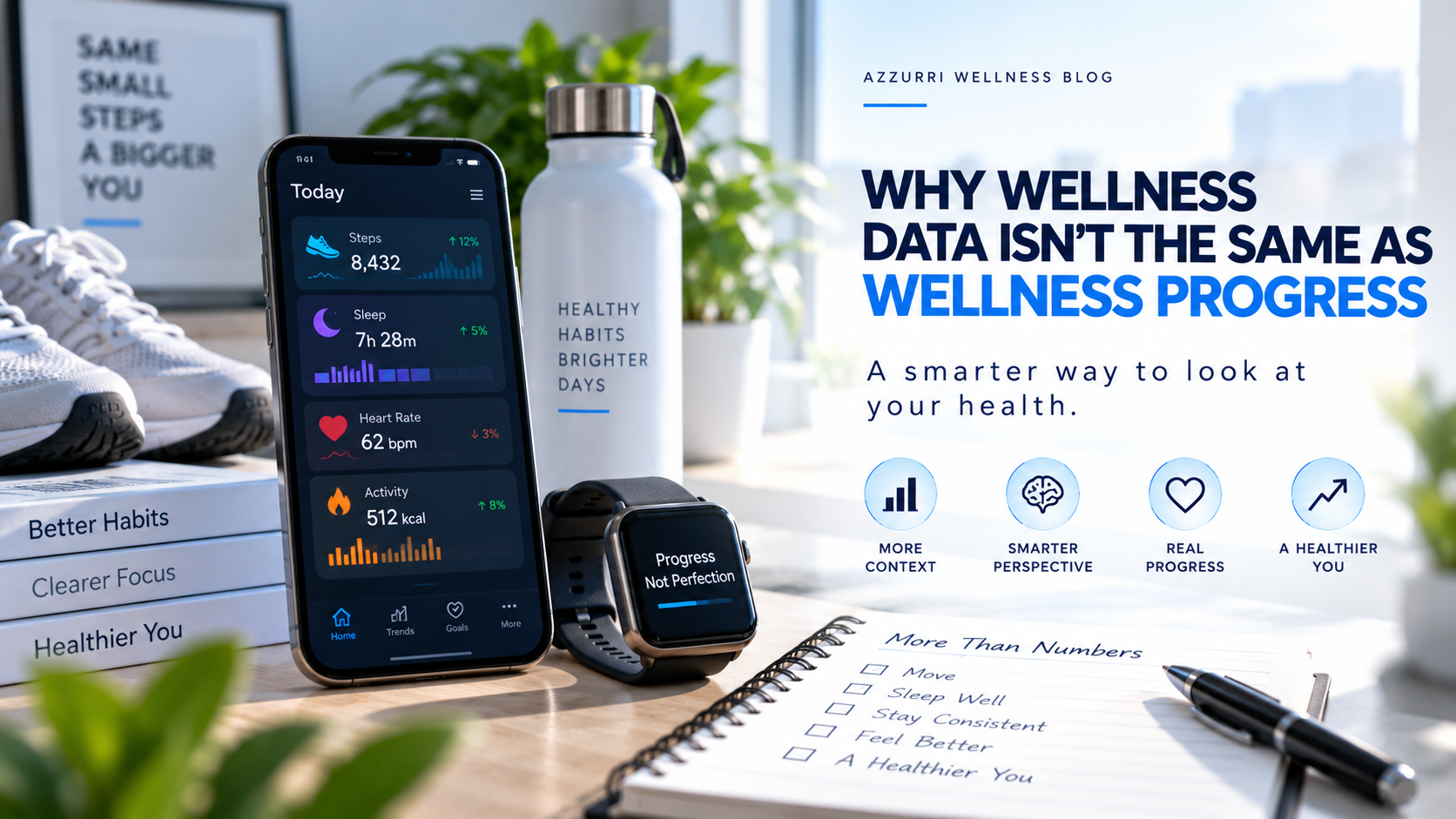
Why Wellness Data Isn't the Same as Wellness Progress
Your smartwatch can tell you how many steps you took, how long you slept, how fast your heart was beating, and sometimes dozens of other numbers before breakfast.
Having all that information can be useful. But there is an important difference between collecting data and understanding what that data actually means.
More numbers don't automatically mean more progress.
A Number Is a Measurement, Not the Whole Story
Wearable technology has made health and fitness information much easier to collect. Many devices can continuously monitor signals and turn them into easy-to-read metrics.
But not every number displayed by a wearable is a direct measurement of a physiological process.
Some metrics are generated by combining sensor signals with algorithms, user information, and assumptions about how the body behaves.
A recent review of consumer smartwatch technology highlights this distinction, noting that many user-facing metrics are modeled estimates rather than direct physiological measurements.
Why the Same Metric Can Vary
Different wearable devices may use different sensors, algorithms, software, and validation methods.
Even the same device can produce different results depending on factors such as how it is worn, the activity being performed, environmental conditions, and characteristics of the individual using it.
A large umbrella review of consumer wearables found substantial variation in accuracy depending on the biometric being measured, device, activity, and context.
That doesn't make wearable technology useless. It simply means that numbers should be interpreted within their limitations.
Daily Numbers Can Move Around
One of the easiest mistakes to make with wellness tracking is treating every daily change as meaningful.
You might see a different sleep score from one night to the next. Activity levels can change because of your schedule. Heart-rate measurements can vary depending on activity and circumstances.
A single reading often provides less context than a pattern observed over time.
Instead of asking, "Was today's number perfect?" it can be more useful to ask, "What pattern am I seeing over several days or weeks?"
Look for Trends Instead of Chasing Scores
Imagine your activity tracker shows 6,000 steps one day and 9,000 the next. Neither number tells you everything about your overall activity.
Looking at your average activity over a longer period can provide more useful context than focusing on one unusually high or low day.
The same principle can apply to many forms of wellness tracking.
- Look at patterns rather than isolated readings.
- Compare your current routine with your own previous routine.
- Pay attention to changes that persist over time.
- Consider what was happening in your life when a measurement changed.
- Don't assume that a single score represents your overall health.
Context Makes the Data More Useful
Numbers become more meaningful when you understand what was happening around them.
Maybe you slept less because you had an unusually late work night. Maybe your activity dropped because you spent the day traveling. Maybe your workout looked different because you changed your training routine.
Without context, a metric can be easy to misunderstand.
This is one reason researchers emphasize that wearable measurements can be affected by factors such as device placement, algorithms, activity type, environment, and individual characteristics.
Not Every Metric Deserves Your Attention
Modern wearable devices can provide an impressive number of statistics. That doesn't mean you need to monitor every one.
Choose measurements that actually relate to the habits you're trying to understand.
If you're working on becoming more active, activity trends may be more useful to you than a complicated collection of secondary scores.
If you're interested in sleep habits, looking at your sleep schedule and longer-term patterns may be more useful than reacting emotionally to every individual sleep score.
The goal is to turn information into something useful—not to create another source of daily pressure.
Wearables Are Tools, Not Judges
A fitness tracker doesn't know everything about your day.
It doesn't know whether you had a difficult meeting, spent time with family, worked on a demanding project, or simply decided to take a rest day.
Its data can provide another perspective, but it shouldn't replace common sense or professional guidance when medical concerns are involved.
Research on wearable technology also highlights concerns around data quality, privacy, accessibility, and the consequences of interpreting wearable information without enough context.
Create a Simpler Personal Dashboard
You don't need to track everything.
Start with a small group of measurements that are genuinely useful to your goals.
For example, someone building a more active lifestyle might choose weekly activity levels, workout frequency, and general sleep patterns.
Someone working on consistency might simply track whether they completed the habits they planned for the week.
The exact metrics will depend on the person. The important part is making the information simple enough that you can actually use it.
Progress Is Bigger Than a Dashboard
Wellness progress isn't always something that appears as a number on a screen.
Becoming more consistent with your routine, finding activities you enjoy, improving your daily habits, and learning how your body responds to your lifestyle can all be meaningful parts of progress.
Wearable technology can help you notice patterns, but it doesn't define what progress means for you.
Use the data as information. Look for trends. Keep the bigger picture in mind.
Most importantly, don't let one number decide whether you had a good day.
Azzurri Wellness
Technology can make it easier to understand your habits, but meaningful wellness is about more than what appears on a screen. Use data as a tool, keep it in context, and build routines that work for your life.
Discover more from Azzurri Wellness at azzurriwellness.com.
References
- Doherty C, et al. Keeping Pace with Wearables: A Living Umbrella Review of Systematic Reviews Evaluating the Accuracy of Consumer Wearable Technologies in Health Measurement. Sports Medicine, 2024.
- Consumer Smartwatch Technology in Health and Performance Research: Validity, Limitations, and Real-World Applications. 2026.
- A Systematic Literature Review of the Factors that Influence the Accuracy of Consumer Wearable Health Device Data. PMC / National Library of Medicine.
- Use of Consumer Wearables in Health Research: Issues and Considerations. Journal of Medical Internet Research, 2023.