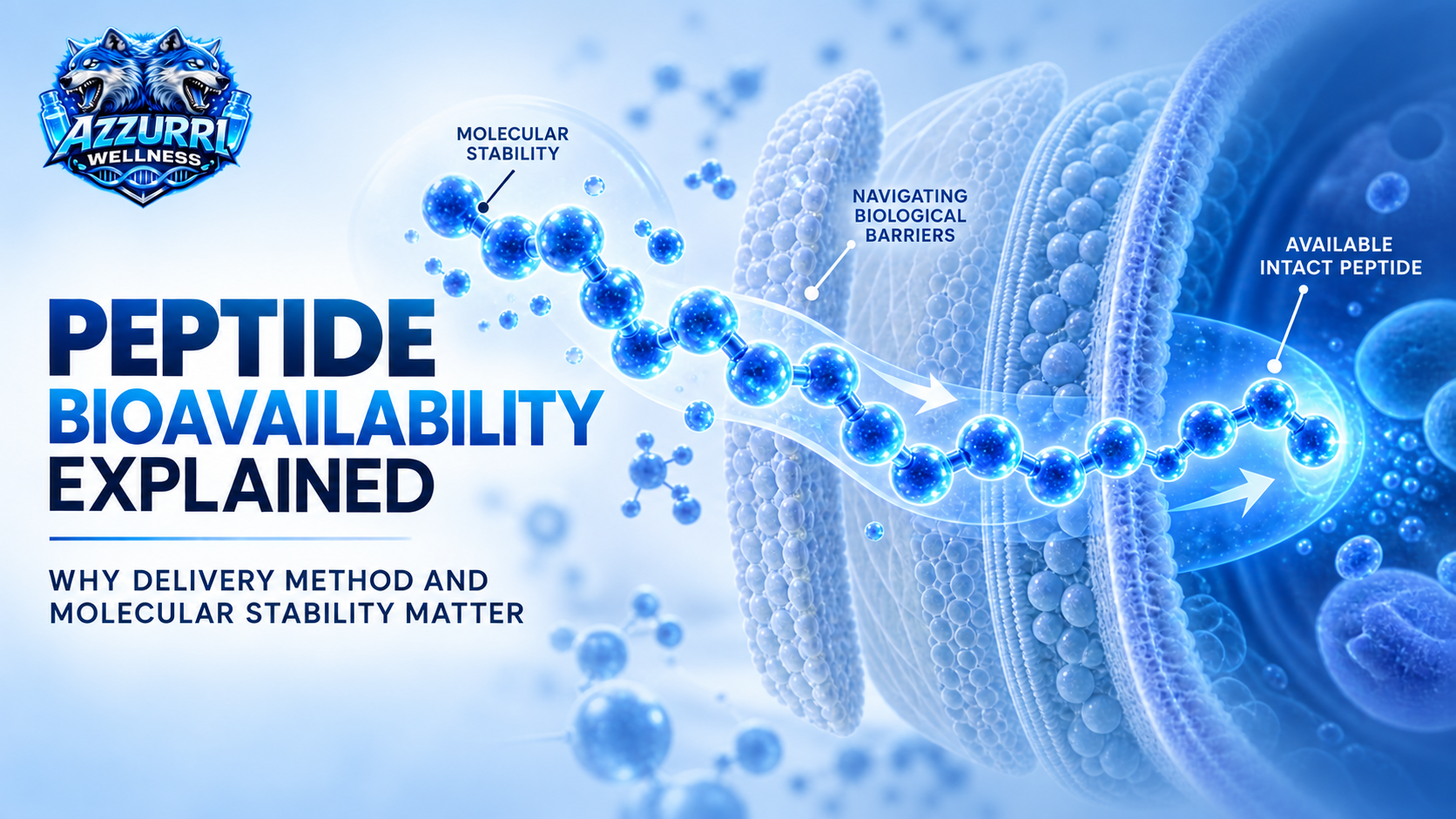
Peptide Bioavailability Explained: Why Delivery Method and Molecular Stability Matter
Peptide bioavailability is an important concept in peptide science because detecting a compound in a formulation does not automatically mean that the same amount will reach its intended biological environment.
Bioavailability generally describes the proportion of a compound that reaches systemic circulation in an available form. Researchers examine it alongside absorption, distribution, metabolism, and elimination to understand how a molecule behaves under specific experimental conditions.
Peptides present distinctive research challenges because they are chains of amino acids. Their biological specificity makes them valuable research tools, but their structures may also leave them vulnerable to enzymes, environmental conditions, and biological barriers.
Why Peptide Stability Matters
A peptide must remain sufficiently intact for researchers to study its intended molecular activity. During storage, preparation, transport, or exposure to biological environments, a peptide may undergo chemical or physical changes.
Potential stability concerns include:
- Enzymatic cleavage
- Oxidation
- Deamidation
- Aggregation
- Adsorption to container surfaces
- Temperature-related degradation
- Changes associated with pH or light exposure
These changes do not affect every peptide equally. The amino-acid sequence, molecular size, structural arrangement, formulation environment, and storage conditions can all influence stability.
Researchers therefore evaluate more than the amount of material originally present. Analytical methods may also be used to examine identity, purity, degradation products, concentration, and structural integrity.
How Biological Barriers Influence Availability
The body contains protective systems designed to break down unfamiliar or unnecessary molecules. These systems can create significant barriers in peptide research.
The gastrointestinal environment is a familiar example. Acidic conditions and digestive enzymes may break peptide bonds, while the intestinal lining can restrict the passage of larger or highly water-soluble molecules.
Scientific literature identifies enzymatic degradation and limited intestinal penetration as two major obstacles to oral peptide bioavailability. Even when a peptide crosses an initial barrier, additional enzymes in blood and tissues may affect how long it remains intact.
Molecular stability and delivery method must therefore be evaluated as connected parts of the same scientific question.
Delivery Method Is Part of the Research
Different delivery methods expose peptide molecules to different physical and biological environments. Researchers may investigate oral, nasal, transdermal, injectable, or specialized carrier-based approaches.
Each method presents several important research questions:
- Can the peptide remain stable during delivery?
- Can it cross the relevant biological barrier?
- How much intact material reaches circulation?
- How consistent is the exposure between research subjects?
- Does the delivery system affect the peptide’s structure?
- Are the formulation components properly characterized?
Oral delivery receives substantial scientific attention because it is convenient, but it remains technically challenging.
Studies have examined protective coatings, permeation-enhancing technologies, enzyme inhibitors, lipid-based carriers, nanoparticles, and changes to peptide structure. Absorption variability, formulation complexity, safety evaluation, and manufacturing requirements remain important considerations.
How Molecular Design Can Affect Stability
Scientists may explore structural strategies intended to make a research peptide less vulnerable to degradation. These approaches can include cyclization, terminal modifications, lipid attachment, replacement of selected amino acids, and conjugation with larger molecular groups.
These modifications may affect more than stability. They can also influence receptor binding, solubility, distribution, clearance, and analytical behavior.
A more stable molecule is therefore not automatically a more suitable molecule. Researchers must evaluate the complete molecular profile instead of relying on a single measurement.
Bioavailability Is Not the Same as Biological Effect
Bioavailability describes molecular exposure rather than a guaranteed biological outcome. Two formulations may produce different concentration profiles, while two peptides with similar exposure may interact differently with their molecular targets.
Researchers must consider several connected factors:
- How much intact peptide becomes available
- How long it remains present
- Where it is distributed
- Whether it retains its intended structure
- How it interacts with its molecular target
- How consistently the result can be reproduced
A finding that a formulation changes absorption does not, by itself, demonstrate a specific wellness or biological benefit.
Why Careful Scientific Interpretation Matters
Peptide bioavailability depends on an interconnected system involving molecular design, formulation, delivery conditions, biological barriers, and analytical methodology.
Meaningful evaluation requires transparent testing and clear reporting of the conditions behind every result. Bioavailability percentages should be interpreted alongside study design, analytical methods, variability, molecular integrity, and the limitations of the available evidence.
Peptide research continues to explore new delivery platforms, but the central question remains the same: how much intact and correctly characterized material reaches the environment being studied?
References
- Hamman JH, Enslin GM, Kotzé AF. Oral delivery of peptide drugs: barriers and developments. BioDrugs. 2005;19(3):165–177. https://doi.org/10.2165/00063030-200519030-00003
- Tyagi P, Pechenov S, Subramony JA. Oral peptide delivery: translational challenges due to physiological effects. Journal of Controlled Release. 2018;287:167–176. PubMed
- Verma S, Goand UK, Husain A, Katekar RA, Garg R, Gayen JR. Challenges of peptide and protein drug delivery by oral route: current strategies to improve bioavailability. Drug Development Research. 2021;82(7):927–944. PubMed
- Yao JF, Yang H, Zhao YZ, Xue M. Metabolism of peptide drugs and strategies to improve their metabolic stability. Current Drug Metabolism. 2018;19(11):892–901. PubMed
- U.S. Food and Drug Administration. Clinical Pharmacology Considerations for Peptide Drug Products. FDA guidance