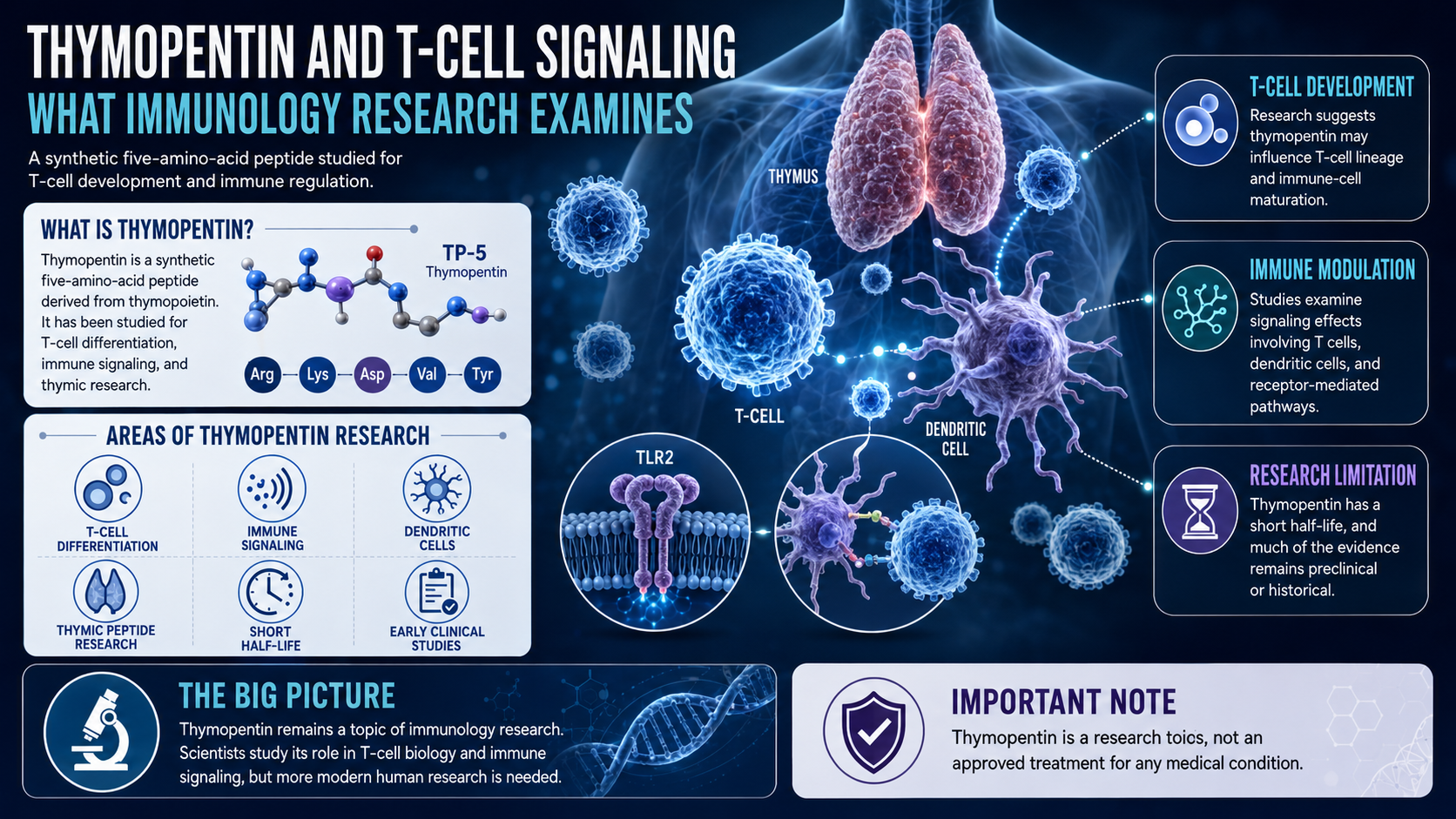
Thymopentin and T-Cell Signaling: What Immunology Research Examines
Thymopentin is a synthetic five-amino-acid peptide studied for its effects on T-cell development and immune regulation, but much of the evidence remains historical or preclinical.
Thymopentin, also known as TP-5, is a synthetic pentapeptide derived from a biologically active region of the thymic protein thymopoietin.
The peptide has been investigated for several decades because of its proposed effects on T-cell differentiation and immune regulation.
Early clinical research explored thymopentin in immune-related disorders, while more recent laboratory studies have examined T-cell development, dendritic-cell activity, receptor signaling, and improved delivery methods.
Although thymopentin is often described as an immunomodulatory peptide, the available evidence does not establish broad or predictable immune benefits.
What Is Thymopentin?
Thymopentin is composed of five amino acids:
Arginine–Lysine–Aspartic acid–Valine–Tyrosine
It corresponds to the biologically active portion of thymopoietin, a thymic polypeptide associated with immune development and neuromuscular signaling.
Research reviews describe thymopentin as a synthetic immunomodulating peptide that can influence T-cell differentiation and function.
The Role of the Thymus
The thymus plays a central role in immune development. Immature T-cell precursors enter the thymus, undergo selection and maturation, and later circulate as specialized T lymphocytes.
Because thymopentin was designed from a thymic signaling region, researchers have studied whether it can reproduce selected immunological effects associated with the thymus.
Thymopentin and T-Cell Differentiation
Some of the earliest thymopentin studies focused on T-cell development.
A historical research review reported that thymopentin could influence peripheral T cells through intracellular cyclic GMP signaling.
Thymopoietin-related activity in precursor cells was also associated with cyclic AMP and further T-cell differentiation.
Laboratory Research With Stem Cells
A later laboratory study using human embryonic stem cells found that thymopentin enhanced differentiation toward the T-cell lineage in vitro.
Researchers suggested that TP-5 helped reproduce part of the peptide environment normally provided by the thymus.
These findings help scientists understand possible signaling mechanisms, but laboratory-generated T-cell differentiation does not prove improved immunity in people.
Possible Interaction With TLR2
More recent work has proposed that thymopentin may interact with Toll-like receptor 2, or TLR2.
TLR2 is part of the innate immune system and recognizes certain microbial and cellular signals.
Activation of TLR2 can influence:
- Cytokine production
- Antigen presentation
- Inflammatory signaling
- Communication between innate and adaptive immunity
Research on Thymopentin Analogues
A study examining a thymopentin analogue proposed that TP-5 could modulate immune activity through TLR2-related binding.
Researchers developed the modified compound partly because thymopentin’s short half-life limits its potential pharmacological usefulness.
This proposed mechanism remains primarily supported by laboratory research. The exact clinical importance of TLR2-related thymopentin signaling has not been established.
Thymopentin and Dendritic Cells
Dendritic cells help connect innate and adaptive immunity.
They process antigens and present them to T cells, helping initiate targeted immune responses.
Preclinical Findings
A preclinical study examined thymopentin in mouse bone-marrow-derived dendritic cells.
Researchers evaluated whether TP-5 influenced dendritic-cell maturation and function.
Research of this type suggests that thymopentin’s effects may extend beyond direct T-cell activity.
However, experiments involving cultured mouse cells cannot determine whether the same effects occur safely or consistently in humans.
Early Human Research
Several older clinical studies evaluated thymopentin in immune-related disorders.
Atopic Dermatitis Research
A clinical trial involving atopic dermatitis reported changes in clinical measurements and lymphocyte subpopulations.
The study included an increase in a reduced cytotoxic or suppressor T-cell population among some participants.
Other Conditions Studied
Thymopentin was also examined in conditions including:
- Rheumatoid arthritis
- Herpes infections
- Multiple sclerosis
- Early HIV-related immune dysfunction
A small study involving people with multiple sclerosis examined peripheral T-lymphocyte populations and reported immune measurements and clinical observations.
These studies did not provide strong evidence supporting routine thymopentin treatment.
Much of the clinical literature is decades old, involved small participant groups, and used immune markers that are not always equivalent to meaningful long-term health outcomes.
Thymopentin in Cancer Research
Laboratory researchers have also examined thymopentin in cancer-related immune models.
Leukemia Cell Research
A cell study reported that TP-5 inhibited proliferation and encouraged differentiation in a human leukemia cell line.
These findings were produced under laboratory conditions and did not establish thymopentin as a cancer treatment.
Thymic Regeneration and Antitumor Immunity
More recent preclinical research has explored thymopentin in relation to thymic regeneration and antitumor T-cell activity.
Animal research has reported effects involving thymus growth, T-cell development, and antitumor immune activity.
This emerging evidence is scientifically interesting, but it remains preclinical and should not be presented as proof that thymopentin treats cancer in humans.
The Challenge of a Short Half-Life
One of thymopentin’s major research limitations is its rapid breakdown in the body.
Its short circulating half-life makes it difficult to maintain sustained biological exposure.
Delivery Strategies Under Investigation
Researchers have investigated:
- Modified thymopentin analogues
- Nanoparticle delivery systems
- Conjugated peptides
- Slow-release formulations
- Receptor-targeted designs
The purpose of these approaches is to increase stability and extend exposure.
However, a longer-lasting analogue may behave differently from the original peptide and requires separate safety and effectiveness testing.
Immunomodulation Is Not the Same as Immune Enhancement
The term “immune support” can be misleading.
A stronger immune response is not always beneficial. Excessive immune activation can contribute to inflammation, allergies, tissue damage, and autoimmune disease.
Early thymopentin literature sometimes used the term immunonormalizing, suggesting that its effects might depend on the starting condition of the immune system rather than simply increasing immune activity.
Outcomes Modern Research Must Evaluate
These include:
- T-cell number
- T-cell subtype balance
- Cytokine signaling
- Antigen responses
- Inflammation
- Infection outcomes
- Autoimmune activity
- Long-term safety
Changes in laboratory immune markers do not automatically translate into better clinical health.
What the Research Does Not Yet Prove
Current evidence does not establish that thymopentin:
- Prevents infections
- Treats immune deficiency
- Improves immunity in healthy adults
- Treats autoimmune disease
- Reverses age-related thymic decline
- Treats cancer
- Produces lasting T-cell improvements
- Is safe or effective for unsupervised use
The evidence base includes historical clinical studies, laboratory experiments, and animal research using different dosing methods and endpoints.
More modern, well-controlled human trials would be needed before broad conclusions could be made.
Final Takeaway
Thymopentin is a synthetic five-amino-acid peptide derived from thymopoietin and studied for possible effects on T-cell differentiation and immune regulation.
Research suggests that it may influence T-cell development, dendritic-cell activity, and receptor-mediated immune signaling.
Early human trials reported changes in certain immune markers, while newer research has focused mainly on preclinical mechanisms and improved delivery methods.
The available evidence is not sufficient to describe thymopentin as a proven immune treatment. Its strongest current value lies in helping scientists investigate thymic signaling and T-cell biology.
Research References
- Goldstein G. Thymopoietin to thymopentin: experimental studies. View research
- Singh VK, et al. Thymopentin and splenopentin as immunomodulators. View research
- Zhu MX, et al. Thymopentin enhances the generation of T-cell lineage cells from human embryonic stem cells. View research
- Kang K, et al. Thymopoietin pentapeptide improves clinical parameters and lymphocyte subpopulations in atopic dermatitis. View research
- Wang Y, et al. The novel role of thymopentin in induction of maturation of bone-marrow-derived dendritic cells. View research
- Wei X, et al. Targeting the TLR2 receptor with a novel thymopentin-derived peptide. View research