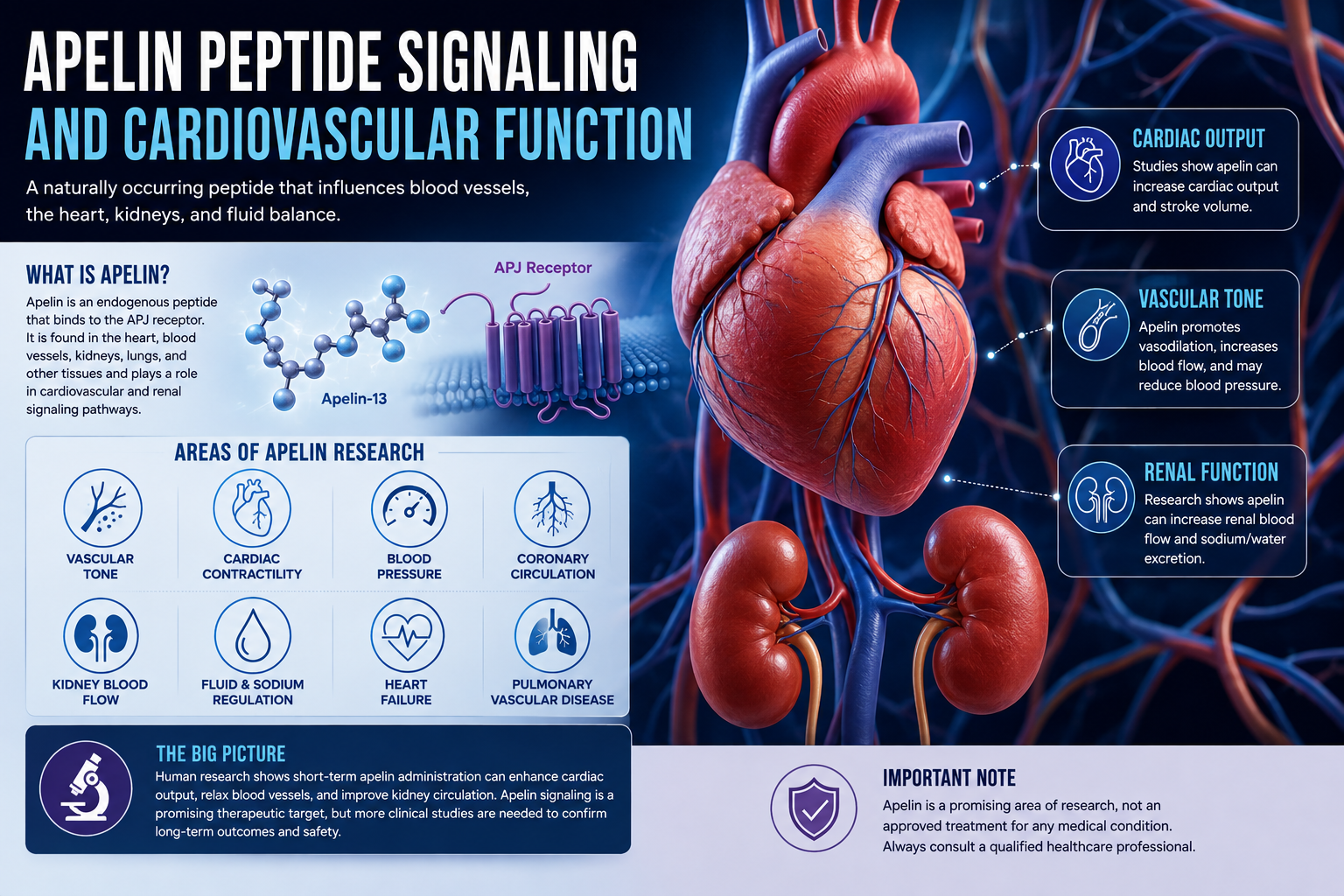
Apelin Peptide Signaling and Cardiovascular Function: What Human Research Shows
Apelin is an endogenous signaling peptide involved in blood-vessel tone, cardiac output, and kidney circulation, but its potential clinical applications remain under investigation.
Apelin is a naturally occurring peptide that interacts with the apelin receptor, historically known as APJ. This signaling system is found throughout the cardiovascular system and has attracted scientific interest because it may influence blood-vessel relaxation, cardiac performance, fluid regulation, and renal circulation.
Human studies have shown measurable cardiovascular responses following short-term apelin administration. However, these findings should not be interpreted as proof that apelin is an established treatment for heart disease, high blood pressure, or kidney disease.
What Is Apelin?
Apelin is produced from the APLN gene and is processed into several biologically active peptide forms, including apelin-13.
It binds to the apelin receptor, a G-protein-coupled receptor found in the heart, blood vessels, kidneys, lungs, and other tissues.
The apelin system also includes another endogenous receptor ligand called Elabela. Together, these signaling molecules appear to participate in cardiovascular and fluid-balance pathways that interact with systems involving angiotensin and vasopressin.
Areas of Apelin Research
Researchers have examined apelin signaling in relation to:
- Vascular tone
- Cardiac contractility
- Blood pressure
- Coronary circulation
- Kidney blood flow
- Fluid and sodium regulation
- Heart failure
- Pulmonary vascular disease
These functions make the apelin receptor an important experimental target, although its biology remains complex.
How Apelin Affects Blood Vessels
One of the best-documented actions of apelin is its ability to influence vascular tone.
In healthy blood vessels, apelin receptor activation can stimulate the endothelium, which is the thin cellular layer lining the inside of blood vessels. This may encourage nitric-oxide-related signaling and promote vasodilation.
Human Vascular Research
A human study published in 2010 found that acute apelin administration caused peripheral and coronary vasodilation and increased cardiac output. These results demonstrated that the apelin pathway is active in the human cardiovascular system.
Reviews of vascular research generally describe reductions in blood pressure and increases in blood flow after systemic apelin exposure.
However, vascular contraction or pressure-raising responses have also been observed under certain experimental conditions. The outcome may depend on receptor location, disease state, dose, and administration method.
Apelin and Cardiac Output
Apelin has also been studied for its effects on cardiac performance.
Preclinical research identified apelin as a positive inotrope, meaning it may increase the force of heart contraction.
Animal studies reported increased stroke volume and improved cardiac contractility in both normal and failing hearts.
Findings From Human Studies
Human research has also reported increased cardiac output after short-term apelin administration.
This does not mean that apelin simply causes the heart to work harder in every setting. Its effects appear to involve a combination of vascular relaxation, changes in cardiac loading conditions, and direct signaling within heart tissue.
Researchers are investigating whether the apelin pathway could eventually contribute to new approaches for conditions such as heart failure. Current reviews describe it as a promising therapeutic target rather than an established clinical therapy.
Cardiovascular and Renal Research in Chronic Kidney Disease
A controlled human study examined the cardiovascular and renal effects of [Pyr1]apelin-13 in healthy participants and people with chronic kidney disease.
Short-Term Physiological Findings
The study reported increases in:
- Renal blood flow
- Sodium excretion
- Free-water clearance
In participants with chronic kidney disease, researchers also reported short-term reductions in filtration fraction and proteinuria.
These results are scientifically important because chronic kidney disease frequently overlaps with cardiovascular dysfunction, high blood pressure, and impaired fluid regulation.
What the Study Did Not Establish
The research examined acute physiological responses. It did not establish that repeated apelin administration improves long-term kidney outcomes, prevents cardiovascular events, or slows chronic kidney disease progression.
Apelin and Heart Failure
The apelin system has been studied extensively in heart-failure research.
Some investigations have found reduced apelin signaling in people with heart failure, while improvements in cardiac function have sometimes been associated with changes in apelin-related activity.
Researchers have proposed that reduced apelin signaling may contribute to declining cardiovascular performance.
Potentially Relevant Effects
Apelin is scientifically interesting because it may combine several potentially useful effects:
- Increased cardiac output
- Endothelium-dependent vasodilation
- Reduced vascular resistance
- Possible anti-inflammatory activity
- Possible anti-fibrotic signaling
- Interaction with fluid-regulating pathways
Much of the evidence involving fibrosis, inflammation, arrhythmia protection, and tissue remodeling comes from animal or laboratory models. These findings cannot automatically be applied to patients.
The Challenge of Apelin’s Short Half-Life
One limitation of naturally occurring apelin peptides is their short duration in circulation.
The body rapidly breaks them down, meaning cardiovascular effects following experimental administration may be brief.
Longer-Acting Research Approaches
Researchers have investigated:
- Modified apelin peptides
- PEGylated apelin formulations
- Longer-lasting receptor agonists
- Small-molecule apelin-receptor agonists
These approaches may help scientists investigate sustained receptor activation. However, modifying a peptide can also change its distribution, receptor behavior, metabolism, and safety profile.
What the Research Does Not Yet Prove
Current research does not establish that apelin:
- Treats heart failure
- Prevents heart attacks
- Provides routine blood-pressure control
- Reverses cardiovascular disease
- Improves long-term kidney function
- Prevents arrhythmias in humans
- Produces safe benefits through unsupervised use
Most human studies have been small and short term. Larger clinical trials would be needed to evaluate outcomes such as hospitalization, disease progression, cardiovascular events, and long-term safety.
Final Takeaway
Apelin is an important endogenous peptide involved in cardiovascular and renal signaling.
Controlled human research shows that short-term apelin administration can increase cardiac output, relax blood vessels, and influence kidney circulation.
These findings make the apelin receptor a promising research target, but the evidence does not yet establish apelin as a proven treatment for cardiovascular or kidney disease.
Its most responsible interpretation remains as an emerging scientific pathway that may guide future drug development.
Research References
- Chapman FA, et al. Cardiovascular and renal effects of apelin in chronic kidney disease. View research
- Japp AG, et al. Acute cardiovascular effects of apelin in humans: potential role in patients with chronic heart failure. View research
- Chapman FA, et al. Targeting the apelin system for the treatment of cardiovascular disease. View research
- Mughal A, O’Rourke ST. Vascular effects of apelin: mechanisms and therapeutic potential. View research
- Ashley EA, et al. The endogenous peptide apelin potently improves cardiac contractility and reduces cardiac loading in vivo. View research
- Rozwadowski J, et al. A review of the roles of apelin and Elabela peptide ligands in cardiovascular diseases. View research