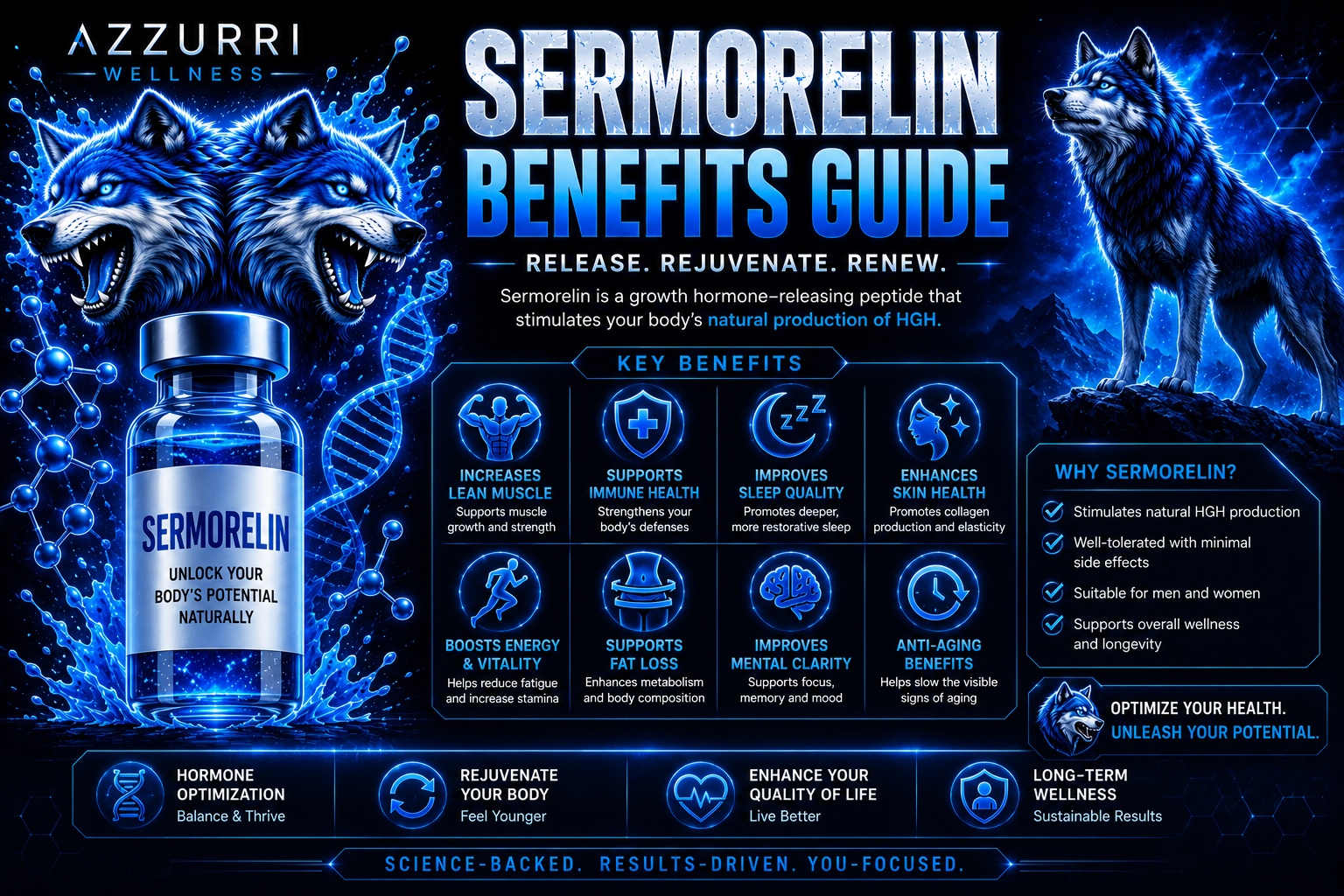
Sermorelin is one of the original growth-hormone peptides, and it works in a notably different way from just taking growth hormone. Here's a clear rundown of what it is, what it does, and how strong the evidence really is.
What is Sermorelin?
It's a synthetic peptide of 29 amino acids that copies the first 29 of your body's own growth-hormone-releasing hormone (GHRH) — the part that carries essentially all the activity.
How it works, and why that beats taking HGH
Sermorelin is a nudge, not a substitute. It binds the GHRH receptor on your pituitary and asks it to release your own growth hormone, rather than piping in hormone from outside. Because your body's natural feedback stays in charge, the release stays pulsatile and self-limiting. Injected HGH does the opposite — sustained, non-pulsatile levels that can switch off your own production. Keeping that feedback intact is the main argument for sermorelin over straight HGH.
Half-life and timing
Sermorelin clears fast — a half-life of roughly 10 to 20 minutes, so it's gone within a couple of hours. That brief pulse is usually discussed alongside your body's natural overnight surge of growth hormone, which peaks during deep sleep. For why half-life drives the timing, see our half-life guide.
A bit of history
Sermorelin has a real track record. It reached approved-medicine status in 1990 as a diagnostic agent, and again in 1997 for growth-hormone deficiency in children. The maker withdrew it in 2008 for commercial reasons — not over safety or effectiveness, as a later Federal Register notice confirmed. Today US sermorelin is compounded (503A/503B) and used off-label.
What the evidence backs up
- Raising GH and IGF-1 is the best-supported effect; studies show sermorelin lifts growth-hormone activity and IGF-1, including in older adults with low levels.
- Body composition gains (more lean mass) are plausible and follow from that GH/IGF-1 bump, but the direct evidence is thinner and mostly extrapolated.
- Sleep and energy improvements get reported a lot and make mechanistic sense (GH release is tied to deep sleep), but they're mostly observational rather than trial-grade.
Side effects
The usual one is a reaction at the injection site — some pain, redness or swelling — reported in roughly one in six people in the trial data. Less often, and each in under 1% of people, came headache, flushing, dizziness or drowsiness. These are generally mild and tend to fade after the first week or two.
Sermorelin vs. CJC-1295 and Ipamorelin
Sermorelin is the classic GHRH analog. Two relatives come up in the same conversation:
- CJC-1295 is a modified GHRH analog that resists breakdown, so it gives a longer, stronger nudge (the DAC version lasts days instead of minutes).
- Ipamorelin works differently — it hits the ghrelin receptor rather than the GHRH receptor, for a clean, selective GH release. Because they act on separate pathways, GHRH peptides and Ipamorelin are often stacked for a bigger combined pulse.
Worth flagging: CJC-1295 and Ipamorelin aren't approved medicines and have thinner human data than sermorelin's historical record.
Keep reading
- What Are Peptides? A Plain-English Guide
- Peptide Half-Life Explained: Why Duration Matters
- Epithalon (Epitalon): Benefits & Overview
A quick, important note
Our products are prepared by a Registered 503B outsourcing facility and provided under physician guidance. This article is here to educate, not to replace medical advice. Your physician should be the one guiding peptide selection for your situation.