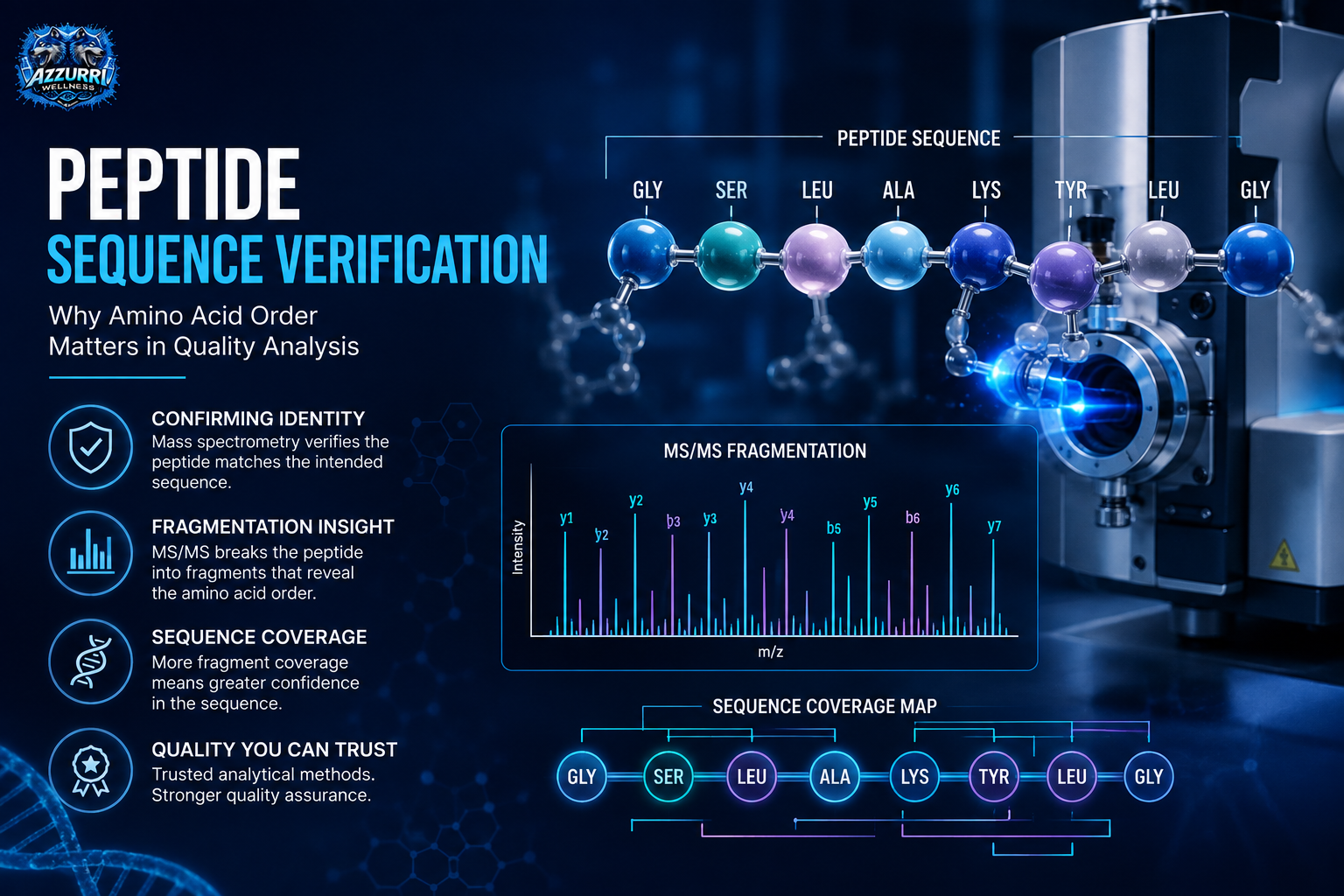
What Is Peptide Sequence Verification?
A peptide is defined not only by the amino acids it contains, but also by the exact order in which those amino acids are connected.
Sequence verification asks whether an analyzed sample matches the intended amino-acid arrangement. For synthetic peptides, the expected sequence is generally known in advance, so analytical testing can be designed to confirm molecular identity and examine whether the observed data agree with that expected structure.
This makes sequence confirmation an important part of a broader analytical-quality picture.
Why Amino Acid Order Matters
Two peptides can contain similar amino acids while having different sequences.
Changing the position of even one residue can alter:
- Molecular structure
- Charge distribution
- Hydrophobicity
- Chromatographic behavior
- Fragmentation pattern
- Interaction with other molecules
For this reason, molecular weight alone cannot always provide complete sequence information.
A measured intact mass may agree with the expected value while additional fragmentation data are still useful for confirming how the molecule is assembled.
Mass Spectrometry and Peptide Identity
Mass spectrometry is one of the most widely used analytical tools for peptide characterization.
An intact peptide can first be measured to determine whether its observed molecular mass agrees with the expected composition.
That is useful, but sequence verification often goes one step further.
Tandem Mass Spectrometry
In tandem mass spectrometry, commonly written as MS/MS, a selected peptide ion is fragmented into smaller pieces.
Those fragments create a pattern that can be compared with the expected peptide sequence.
Researchers use both database-based and de novo approaches to interpret these fragmentation patterns.
How Fragmentation Provides Sequence Information
When peptide bonds break during MS/MS analysis, predictable families of fragment ions can be generated.
By examining the mass differences between neighboring fragments, analysts can obtain information about the amino acids present at different positions in the chain.
The more useful fragment coverage an experiment produces, the more confidently different parts of the sequence can be examined.
Sequence Verification May Consider
- Intact molecular mass
- Fragment-ion pattern
- Sequence coverage
- Expected versus observed fragments
- Chromatographic retention behavior
- Possible modified or related species
No single measurement necessarily answers every analytical question.
Database Matching and De Novo Sequencing
There are different ways to interpret an MS/MS spectrum.
Database-Based Analysis
When the expected sequence is already known, experimental fragments can be compared with predicted fragments from that sequence.
This approach is especially useful for confirmation work.
De Novo Sequencing
De novo approaches attempt to infer amino-acid order directly from the fragmentation spectrum without relying entirely on a known database sequence.
These methods are useful when sequence information is incomplete or when analysts want to interpret fragmentation evidence more independently.
Why Sequence Coverage Matters
An MS/MS spectrum may not produce useful fragments at every peptide bond.
Some parts of a sequence fragment more readily than others.
This means analysts often consider sequence coverage rather than assuming that one spectrum automatically confirms every residue.
Incomplete fragmentation, low signal intensity, or overlapping peaks can make interpretation more difficult.
For constrained peptides, specialized strategies may improve sequence coverage and provide additional structural information.
Some Amino Acids Are Harder to Distinguish
Sequence verification also has analytical limitations.
For example, leucine and isoleucine have the same nominal molecular mass, which makes them difficult to distinguish using ordinary mass information alone.
Specialized fragmentation techniques can sometimes help resolve these types of questions.
This is another reason peptide identity should be viewed as a combination of analytical evidence rather than a single number.
Sequence Confirmation and Purity Are Different
Sequence verification and purity analysis answer different questions.
Sequence Verification Asks
Does the molecular structure agree with the expected amino-acid order?
Purity Analysis Asks
What other detectable components are present relative to the main component under the analytical conditions?
A sample can therefore have a strong identity match while still containing related components that require separate investigation.
Likewise, a high chromatographic main-peak percentage does not independently prove the entire amino-acid sequence.
Why Complementary Testing Helps
Analytical laboratories often combine several techniques when characterizing peptide materials.
Depending on the analytical objective, these can include:
- Intact mass measurement
- Tandem mass spectrometry
- Chromatography
- Amino acid analysis
- Reference-standard comparison
- Other structural methods
Combining independent analytical approaches can provide stronger evidence for identity and overall characterization.
What Sequence Verification Does Not Establish
Sequence confirmation alone does not establish:
- Absolute concentration
- Complete purity
- Moisture level
- Aggregation state
- Long-term stability
- Every possible related component
Those characteristics require separate analytical measurements.
This is why peptide characterization is best approached as a collection of complementary tests.
Final Takeaway
Peptide sequence verification focuses on confirming that amino acids appear in the intended order.
Intact mass measurement can provide an important first check, while tandem mass spectrometry adds deeper structural information by examining fragmentation patterns throughout the molecule.
The central idea is simple: identity is more than molecular weight. Understanding how the molecule is assembled provides a stronger analytical picture.