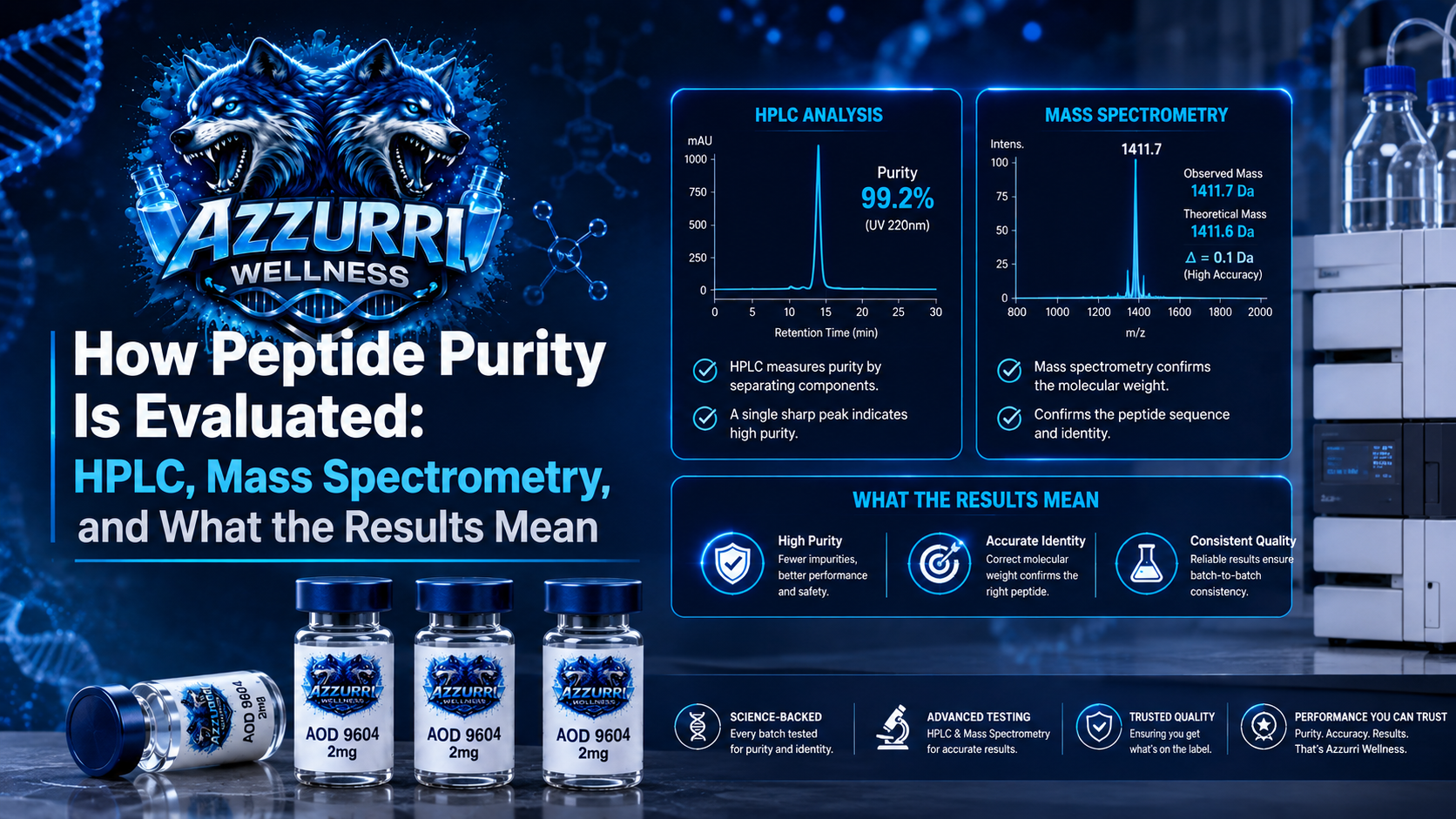
Introduction
Peptides are complex molecules, and their synthesis can produce not only the intended peptide sequence but also closely related substances. These related substances can originate from incomplete synthesis, side reactions, degradation, oxidation, or other chemical processes.
For researchers working with peptides, understanding what is present in a sample is therefore an important part of analytical characterization.
Two widely used analytical technologies are high-performance liquid chromatography (HPLC) and mass spectrometry (MS). Although both are valuable, they provide different types of information. HPLC is primarily used to separate components and assess chromatographic purity, while mass spectrometry provides molecular-mass information that can help characterize those components.
Using complementary analytical techniques can provide a more complete understanding of a peptide sample.
What Does Peptide Purity Mean?
Peptide purity generally describes the proportion of the desired peptide relative to other detectable components under a defined analytical method.
Potential related substances can include:
- Incomplete or deletion sequences
- Truncated peptides
- Oxidized forms
- Deamidated forms
- Hydrolysis products
- Other process-related impurities
- Aggregated or modified species
However, a reported purity percentage should always be interpreted in the context of the analytical method used.
A result such as "98% purity" does not mean that every possible impurity has been ruled out. Instead, it indicates the result obtained according to a particular analytical procedure and calculation.
Why HPLC Is Important in Peptide Analysis
High-performance liquid chromatography (HPLC) is a separation technique widely used in analytical chemistry.
In a typical peptide HPLC analysis, a sample is introduced into a chromatographic system and carried through a column by a mobile phase. Different components interact differently with the stationary phase and therefore travel through the column at different rates.
The instrument produces a chromatogram, which displays detector response against time.
A peptide chromatogram may contain:
- A dominant main peak
- Smaller related peaks
- Degradation products
- Other detectable components
The relative areas of these peaks can be used to calculate chromatographic purity according to the selected method.
What Can HPLC Tell Researchers?
HPLC can provide valuable information about the separation profile of a peptide sample.
For example, it can help researchers determine whether a sample contains:
- A dominant peptide component
- Multiple chromatographically separable components
- Significant related peaks
- Changes in the chromatographic profile over time
HPLC can also be useful for monitoring changes during stability studies.
However, the chromatogram alone does not necessarily establish the molecular identity of every peak.
Why the HPLC Method Matters
A purity percentage cannot be separated from the analytical method that produced it.
Factors such as:
- Column chemistry
- Mobile-phase composition
- Gradient conditions
- Flow rate
- Temperature
- Detection wavelength
- Injection volume
- Sample concentration
can influence chromatographic separation.
Consequently, two different analytical methods can produce different chromatographic profiles for the same sample.
What Is Mass Spectrometry?
Mass spectrometry (MS) is an analytical technique that measures ions according to their mass-to-charge ratio (m/z).
For peptide analysis, mass spectrometry can provide molecular-mass information that helps researchers investigate whether a detected component is consistent with the expected peptide.
A simplified analytical sequence is:
Sample → Ionization → Mass Analysis → Mass Spectrum
Peptides can produce multiple charged ions, meaning that interpretation of a peptide mass spectrum requires appropriate analytical expertise.
HPLC vs. Mass Spectrometry
HPLC
HPLC primarily addresses questions such as: How does the sample separate chromatographically?
It can provide information about the main component and other chromatographically detectable peaks.
Mass Spectrometry
Mass spectrometry addresses questions such as: What molecular-mass information is associated with the detected component?
This can help researchers evaluate whether an observed component is consistent with the expected molecular mass.
Combined Analysis
When HPLC and MS are combined, researchers can obtain complementary information about both separation and molecular characterization.
This can be particularly useful when investigating minor peaks or possible peptide modifications.
Why Purity and Identity Are Different
One of the most important concepts in peptide characterization is the distinction between purity and identity.
Purity concerns the relative amount of the desired component detected by a particular analytical method.
Identity concerns whether the material corresponds to the intended molecule.
These are not interchangeable.
Common Sources of Peptide-Related Impurities
Incomplete Synthesis
If an individual synthesis step does not proceed as intended, incomplete or deletion sequences can be generated.
Truncated Sequences
Incomplete synthesis or degradation can result in shorter peptide-related products.
Oxidation
Certain amino-acid residues can undergo oxidative modification under appropriate environmental conditions.
Deamidation
Asparagine- and glutamine-containing sequences can undergo deamidation, producing chemically modified forms.
Hydrolysis
Peptide bonds or other susceptible chemical groups can undergo hydrolytic reactions depending on environmental conditions.
Aggregation
Some peptides can associate with one another and form higher-order species. Factors including peptide sequence, concentration, pH, temperature, impurities, and excipients can influence physical stability and aggregation.
Why Multiple Analytical Methods Matter
No single analytical technique provides unlimited information.
HPLC can provide excellent separation information, but a chromatographic peak does not automatically reveal its molecular identity.
Mass spectrometry can provide molecular-mass information, but molecular mass alone may not distinguish every possible structural variant.
Depending on the research objective, additional analytical approaches may include:
- LC-MS
- High-resolution mass spectrometry
- MS/MS
- Peptide mapping
- Size-exclusion chromatography
- UV spectroscopy
- Other specialized characterization methods
What Should Researchers Look for in a Peptide Purity Report?
Sample or Batch Identification
The report should clearly identify the material or batch analyzed.
Analytical Method
The analytical procedure used to generate the result should be identified.
Chromatogram
Where appropriate, the chromatographic profile provides useful context for the reported purity value.
Purity Calculation
The report should clarify how the reported percentage was calculated.
Molecular-Mass Information
Where mass spectrometry is performed, the observed result can be compared with the expected molecular mass.
Testing Date
The date of analysis helps establish when the sample was evaluated.
Laboratory Information
Identifying the testing laboratory supports traceability and documentation.
Why Batch-Specific Testing Matters
Peptide characteristics can change depending on manufacturing, purification, handling, and storage conditions.
For this reason, analytical results associated with a specific batch can provide more useful information than a generic statement about a material.
Batch-specific documentation creates a connection between:
Material → Batch → Analytical Method → Test Result
Analytical Validation and Reliable Results
Sophisticated equipment alone does not guarantee a reliable analytical result.
The analytical procedure itself needs to be appropriate for its intended purpose.
An analytical result is most meaningful when the method used to obtain it is scientifically appropriate for the question being asked.
Final Thoughts
Peptide purity is more than a number printed on a report.
HPLC can provide important information about chromatographic separation and relative purity, while mass spectrometry can provide complementary molecular-mass information.
Together with appropriate analytical procedures and documentation, these techniques can help researchers develop a clearer understanding of peptide samples.
When evaluating peptide analytical data, it is therefore useful to consider:
- What was tested?
- Which analytical method was used?
- What does the purity percentage actually represent?
- Was molecular identity evaluated separately?
- Were relevant impurities investigated?
- Is the result linked to a specific batch?
Frequently Asked Questions
Is HPLC enough to confirm peptide identity?
Not necessarily. HPLC is valuable for chromatographic separation and purity assessment, while identity may require complementary analytical evidence.
Does 99% HPLC purity mean a peptide is completely pure?
No. It represents the result obtained under the specified chromatographic method and calculation. It does not prove that every possible impurity is absent.
What is the difference between HPLC and mass spectrometry?
HPLC primarily separates components, while mass spectrometry provides mass-to-charge information that can assist with molecular characterization.
Why can purity results differ between laboratories?
Different analytical conditions, columns, calculations, and procedures can produce different chromatographic results.
Why is batch-specific testing useful?
It connects analytical results to the particular material that was tested, improving traceability and interpretation.