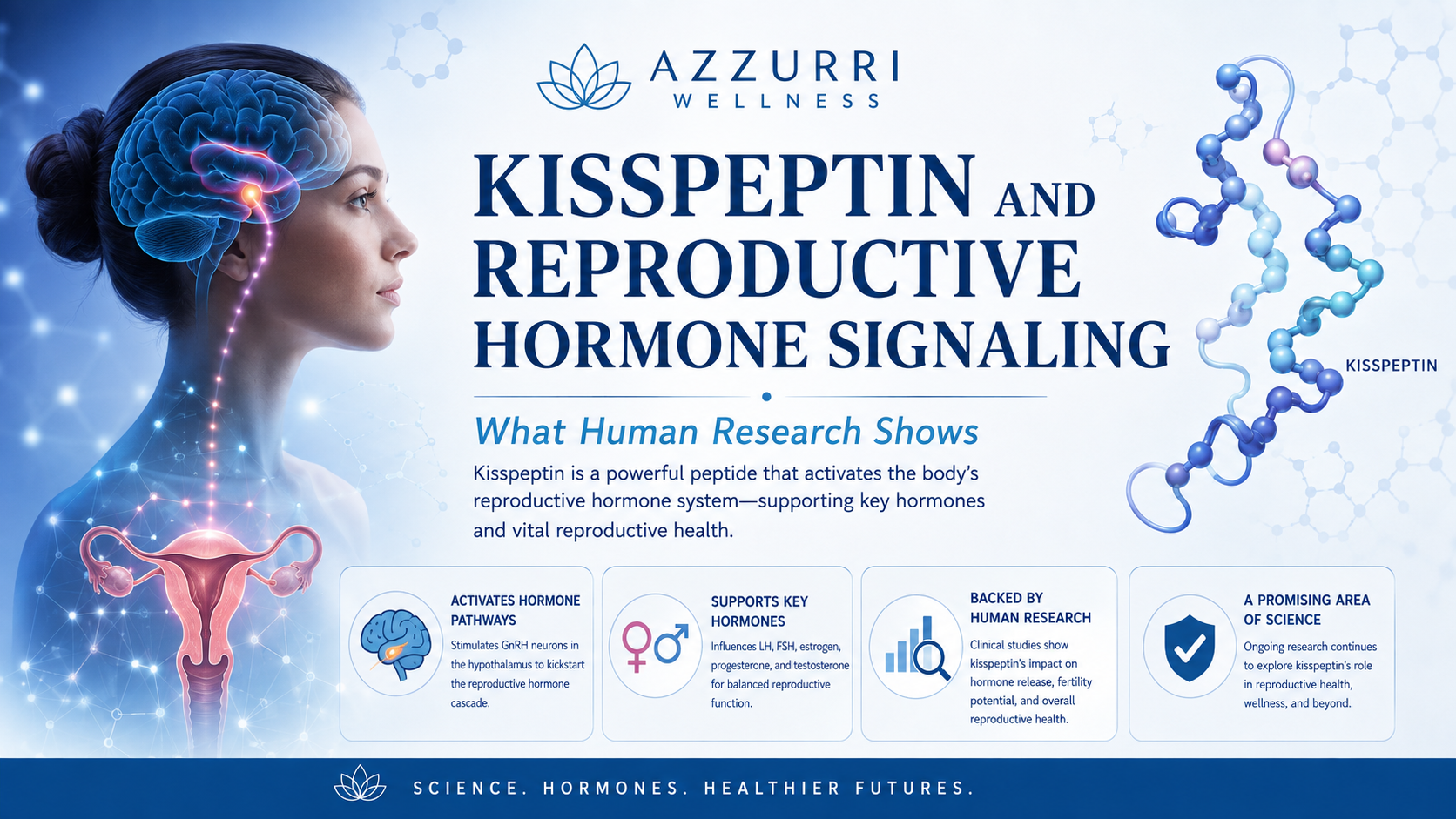
Kisspeptin and Reproductive Hormone Signaling: What Human Research Shows
Human studies show that kisspeptin can activate key reproductive-hormone pathways, but its potential clinical applications remain under investigation.
The reproductive system depends on precise communication between the brain, pituitary gland, and reproductive organs. One peptide at the center of this communication network is kisspeptin.
Kisspeptin is widely studied because it helps activate the hypothalamic-pituitary-gonadal axis, commonly called the HPG axis. This system contributes to the regulation of puberty, ovulation, testosterone production, menstrual function, and fertility.
Human research shows that kisspeptin administration can increase important reproductive hormones. However, this does not establish kisspeptin as a treatment for every hormonal or fertility-related concern.
What Is Kisspeptin?
Kisspeptins are peptide fragments produced from the KISS1 gene. They bind to the kisspeptin receptor, also known as KISS1R or GPR54.
Within the brain, kisspeptin signaling helps stimulate neurons that release gonadotropin-releasing hormone, or GnRH. GnRH then signals the pituitary gland to release:
- Luteinizing hormone, or LH
- Follicle-stimulating hormone, or FSH
LH and FSH subsequently act on the ovaries or testes, supporting reproductive hormone production and reproductive function. Kisspeptin is therefore considered an important upstream regulator of the human reproductive axis.
How Kisspeptin Connects the Brain and Reproductive Organs
The HPG axis operates through a sequence of coordinated hormonal signals.
- Kisspeptin activates GnRH-producing neurons.
- GnRH travels to the pituitary gland.
- The pituitary releases LH and FSH.
- LH and FSH act on the reproductive organs.
- Estrogen, progesterone, and testosterone provide feedback to the brain.
Kisspeptin appears to help integrate this feedback, allowing the reproductive system to respond to changes in sex hormones, nutritional status, and other physiological conditions.
Human genetic evidence also shows that functional kisspeptin signaling is important for normal puberty and gonadotropin secretion.
What Early Human Studies Found
One influential study examined kisspeptin-54 administration in healthy men. Researchers reported increases in circulating LH, FSH, and testosterone after kisspeptin infusion.
The findings demonstrated that peripheral kisspeptin administration could activate the human reproductive-hormone axis. The study did not establish kisspeptin as a routine treatment, but it provided evidence that the signaling pathway observed in laboratory research was also biologically active in humans.
Later studies confirmed that kisspeptin can stimulate reproductive-hormone secretion in both men and women. However, the strength and timing of the response may vary according to:
- Biological sex
- Baseline hormone status
- Reproductive condition
- Dose and timing
- Administration method
Kisspeptin and Hypothalamic Amenorrhea
Hypothalamic amenorrhea is a condition in which menstrual periods stop because signaling from the hypothalamus becomes suppressed. It may be associated with low energy availability, intense exercise, weight loss, or physiological stress.
Acute Hormone Responses
In a small randomized study, women with hypothalamic amenorrhea received kisspeptin or saline injections. Acute kisspeptin administration stimulated gonadotropin release, showing that the reproductive axis could respond to the peptide.
Reduced Response With Repeated Administration
Repeated administration produced a reduced response over time in some research settings. This suggests that dose timing and administration frequency are important and that continuous stimulation may not reproduce the body’s natural pulsatile signaling.
Intranasal Kisspeptin Research
Researchers have also examined intranasal kisspeptin-54. A study reported rapid increases in LH among healthy men, healthy women, and women with hypothalamic amenorrhea after intranasal administration.
Although these findings are of scientific interest, larger studies are needed to evaluate long-term usefulness, dosing, and safety.
Kisspeptin in IVF Research
One of the most developed areas of kisspeptin research involves in vitro fertilization, or IVF.
During IVF, final egg maturation must be triggered before egg retrieval. Traditional triggering methods can increase the risk of ovarian hyperstimulation syndrome, particularly among women who respond strongly to ovarian stimulation.
Triggering Egg Maturation
A clinical study found that a single injection of kisspeptin-54 could trigger egg maturation in women undergoing IVF. Mature eggs were retrieved, fertilized, and, in some cases, resulted in successful pregnancies.
Research in Higher-Risk Patients
A subsequent phase 2 study involving women at higher risk of ovarian hyperstimulation syndrome evaluated several kisspeptin-54 doses.
Researchers concluded that kisspeptin showed promise as a method of triggering oocyte maturation in this closely monitored population.
These findings relate to supervised fertility treatment and should not be interpreted as evidence supporting unsupervised kisspeptin use.
Does Kisspeptin Increase Testosterone?
Human research indicates that kisspeptin can increase LH and, under certain conditions, downstream testosterone concentrations in men.
The response may depend on factors including:
- Baseline hormone status
- Dose
- Administration route
- Timing and pulse frequency
- Reproductive health
- Sensitivity of the GnRH system
Kisspeptin does not act in the same way as externally administered testosterone. Instead, it activates an upstream signaling pathway that may encourage the reproductive axis to release its own hormones.
A temporary increase in one hormone measurement does not automatically produce lasting improvements in fertility, energy, body composition, or sexual function.
Emerging Research Beyond Hormone Release
Scientists are also studying kisspeptin’s possible involvement in sexual behavior, emotional processing, and reproductive motivation.
Brain Activity and Sexual Stimuli
Controlled human studies have reported changes in brain activity related to sexual and emotional stimuli following kisspeptin administration.
Sexual-Health Research
Early research has included men with low sexual desire and women with hypoactive sexual desire disorder.
These studies remain exploratory and do not establish kisspeptin as a broadly approved treatment for sexual-health concerns.
Why the Research Is Still Limited
Although kisspeptin has been investigated in multiple clinical studies, several important questions remain:
- What dosing pattern best reflects natural signaling?
- Can repeated administration cause reduced responsiveness?
- Which reproductive conditions are most likely to respond?
- Do short-term hormonal changes produce meaningful long-term outcomes?
- How do responses differ between men and women?
- What are the effects of long-term exposure?
Systematic reviews describe a growing number of interventional kisspeptin studies. However, the field still includes small participant groups, varied protocols, and several experimental applications.
Final Takeaway
Kisspeptin is a central regulator of reproductive-hormone signaling. Human studies demonstrate that it can stimulate GnRH-related activity and increase LH and FSH, with possible downstream effects on reproductive hormones.
Research involving hypothalamic amenorrhea, IVF, and reproductive behavior is promising, but kisspeptin remains an investigational subject rather than a universal solution for fertility or hormonal concerns.
The most responsible interpretation is that kisspeptin gives scientists a valuable way to study and potentially influence the reproductive axis while further clinical research continues.
Research References
- Skorupskaite K, et al. The kisspeptin-GnRH pathway in human reproductive health and disease. View research
- Dhillo WS, et al. Kisspeptin-54 stimulates the hypothalamic-pituitary-gonadal axis in human males. View research
- Jayasena CN, et al. Subcutaneous injection of kisspeptin-54 acutely stimulates gonadotropin secretion in women with hypothalamic amenorrhea. View research
- Jayasena CN, et al. Kisspeptin-54 triggers egg maturation in women undergoing in vitro fertilization. View research
- Abbara A, et al. Efficacy of kisspeptin-54 to trigger oocyte maturation in women at high risk of ovarian hyperstimulation syndrome. View research
- Mills EG, et al. Translating kisspeptin biology into new reproductive treatments. View research