Dual incretin peptides are among the most discussed molecules in modern metabolic science. The reason is not marketing — it is that they represent a specific, testable idea about how gut hormones talk to the rest of the body, and that idea turned out to be worth investigating.
The Incretin Effect: A Sixty-Year-Old Puzzle
Start with an observation that predates any of these molecules by decades.
Give a person glucose by mouth and measure their insulin response. Then give the same person enough glucose intravenously to reach the same blood-sugar level, and measure again. The insulin response to the oral glucose is substantially larger — even though the blood sugar is the same.
Something about food passing through the gut, rather than sugar simply appearing in the blood, amplifies the body's insulin response. That amplification is called the incretin effect, and the search for the hormones responsible produced two answers.
GLP-1: The Well-Characterised One
Glucagon-like peptide-1 is released from cells in the lining of the lower small intestine and colon in response to nutrients arriving.
Its metabolic signature is well mapped. It amplifies insulin release in a glucose-dependent way — meaning it mostly acts when glucose is already elevated, which is why incretin signalling on its own rarely drives blood sugar too low. It suppresses glucagon release when glucose is high. It slows the rate at which the stomach empties. And it acts on receptors in the hypothalamus and brainstem that participate in satiety signalling.
GIP: The Contested One
Glucose-dependent insulinotropic polypeptide is released further up the small intestine, and it is the older discovery of the two. It is also insulinotropic — it too amplifies glucose-dependent insulin release.
But GIP is scientifically messier. Its receptors appear not only in the pancreas but on adipose tissue and in the central nervous system, and its role in nutrient partitioning has been debated for years. Interestingly, both GIP receptor activation and GIP receptor blockade have been investigated as strategies in metabolic research, which tells you how genuinely unsettled that pathway's biology has been.
Why Engage Both
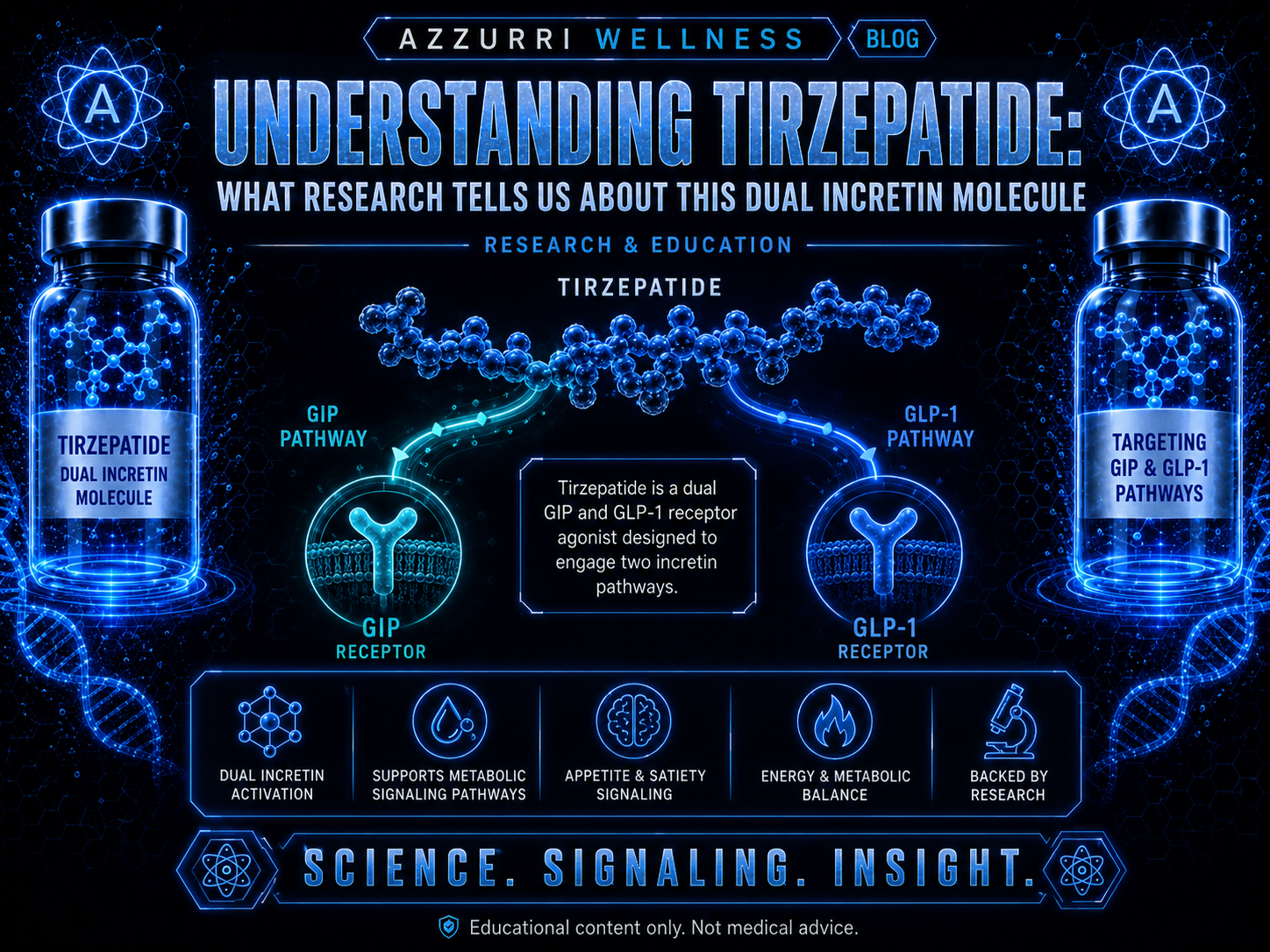
The premise of a dual incretin peptide is straightforward to state and hard to execute: if the incretin effect is produced by two hormones acting together, a molecule that engages both pathways may act on metabolic signalling in ways that engaging one pathway alone does not.
The scientific interest lies in the interaction between the two pathways — whether GIP activity complements GLP-1 activity, alters its tolerability, or contributes something distinct on the fat-tissue side.
How a Dual Incretin Peptide Is Engineered
Native GLP-1 is destroyed in the bloodstream within minutes, largely by an enzyme called DPP-4. Native GIP is degraded by the same enzyme. Any molecule intended to sustain incretin signalling has to solve that problem first.
The engineering toolkit is well established:
- A backbone drawn from the glucagon peptide superfamily. GIP, GLP-1 and glucagon are structurally related hormones. That family resemblance is what makes a single engineered chain capable of binding more than one of their receptors at all.
- Substituted amino acids at the enzyme's cutting site. Change the residues the enzyme recognises, and it can no longer cleave efficiently.
- A fatty-acid chain attached to the peptide backbone. This lets the molecule bind reversibly to albumin, the most abundant protein in blood, which acts as a circulating reservoir.
- Deliberately tuned receptor potency. These molecules are not designed to hit both receptors equally. The potency ratio is a design decision, and it is one of the things that distinguishes molecules within the class.
What Researchers Examine
Glycemic endpoints. HbA1c, which reflects average blood glucose over roughly the preceding three months, plus fasting glucose and markers of insulin sensitivity and beta-cell function.
Anthropometric endpoints. Body weight and waist circumference. Increasingly, study designs also measure body composition directly, because the fat-versus-lean-tissue question matters for any molecule associated with substantial weight change.
Hepatic and lipid measures. Liver-fat content by imaging, and standard lipid panels.
Cardiovascular parameters. Blood pressure and resting heart rate, the latter because a modest heart-rate signal is recognised across this peptide family.
Tolerability. Which adverse events participants reported, how severe investigators graded them, and how many people discontinued because of them. Gastrointestinal events lead this list across the incretin family, which follows directly from the mechanism.
All of these are measurements taken in defined populations under medical supervision. None of them is a result an individual should expect.
Why Peptide Design Matters Beyond This Class
The body's own signalling peptides are extraordinarily specific and extraordinarily short-lived — that combination is a feature of physiology, not a bug. Turning one into a molecule that can be studied over months means altering it enough to survive, without altering it so much that it stops doing what the original did.
Dual incretin peptides are one of the clearest worked examples of that trade-off being handled well. Whatever you make of the metabolic story, the design story is a genuine landmark in peptide science.
Supervision Is Not a Formality
These are medical molecules, not wellness curiosities. Their effects on glucose, on gastric motility and on cardiovascular parameters are real, they interact with other medications, and they require someone qualified to assess whether they are appropriate for a particular person at all.
That is a clinical judgement, and no article, including this one, can make it for you.
A quick, important note
Our products are prepared by a Registered 503B outsourcing facility and provided under physician guidance. This article is here to educate, not to replace medical advice. Your physician should be the one guiding whether any peptide is appropriate for your situation.