Basic mass spectrometry can measure the mass-to-charge ratio of an intact peptide ion. That information is extremely valuable, but different molecular structures may sometimes produce very similar or even identical overall masses.
Tandem mass spectrometry adds another analytical layer.
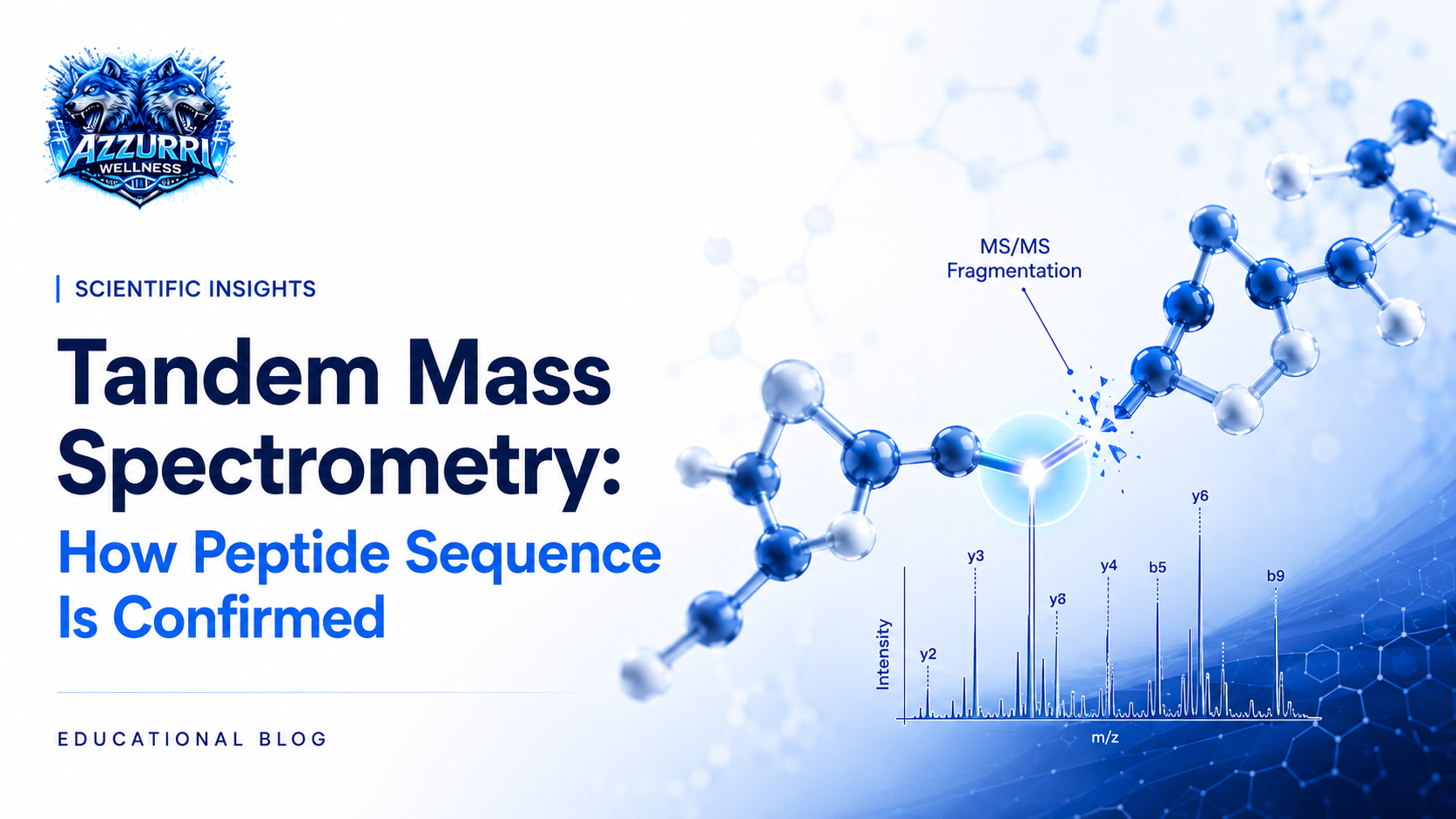
Instead of examining only the intact molecule, an instrument selects a peptide ion, fragments it, and records the masses of the resulting fragments.
Differences between those fragment masses can provide information about the sequence and structure of the peptide.
Mass-spectrometry-based peptide sequencing has become an important tool in proteomics and peptide characterization because tandem MS can generate partial amino-acid sequence information from characteristic fragmentation patterns.
MS1 and MS/MS Are Not the Same Measurement
It is useful to separate two analytical concepts.
MS1 primarily examines precursor ions and their mass-to-charge ratios.
MS/MS selects one of those ions and fragments it before performing another mass analysis.
The resulting fragment spectrum can contain substantially more structural information than an intact-mass measurement alone.
Depending on fragmentation conditions, analysts may observe families of fragment ions representing breaks at different positions along the peptide backbone.
By comparing those fragments with an expected sequence, the laboratory can evaluate whether the observed data support the proposed molecular identity.
Sequence Confirmation Is About Patterns
One fragment peak alone normally does not establish an entire peptide sequence. Confidence comes from evaluating a consistent pattern of analytical evidence.
Analysts may evaluate:
- Precursor mass
- Charge state
- Fragment-ion series
- Mass differences between fragments
- Expected sequence coverage
- Modified residues
- Unexpected fragment signals
- Retention time
- Comparison with reference data
When multiple independent pieces of analytical evidence agree, confidence in an assignment can increase.
Database Matching and De Novo Sequencing
There are different ways to interpret tandem mass spectra.
One approach compares a measured spectrum with fragments predicted from known peptide sequences.
Another approach is known as de novo sequencing. In this method, computational systems attempt to reconstruct an amino-acid sequence directly from experimental fragmentation data without relying entirely on a known sequence database.
Modern computational approaches increasingly use machine-learning models to assist with this task. These systems analyze relationships between fragment-ion signals and potential amino-acid sequences.
Computational interpretation can improve analytical efficiency, but the proposed sequence must still remain consistent with the experimental data and the quality of the measured spectrum.
What MS/MS Does Not Automatically Prove
Tandem mass spectrometry is powerful, but it should not be treated as an unlimited measurement.
Interpretation can become more difficult when:
- Fragment coverage is incomplete
- Two amino acids have similar analytical behavior
- Isomeric structures are present
- Multiple modifications occur
- Signals overlap
- Fragment intensity is weak
- The sample contains closely related components
This is one reason modern analytical characterization commonly uses complementary methods.
A peptide may be evaluated using chromatography for separation, intact mass spectrometry for molecular-mass information, and MS/MS for additional structural confirmation.
Each analytical method contributes a different part of the overall characterization profile.
Why Chromatography Still Matters
Mass spectrometry does not eliminate the need for separation.
If several related peptide forms are present in a sample, chromatography can help separate those components before mass analysis.
This becomes especially important when different components have closely related molecular properties.
HPLC primarily provides information about chromatographic separation and sample profiles, while mass spectrometry contributes molecular information.
MS/MS provides another analytical dimension by examining how selected ions fragment.
What Good Analytical Documentation Should Show
Useful peptide-sequencing documentation may include:
- Sample or batch identifier
- Expected peptide sequence
- Precursor-ion information
- Instrument platform
- Fragmentation method
- Observed sequence coverage
- Major fragment assignments
- Search or interpretation method
- Reference standard, when applicable
- Defined acceptance criteria
Clear documentation is important because analytical conclusions should be traceable back to the actual measurement.
The Main Takeaway
Peptide sequencing by tandem mass spectrometry can provide substantially more structural information than an intact molecular-mass value alone.
By examining how peptide ions fragment, laboratories can gather analytical evidence supporting amino-acid sequence and molecular identity.
The strongest interpretation still comes from combining MS/MS with suitable separation methods, reference information, documented conditions, and appropriate analytical controls.
At Azzurri Wellness, precision means looking beyond a single number and understanding the evidence behind the result.
References
- Steen H, Mann M. The abc's (and xyz's) of peptide sequencing. Nature Reviews Molecular Cell Biology. 2004;5:699–711.
- Yilmaz M, Fondrie W, Bittremieux W, et al. De novo mass spectrometry peptide sequencing with a transformer model. Proceedings of ICML. 2022.
- Chen T, Kao MY, Tepel M, Rush J, Church GM. A Dynamic Programming Approach to De Novo Peptide Sequencing via Tandem Mass Spectrometry. 2001.
- Zabolotna Y, et al. PowerNovo: de novo peptide sequencing via tandem mass spectrometry using an ensemble of transformer and BERT models. Scientific Reports. 2024.
Disclaimer: This article is provided for general educational and scientific-information purposes only. It does not provide medical advice, product-use instructions, or guarantees regarding any individual material.