What Is SHLP2?
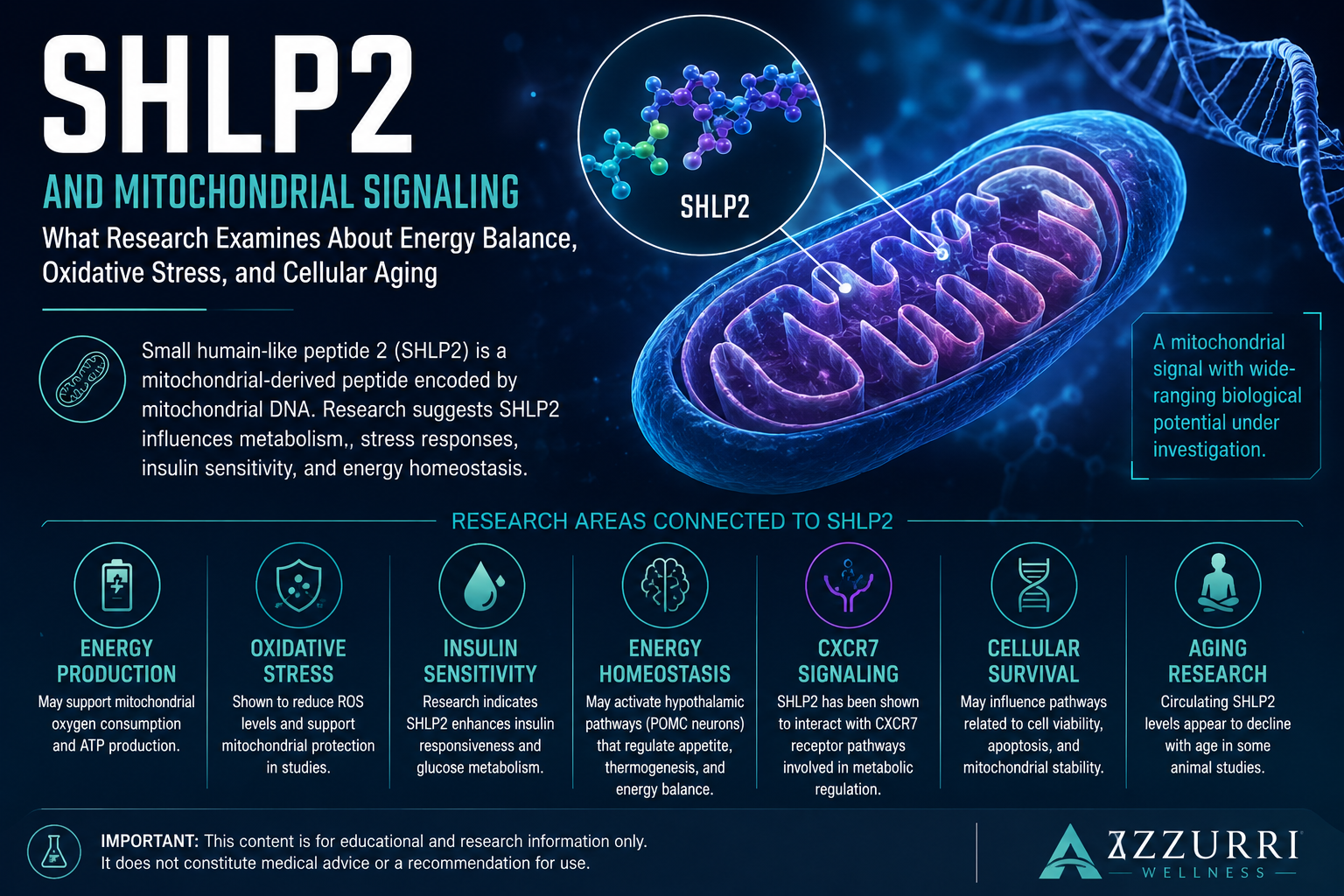
Small humanin-like peptide 2, usually abbreviated as SHLP2, is a mitochondrial-derived peptide encoded within the mitochondrial genome.
Mitochondria are best known for their role in producing cellular energy, but research has shown that they also participate in signaling processes that influence metabolism, stress responses, inflammation, and cellular survival.
SHLP2 belongs to a broader family of small mitochondrial-derived peptides that includes Humanin, MOTS-c, and other SHLP peptides.
Early research found that SHLP2 influenced mitochondrial metabolism, cellular viability, insulin signaling, and oxidative-stress responses in experimental models.
Mitochondria Are More Than Energy Factories
Mitochondria generate much of the ATP used to power cellular processes. However, their biological role extends far beyond energy production.
Important Roles of Mitochondria
- Cellular stress responses
- Reactive oxygen species signaling
- Programmed cell death
- Metabolic regulation
- Calcium signaling
- Communication between cellular compartments
Mitochondrial-derived peptides such as SHLP2 are especially interesting because they suggest mitochondria can actively produce signaling molecules that communicate with the rest of the cell and potentially with distant tissues.
This changes the traditional view of mitochondria from passive energy-producing structures into active participants in biological regulation.
SHLP2 and Cellular Energy Production
One of the early areas of SHLP2 research involved mitochondrial energy metabolism.
In cellular experiments, researchers observed that SHLP2 and SHLP3 increased mitochondrial oxygen-consumption rates and cellular ATP levels.
These findings suggested that mitochondrial-derived peptides may influence how cells use mitochondrial pathways to generate energy.
Why ATP Matters
ATP is the main energy currency used by cells.
It supports biological processes including:
- Muscle contraction
- Protein synthesis
- Cellular transport
- DNA maintenance
- Nerve signaling
- Tissue repair
Changes in mitochondrial ATP production can therefore influence many aspects of cellular function.
However, laboratory findings involving cultured cells should not automatically be interpreted as evidence that SHLP2 increases energy, endurance, or physical performance in humans.
SHLP2 and Oxidative Stress
Mitochondria naturally generate reactive oxygen species, often abbreviated as ROS, during normal metabolism.
At controlled levels, ROS participate in normal cellular signaling. When ROS production becomes excessive, however, oxidative stress can damage proteins, lipids, and DNA.
Early SHLP2 research found reductions in ROS generation under specific experimental stress conditions.
Researchers also observed effects involving mitochondrial membrane function and cellular survival.
Why Oxidative Stress Is Relevant to Aging
Oxidative stress has long been studied as one component of age-related cellular dysfunction.
Aging is far more complex than simply accumulating oxidative damage, but mitochondrial redox balance remains an important research area.
SHLP2 is scientifically interesting because it appears to connect mitochondrial metabolism with cellular stress-response pathways.
This does not establish SHLP2 as an anti-aging treatment. It simply provides a biological basis for studying its role in aging-related cellular processes.
SHLP2 and Insulin Sensitivity
Another important area of SHLP2 research involves glucose regulation and insulin signaling.
In experimental studies, SHLP2 increased insulin responsiveness and influenced glucose metabolism.
Animal research also found that SHLP2 influenced glucose uptake into peripheral tissues and altered insulin-related control of liver glucose production.
Why Insulin Sensitivity Matters
Insulin helps regulate how glucose moves from the bloodstream into tissues.
Reduced insulin sensitivity can influence:
- Glucose utilization
- Energy storage
- Liver glucose production
- Metabolic flexibility
- Long-term metabolic health
These findings make SHLP2 an interesting peptide for understanding how mitochondrial signals may influence whole-body metabolism.
Importantly, the strongest evidence in this area remains experimental rather than established human therapeutic evidence.
SHLP2 and Energy Homeostasis
More recent research has investigated SHLP2's role in energy homeostasis, the biological system that balances energy intake, storage, and expenditure.
Experimental research found evidence that SHLP2 may influence hypothalamic pathways involved in metabolic regulation.
Researchers reported activation of POMC neurons in the arcuate nucleus of the hypothalamus.
These neurons participate in appetite and metabolic regulation.
Effects Examined in Experimental Models
- Food intake
- Thermogenesis
- Insulin sensitivity
- Energy expenditure
- Diet-related weight changes
These findings are useful for understanding SHLP2 biology, but they should not be interpreted as proof of equivalent effects in humans.
The SHLP2 and CXCR7 Connection
One of the most interesting findings from recent research involves a possible receptor pathway for SHLP2.
Researchers reported that SHLP2 interacted with CXCR7, also known as atypical chemokine receptor 3.
Activation of this pathway was linked with observed effects involving hypothalamic neurons and energy regulation.
Why Receptor Identification Matters
Identifying a receptor can help scientists understand:
- How a peptide communicates with cells
- Which tissues may respond
- Which signaling pathways become activated
- Why certain biological effects occur
- How related peptides may behave differently
Earlier SHLP2 research demonstrated biological activity without clearly identifying a receptor.
The CXCR7 findings therefore provide an important direction for future mechanistic research.
SHLP2 and Cellular Survival
SHLP2 has also been studied for its effects on cellular survival.
Early experiments found that SHLP2 influenced apoptosis under certain laboratory conditions.
Apoptosis is a programmed process that helps the body remove damaged or unnecessary cells.
It is essential for normal biology, although excessive apoptosis can contribute to tissue dysfunction in some experimental models.
Cellular Pathways Examined in SHLP2 Research
- Cell viability
- Apoptosis
- Mitochondrial membrane stability
- ROS generation
- ERK signaling
- STAT3 signaling
These findings suggest that SHLP2 may function as part of a broader mitochondrial stress-response network rather than acting through only one metabolic pathway.
Does SHLP2 Change With Age?
One particularly interesting observation is that circulating SHLP2 appears to decline with age in some experimental research.
Lower circulating SHLP2 levels were observed in older animals compared with younger animals.
This does not prove that reduced SHLP2 causes aging.
Age-related biological changes can occur for many reasons, and correlation does not establish causation.
However, the observation has encouraged researchers to investigate whether mitochondrial-derived peptides participate in communication between mitochondrial function and age-related physiology.
SHLP2 Compared With Humanin and MOTS-c
SHLP2 belongs to the same general category of mitochondrial-derived peptides as Humanin and MOTS-c, but these molecules should not be treated as interchangeable.
Areas Where Mitochondrial-Derived Peptides May Differ
- Amino-acid sequence
- Receptor interactions
- Cellular targets
- Metabolic effects
- Stress-response pathways
- Tissue distribution
Humanin has received substantial attention for cellular-survival signaling.
MOTS-c has been investigated extensively in metabolic and exercise-related research.
SHLP2 appears to occupy another area within this emerging signaling network, particularly involving mitochondrial function, insulin sensitivity, and hypothalamic energy regulation.
What Current Research Does Not Establish
Current SHLP2 research does not establish that the peptide:
- Reverses human aging
- Guarantees improved insulin sensitivity in people
- Produces weight loss in humans
- Prevents metabolic disease
- Increases human energy or exercise performance
- Eliminates oxidative stress
- Treats mitochondrial disorders
- Produces the same effects across species
Much of the existing evidence comes from cellular experiments and animal models.
Human clinical evidence remains limited.
Why SHLP2 Research Matters
SHLP2 is scientifically interesting because it expands our understanding of mitochondrial biology.
Mitochondria appear capable of producing signals that influence biological processes far beyond ATP generation.
Fields Connected by SHLP2 Research
- Mitochondrial biology
- Metabolic signaling
- Insulin sensitivity
- Hypothalamic regulation
- Oxidative stress
- Cellular survival
- Aging biology
As scientists continue identifying mitochondrial-derived peptides and their receptors, these molecules may provide new insight into how cells coordinate energy availability with stress and metabolic demands.
Final Takeaway
SHLP2 is a mitochondrial-derived peptide being studied for its role in energy metabolism, oxidative-stress responses, insulin sensitivity, cellular survival, and energy homeostasis.
Experimental research suggests that SHLP2 can influence mitochondrial metabolism and ATP production, affect ROS under specific conditions, alter insulin responsiveness, and interact with hypothalamic signaling involved in energy balance.
The observation that circulating SHLP2 may change with age further supports scientific interest in the relationship between mitochondrial-derived peptides and aging biology.
However, much of the current evidence remains preclinical.
For now, SHLP2 is best understood as an important research tool for exploring how mitochondrial-derived signaling molecules connect cellular energy production with metabolism, stress responses, and aging biology.