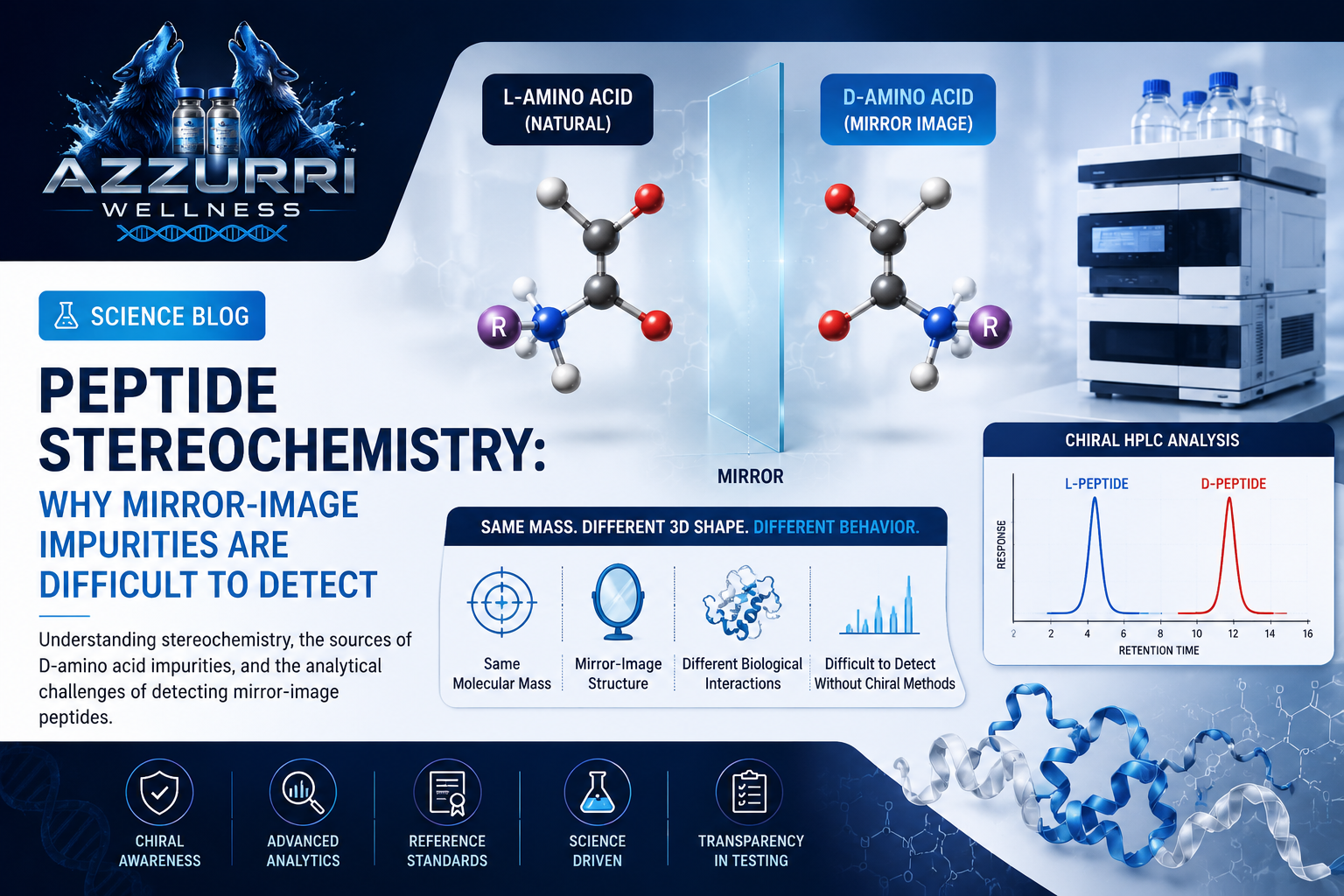
Most amino acids used in conventional peptide synthesis are selected in a specific three-dimensional form. This spatial arrangement is called stereochemistry, and it can influence how a peptide folds, interacts, and behaves during analysis.
A residue with the opposite configuration may be introduced through starting materials, synthesis-related racemization, or sample-preparation artifacts. The resulting peptide can have the same elemental composition and molecular mass as the intended form, making detection difficult.
1. D and L Forms Are Chemically Similar
D- and L-amino acids are mirror-image forms. In an ordinary non-chiral environment, they can share many physical and chemical properties. When one residue changes configuration inside a peptide, the product becomes a diastereomer or epimer of the intended sequence.
Standard mass spectrometry may show the same precursor mass for both forms. Their fragmentation patterns may also appear very similar, so additional separation or structural sensitivity is often needed.
2. Where Stereochemical Variants Can Come From
- Trace D-isomers in amino-acid starting materials
- Racemization during activation and coupling steps
- Sequence-dependent isomerization during processing or storage
- Artificial conversion during acid hydrolysis used for analysis
- Post-translational modification in naturally occurring peptides
Distinguishing a pre-existing variant from one created during sample preparation is essential. Studies using deuterated acid and controlled hydrolysis have been developed to correct for racemization introduced during the test itself.
3. Analytical Methods Used for Chiral Purity
- Chiral liquid chromatography
- Capillary electrophoresis with a chiral selector
- LC-MS or LC-MS/MS after controlled hydrolysis
- Comparison with synthetic stereochemical reference standards
- Ion-mobility or specialized fragmentation methods for site-specific analysis
Each approach answers a different part of the question. Complete hydrolysis can reveal which D-amino acids are present, but it may remove information about their original position in the peptide. Intact-peptide approaches may preserve sequence context but can require more specialized methods.
4. Why Reference Standards Matter
A synthetic standard containing the suspected D-residue can be compared with the sample. Co-elution or matching analytical behavior can strengthen a stereochemical assignment, especially when combined with isotope labeling or additional mass-spectrometric evidence.
5. What a Good Report Should Explain
- Whether the result applies to the intact peptide or hydrolyzed amino acids
- How preparation-related racemization was evaluated
- Which chiral separation method was used
- The detection and quantification limits
- How the location of a D-residue was assigned
- Which standards or controls supported the conclusion
6. The Main Takeaway
Peptide stereochemistry is a quality attribute that may remain invisible to routine mass measurements. Detecting mirror-image variants requires methods designed specifically for chiral separation and careful control of sample-preparation artifacts.
At Azzurri Wellness, precision begins with understanding what an analytical method can—and cannot—distinguish.
References
- Liu Y, et al. Enantiomeric purity of synthetic therapeutic peptides: A review. Journal of Pharmaceutical and Biomedical Analysis. 2024. View source
- Strege MA, Oman TJ, Risley DS, et al. Enantiomeric purity analysis of synthetic peptide therapeutics by direct chiral HPLC-ESI-MS/MS. Journal of Chromatography B. 2023. View source
- Riester D, Wiesmüller KH, Stoll D, Kuhn R. Racemization of amino acids in solid-phase peptide synthesis investigated by capillary electrophoresis. Analytical Chemistry. 1996;68(14):2361–2365. View source
- Checco JW, et al. Evaluation of endogenous peptide stereochemistry using LC-MS-based spiking experiments. Methods in Enzymology. 2022. View source
- Jia C, Lietz CB, Yu Q, Li L. Site-specific characterization of D-amino-acid-containing peptide epimers by ion mobility spectrometry. Analytical Chemistry. 2014. View source
Disclaimer: This article is provided for general educational information only. It does not provide medical advice, product-use instructions, or claims regarding the suitability of any individual material.