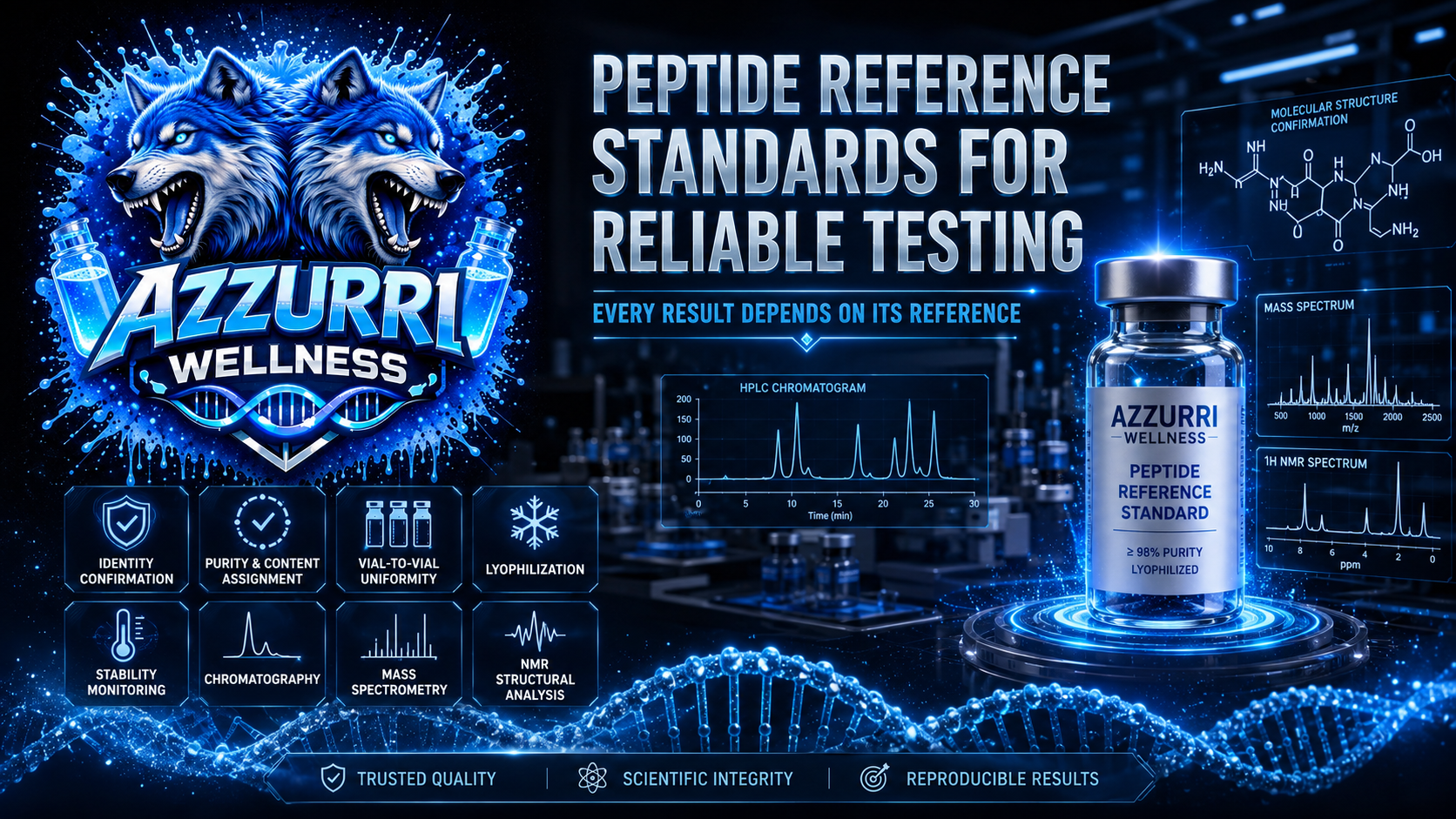
Laboratory equipment cannot produce dependable measurements without a known point of comparison. In peptide analysis, that point of comparison is often a peptide reference standard.
A reference standard is a carefully characterized material used to support measurements such as identity, purity, molecular mass, and peptide content.
Research published by McCarthy and colleagues in 2023 showed that establishing a reliable peptide reference standard requires multiple analytical methods, quantitative value assignment, uniform vial preparation, and ongoing stability monitoring.
Every result depends on the quality of its reference.
Confirming peptide identity
Before a material can function as a reference, analysts must confirm that it has the expected molecular identity.
Several methods may be used together:
Mass spectrometry compares observed and calculated molecular mass. MS/MS examines molecular fragments to support sequence confirmation. NMR spectroscopy provides information about molecular structure and connectivity. HPLC compares chromatographic retention and impurity profiles. Amino-acid or chiral analysis may help evaluate composition and stereochemistry.
No single technique answers every structural question. Confidence comes from agreement between several complementary methods.
Purity and content are different
Chromatographic purity and total peptide content are not interchangeable.
An HPLC purity result generally describes the relative area of detected peptide-related peaks. The complete material may also contain:
Water Counterions Residual solvents Inorganic residue Related peptide components
A reference standard therefore requires a separate quantitative value assignment. Researchers may use mass-balance calculations or other validated approaches to determine how much target peptide is present in each vial.
Why vial uniformity matters
A reference batch is divided into individual vials. Those vials must contain consistent quantities.
When fill amounts vary, the reference material itself can introduce uncertainty into every later result. Analysts may compare vials from the beginning, middle, and end of the filling process to confirm uniformity.
Vial consistency is therefore part of measurement quality—not merely packaging.
Lyophilization and storage
Peptide reference standards are often lyophilized to support controlled preparation and storage. However, freeze-drying alone does not confirm long-term stability.
Important attributes may include:
Residual moisture Headspace oxygen Physical appearance Chromatographic profile Vial-to-vial uniformity
Peptides can still change through oxidation, deamidation, hydrolysis, aggregation, or moisture uptake. Reference batches must therefore be monitored at planned intervals under specified storage conditions.
Why multiple laboratories may be involved
Testing across several laboratories helps identify:
Instrument variation Analyst variation Method reproducibility Unexpected bias Outlying results
The combined data can then be statistically reviewed before a final reference value is assigned. This reduces the chance that one laboratory’s unnoticed error becomes part of every later calculation.
Why the selected reference matters
A laboratory result may inherit errors from the reference used to calculate it.
When a reference has absorbed moisture, changed during storage, or received an inaccurate assigned value, the final sample measurement may also be affected.
The measurement chain is:
Reference characterization → Method calibration → Sample result → Scientific interpretation
A standard established for one analytical procedure may not automatically be suitable for every other method.
Azzurri Wellness perspective
Reliable laboratory documentation should connect every result to:
A defined reference material A suitable analytical method A traceable assigned value Confirmed storage and stability information
A purity or content figure should never be viewed as an isolated number. Its reliability depends on the standard and process behind it.
Every result depends on its reference—and every reference must be characterized, measured, and monitored.
Reference
McCarthy D, Han Y, Carrick K, et al. Reference Standards to Support Quality of Synthetic Peptide Therapeutics. Pharmaceutical Research. 2023;40:1317–1328. DOI: 10.1007/s11095-023-03493-1.
Educational disclaimer: This article is provided for general scientific and laboratory-information purposes. Analytical conclusions should be based on suitable reference materials, validated methods, and appropriate professional procedures.