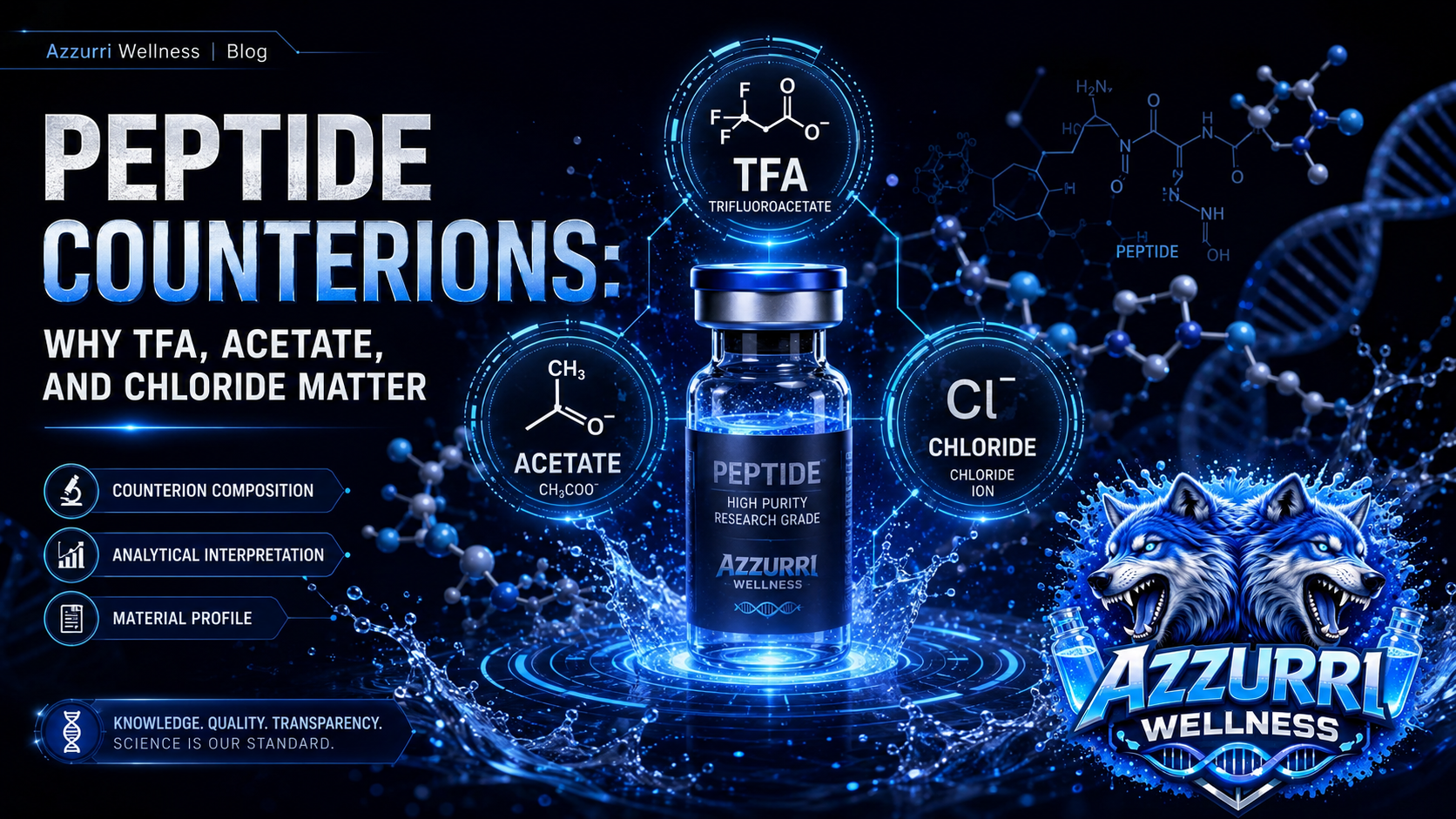
A synthetic peptide may be supplied as a salt containing trifluoroacetate, acetate, chloride, or another counterion. These components help balance electrical charges carried by amino-acid residues within the peptide. Counterions are not merely technical details. They may contribute to the total material weight, affect physicochemical behaviour, and influence how laboratory results are interpreted. Peptide purity and peptide content cannot be fully understood without considering counterions. Why do peptides contain counterions? Some amino-acid side chains become positively charged under particular conditions. A negatively charged counterion associates with those sites to maintain electrical balance. Frequently encountered forms include: Trifluoroacetate, or TFA Acetate Chloride The quantity associated with a peptide can depend on its sequence, number of charged sites, manufacturing conditions, purification process, and counterion-exchange method. A 2025 study found that peptide sequence—particularly the number and position of positive charges—affected measured TFA content and exchange efficiency. Why is TFA commonly present? TFA is widely used during solid-phase peptide synthesis, cleavage, and reversed-phase chromatographic purification. As a result, positively charged peptides may be isolated in a trifluoroacetate salt form. TFA can remain strongly associated with basic residues. Removing it completely may require repeated exchange steps, and the efficiency can vary among different peptide sequences. Counterion content affects total material composition A lyophilized preparation may include: Target peptide Counterions Residual moisture Related peptide components Small amounts of other residual material Therefore, the total weight inside a vial may not equal the weight of target peptide alone. A high chromatographic purity percentage also does not automatically establish absolute peptide content because HPLC peak-area purity typically evaluates detected peptide-related components rather than every non-peptide constituent. This distinction matters when comparing: Chromatographic purity → relative detected peak profile Peptide content → quantity of target peptide in the material Can counterions influence analytical results? Yes. Counterions can affect properties such as solubility, retention behaviour, molecular interactions, and spectroscopic analysis. For example, TFA can form ion pairs with positively charged peptide residues and alter chromatographic selectivity. Its infrared signal may also overlap with regions commonly examined during peptide structural analysis. The impact is peptide- and method-specific. Results obtained with one salt form should not automatically be assumed to match results from another. What is counterion exchange? Counterion exchange replaces one ion with another, such as converting a peptide from a TFA form to an acetate or chloride form. Reported approaches include: Repeated lyophilization from an acid solution Ion-exchange materials Solid-phase extraction Organic-solvent-based exchange methods The selected process can influence exchange efficiency, peptide recovery, moisture, and the final composition. Studies have shown that exchange conditions and formulation variables can also affect how much volatile counterion remains after lyophilization. Counterion exchange should therefore be confirmed analytically rather than assumed from the procedure alone. How are counterions measured? Analytical techniques used for counterion measurement include: Ion chromatography Capillary electrophoresis Isotachophoresis Fluorine NMR for TFA Other validated ion-specific methods A comparison of analytical approaches found ion chromatography particularly effective for measuring acetate, TFA, and chloride in synthetic peptide preparations. Useful documentation should clearly state: The reported counterion The analytical method used The measured amount or accepted range Whether an exchange procedure was performed The batch to which the result applies The Azzurri Wellness perspective A peptide report should not reduce quality to one purity percentage. A more complete analytical picture considers: Identity · Chromatographic purity · Peptide content · Moisture · Counterion composition · Batch traceability Counterion information helps explain what the material contains and supports clearer interpretation of vial weight and laboratory measurements. The peptide may be the main component—but it is not necessarily the only component.
References Sikora K, Neubauer D, Jaśkiewicz M, Kamysz W. The Role of Counter-Ions in Peptides—An Overview. Pharmaceuticals. 2020;13(12):442. Mrozik W, Markowska A, Guzik Ł, Kraska B, Kamysz W. Determination of Counter-Ions in Synthetic Peptides by Ion Chromatography, Capillary Isotachophoresis and Capillary Electrophoresis. Journal of Peptide Science. 2012;18:192–198. DOI: 10.1002/psc.1436. Erckes V, et al. Towards a Consensus for the Analysis and Exchange of TFA Counterions in Synthetic Peptides. 2025. Educational disclaimer: This article is provided for general scientific and laboratory-information purposes. Analytical conclusions should be based on batch-specific documentation, suitable methods, and appropriate professional procedures.