Peptide Content vs Purity: Why They Are Not the Same Number
July 23, 2026 Azzurri Wellness Team
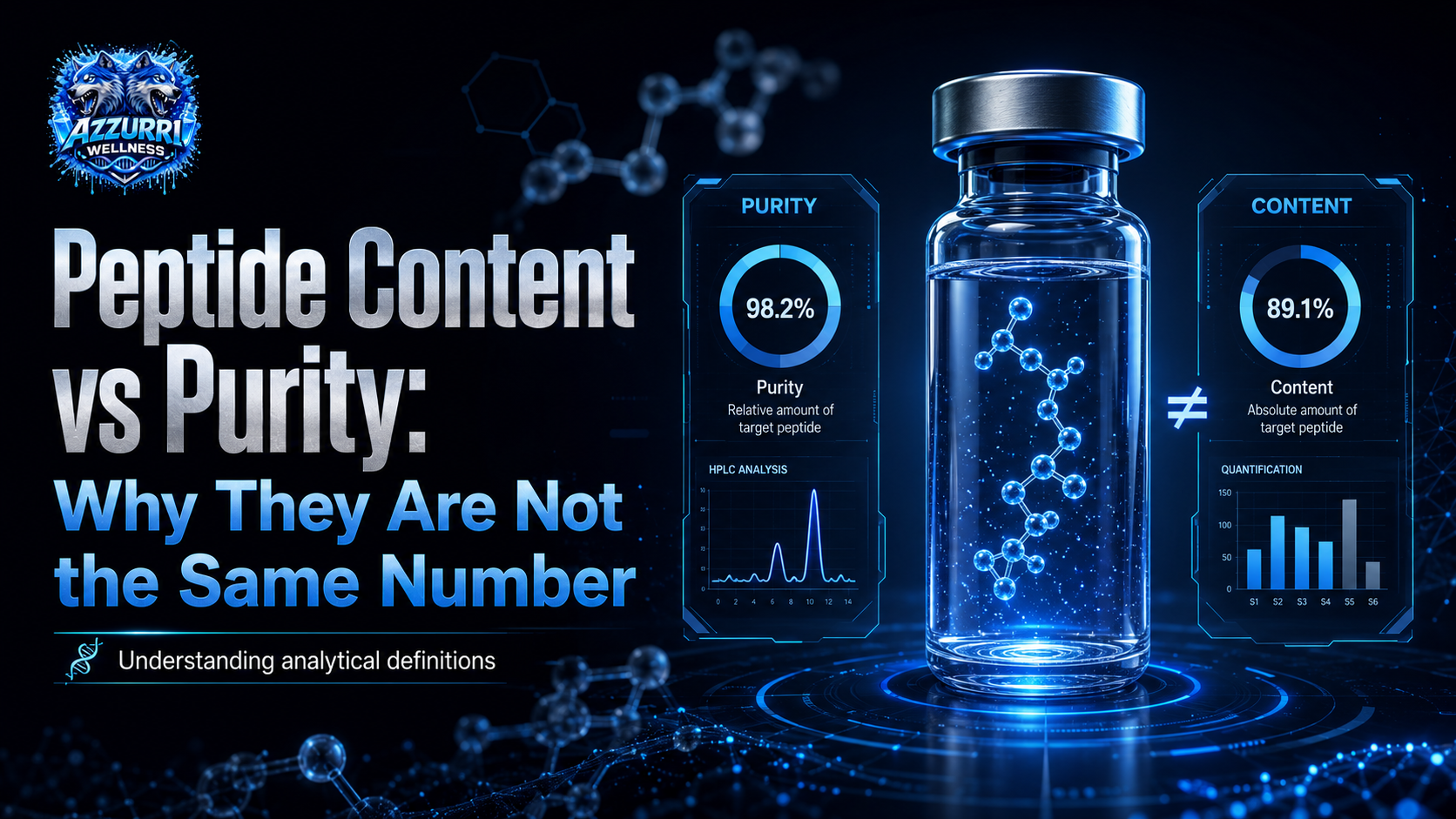
Peptide documentation may report both purity and content, but the two values do not answer the same question. Treating them as interchangeable can create an incomplete or misleading picture of a sample.
What Purity Usually Describes
Chromatographic purity commonly describes the proportion of detected peak area assigned to the main peptide relative to other detected components under a defined analytical method. The result depends on the column, mobile phase, detector, integration settings, and the ability of the method to separate related impurities.
What Content or Assay Describes
Content, sometimes reported through an assay or value assignment, aims to estimate how much of the target peptide is present in a given mass of material. The remaining mass may include water, counterions, residual solvents, salts, or other non-peptide components that are not necessarily represented by a chromatographic peak-area percentage.
Why a High Purity Result Can Still Need Context
A sample can show a dominant main peak while its total peptide content is lower than the peak-area percentage might suggest. This does not automatically indicate a problem; it shows that chromatographic purity and mass-based content measure different attributes.
How Content May Be Assigned
Depending on the intended use and required accuracy, laboratories may use approaches such as quantitative nuclear magnetic resonance, amino acid analysis, mass-balance calculations, or calibrated assay methods. Reliable value assignment also depends on well-characterized reference materials and documented uncertainty.
What to Look for in a Report
A clear distinction between purity and assay or content
The analytical method used for each result
The basis of calculation, such as dry basis or as-is basis
Water, counterion, or residual-solvent information when relevant
A matching batch or lot number
The reference standard or calibration approach
The strongest documentation does not rely on one headline percentage. It explains which property was measured, how it was measured, and what the result does—and does not—represent.
Clear Numbers Need Clear Definitions
At Azzurri Wellness, transparency means presenting analytical values with enough context to be interpreted correctly. Purity, identity, and content each contribute different information to the overall quality profile.
Precision begins with defining the measurement.
References
1. International Council for Harmonisation. Q6A: Specifications—Test Procedures and Acceptance Criteria for New Drug Substances and New Drug Products: Chemical Substances. Source
2. Josephs RD, Stoppacher N, Daireaux A, et al. Purity assignment for peptide certified reference materials by combining qNMR and LC-MS/MS amino acid analysis results: application to angiotensin II. Analytical and Bioanalytical Chemistry. 2018;410:6179-6191. Source
3. McCarthy D, Han Y, Carrick K, et al. Reference standards to support quality of synthetic peptide therapeutics. Pharmaceutical Research. 2023;40:1317-1328. Source
4. Li W, et al. Identification and accurate quantification of structurally related peptide impurities in synthetic human C-peptide by liquid chromatography-high resolution mass spectrometry. Analytica Chimica Acta. 2018. Source
Disclaimer: This article is for educational and informational purposes only. It does not provide medical advice or establish the quality, safety, sterility, or suitability of any individual product.
Looking for premium peptides? Third-party lab tested, fast USA shipping.