What Is Peptide Aggregation?
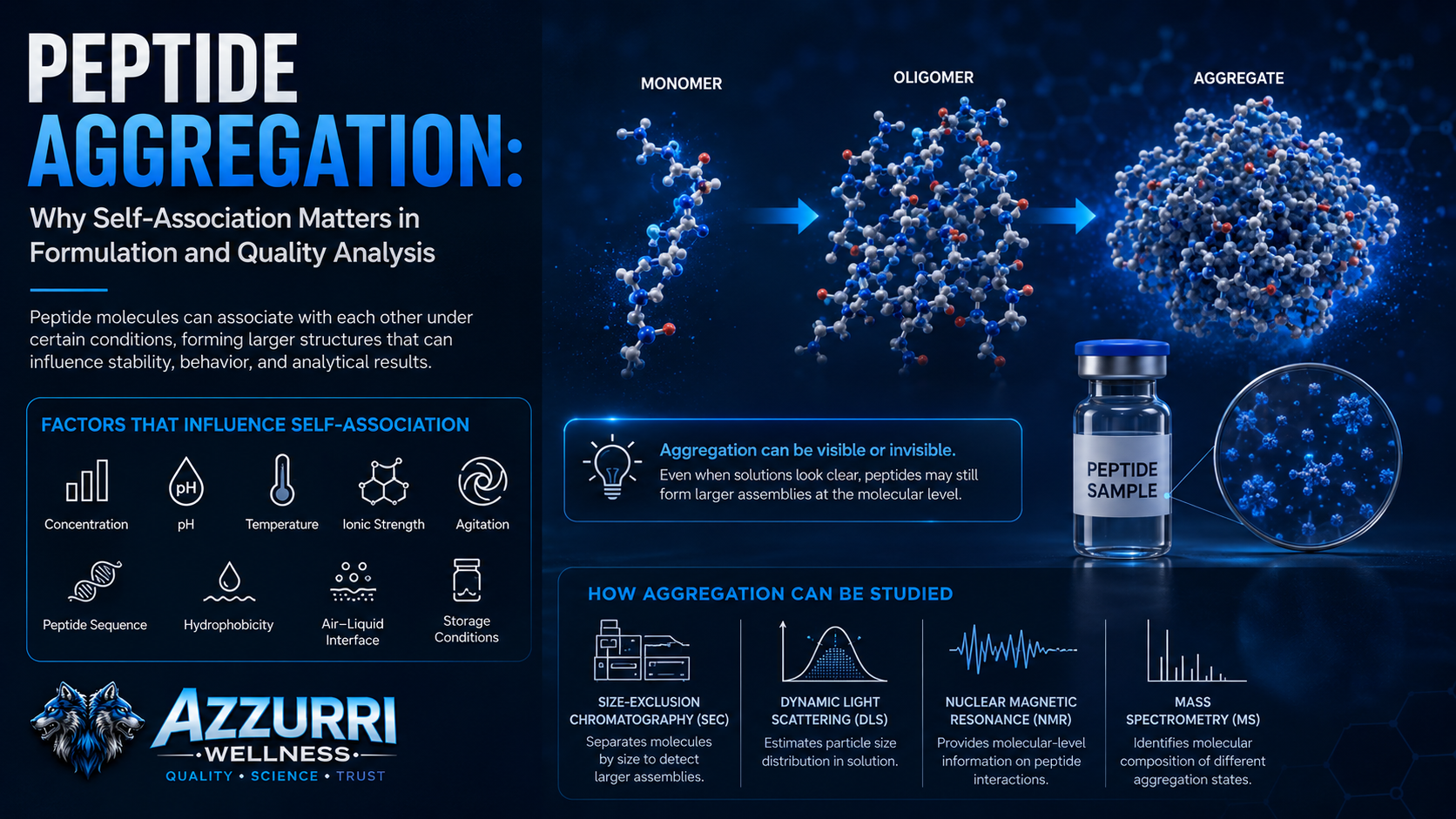
Peptide molecules do not always remain completely independent when placed in solution. Under certain conditions, individual molecules can interact with one another and form larger structures. This process is broadly described as self-association or aggregation.
The extent of aggregation depends on the peptide sequence, concentration, surrounding solution, temperature, and other environmental conditions.
Understanding this behavior matters because aggregation can influence how a sample looks, how it behaves during analysis, and how consistently it can be characterized.
Why Do Peptides Associate With One Another?
Peptides contain amino acids with different chemical characteristics.
Some regions interact strongly with water, while others are more hydrophobic. Certain sequences also contain charged or aromatic amino acids that can participate in intermolecular interactions.
When conditions favor peptide-to-peptide interactions, molecules may begin associating rather than remaining individually dispersed.
Factors That Can Influence Self-Association
- Peptide concentration
- Amino-acid sequence
- Hydrophobicity
- Solution pH
- Ionic environment
- Temperature
- Mechanical agitation
- Interfaces between liquid and air
- Storage conditions
Concentration Can Change Molecular Behavior
Peptide concentration is especially important.
At lower concentrations, peptide molecules may have fewer opportunities to interact with one another. As concentration increases, the frequency of molecular encounters can rise.
This does not mean that every concentrated peptide will aggregate. The result depends heavily on sequence and molecular structure.
Why This Matters
A sample that behaves normally at one concentration may behave differently at another.
Researchers therefore evaluate concentration-dependent behavior when developing analytical methods or studying formulation conditions.
Hydrophobic Regions and Peptide Association
Hydrophobic amino-acid regions tend to avoid prolonged exposure to water.
When several peptide molecules are present, hydrophobic regions can interact with each other, sometimes encouraging self-association.
Experimental research has shown that molecular association can create environments in which peptide structure changes compared with the isolated molecule.
This illustrates an important principle: peptide structure and peptide aggregation can influence each other.
A peptide's shape can affect whether it associates, while association itself can alter the structures adopted by individual molecules.
Aggregation Is Not Always Visible
One of the challenges in aggregation analysis is that not every aggregate can be seen by eye.
Large particles may cause cloudiness or visible material, but smaller molecular assemblies can remain in apparently clear solutions.
For this reason, visual inspection alone does not provide a complete picture.
Researchers use analytical techniques capable of detecting different size ranges and molecular states.
How Peptide Aggregation Can Be Studied
No single analytical method describes every aspect of aggregation.
Instead, laboratories frequently combine complementary techniques.
Size-Exclusion Chromatography
Size-exclusion chromatography, commonly abbreviated as SEC, separates molecules according to their apparent size.
Larger assemblies can often be separated from smaller peptide forms.
Dynamic Light Scattering
Dynamic light scattering, or DLS, estimates particle size by measuring how particles move in solution.
It can be useful for identifying larger species or changes in particle-size distribution.
Nuclear Magnetic Resonance
Nuclear magnetic resonance, or NMR, can provide molecular-level information about interactions between peptide molecules.
Researchers have used NMR to study self-association and distinguish differences in aggregation behavior among structurally related peptides.
Mass Spectrometry
Mass spectrometry can help identify the molecular composition of separated species and support investigation of whether larger signals represent intact peptide assemblies, modified molecules, or other components.
Combining separation and mass analysis can therefore provide more information than either approach alone.
Physical and Chemical Change Are Different
Aggregation is generally considered a physical change, but peptides can also undergo chemical modifications.
These are different processes.
A molecule can potentially self-associate without changing its chemical sequence. Likewise, a peptide can undergo a chemical modification without forming a large aggregate.
Examples of Questions Analysts May Ask
- Is the peptide still chemically intact?
- Has the molecular size distribution changed?
- Are larger assemblies present?
- Has the solution appearance changed?
- Has the concentration influenced association?
- Did environmental stress alter the sample?
Why Formulation Conditions Matter
Formulation conditions can strongly influence peptide behavior.
Peptide folding, concentration, and surrounding solution conditions can all affect physical and chemical stability.
The goal of formulation work is therefore not simply to place a peptide in liquid.
Researchers evaluate conditions that help maintain consistent molecular behavior during the intended analytical or storage period.
Parameters Commonly Evaluated
- pH
- Buffer composition
- Ionic strength
- Concentration
- Temperature
- Mixing conditions
- Container environment
Why Aggregation Testing Matters for Quality Analysis
A purity result does not automatically describe aggregation.
Chromatographic purity typically answers questions about the relative amounts of chemical components detected under a particular analytical method.
Aggregation analysis asks a different question: are peptide molecules associating into larger structures?
That is why multiple analytical approaches may be required when building a complete characterization profile.
Sequence Matters
Two peptides with similar molecular weights can have very different aggregation tendencies.
Sequence Can Influence
- Charge distribution
- Hydrophobic regions
- Hydrogen-bonding potential
- Aromatic interactions
- Molecular flexibility
- Preferred secondary structures
Aggregation behavior therefore cannot reliably be predicted from molecular size alone.
What Aggregation Data Does Not Tell You
Aggregation measurements should be interpreted within the conditions used for the experiment.
A result obtained at one concentration, temperature, or solution composition does not automatically describe every possible condition.
Aggregation data also does not independently establish:
- Complete chemical identity
- Overall sample purity
- Exact peptide concentration
- Sequence confirmation
- Long-term stability under every condition
Why Peptide Aggregation Research Matters
Aggregation research provides another layer of information about peptide quality.
Instead of asking only “What molecules are present?”, it also asks:
“How are those molecules behaving together?”
A well-designed characterization strategy may therefore combine:
- Chemical identity testing
- Purity analysis
- Concentration measurement
- Physical characterization
- Aggregation assessment
Final Takeaway
Peptide aggregation occurs when individual peptide molecules begin associating into larger structures.
Sequence, concentration, solution conditions, temperature, and mechanical stress can all influence this behavior, and different peptides may respond very differently to the same environment.
Analytical techniques such as size-exclusion chromatography, dynamic light scattering, NMR, and mass spectrometry can help researchers investigate these molecular interactions.
The key lesson is simple: peptide quality is not only about chemical composition. Molecular behavior in solution matters too.