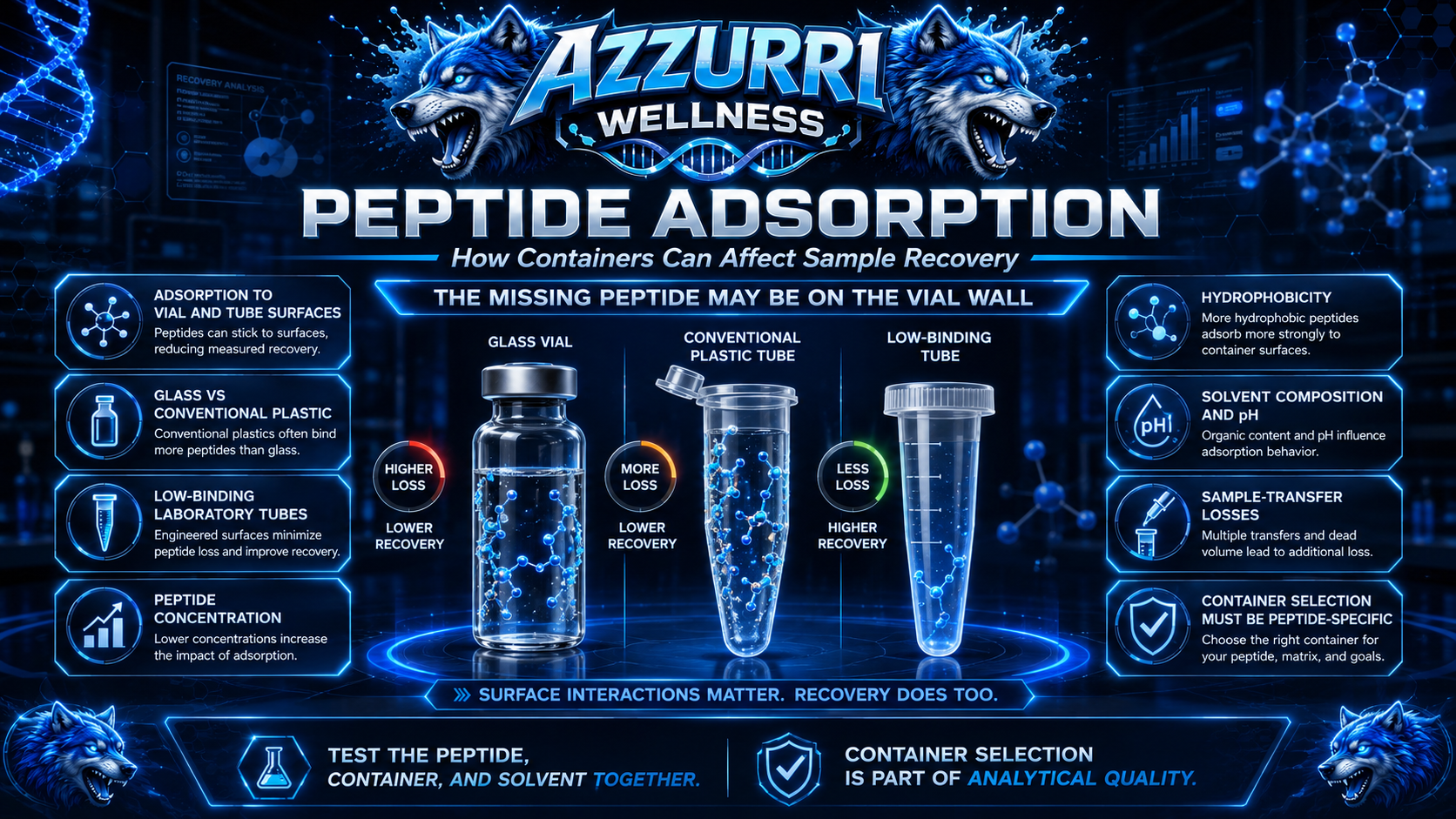
A peptide sample may appear unchanged while part of it is no longer freely available in solution.
Instead of degrading, peptide molecules can attach to the surfaces of vials, tubes, pipette tips, and other laboratory equipment. This process is called adsorption, and it can lower apparent concentration, reduce analytical sensitivity, and create inconsistent results.
The missing peptide may be on the vial wall.
Studies comparing laboratory containers show that peptide recovery can differ substantially between glass, conventional plastic, and specially designed low-binding materials. The best container cannot always be predicted from the peptide’s name or molecular weight alone.
What is peptide adsorption?
Adsorption occurs when peptide molecules accumulate on a solid surface rather than remaining dissolved in the surrounding liquid.
Potential interactions include:
Hydrophobic interactions Electrostatic attraction Hydrogen bonding Van der Waals forces
The extent of adsorption depends on both sides of the interaction: the peptide’s sequence and properties, and the chemical characteristics of the container surface.
This means that a container described simply as “plastic” may behave differently depending on whether it is made from polypropylene, polystyrene, polycarbonate, or a low-retention material. Glass compositions can also produce different recovery results.
Glass versus conventional plastic
Glass is sometimes assumed to be chemically neutral, while plastic is often assumed to bind hydrophobic compounds. Research shows that this distinction is too simple.
Kraut and colleagues compared peptide storage in standard plastic, glass, and low-adsorption plastic tubes. Glass generally performed better than ordinary plastic, but the highest overall recovery was achieved using low-adsorption plastic. Hydrophobic peptides were particularly vulnerable to losses during storage.
A separate study involving eight endocrine peptides found that no single surface was best for every molecule. Polypropylene performed better than polystyrene for several peptides, while borosilicate glass was preferable for others. Some tested surfaces recovered less than half of the peptide under particular conditions.
The practical conclusion is not that glass or plastic is universally superior. It is that container performance must be evaluated for the individual peptide and method.
Why concentration matters
Adsorption becomes especially important when peptide concentrations are low.
A vial has a limited surface area. At higher concentrations, the quantity lost to the wall may represent a relatively small fraction of the total sample. At low concentrations, the same amount of surface binding can remove a large percentage of the peptide from solution.
In one study of cationic peptides, only approximately 10–20% of the expected peptide was recovered from some borosilicate-glass and polypropylene containers at low concentrations, while low-binding tubes substantially reduced the loss.
This is particularly relevant for:
Low-concentration standards Serial dilutions Trace-level LC–MS analysis Small-volume samples Long storage periods Hydrophobicity and charge
Hydrophobic peptides may interact strongly with nonpolar plastic surfaces, while charged peptides may interact with oppositely charged or polar surface groups.
However, hydrophobicity and net charge do not reliably predict every result. The endocrine-peptide study found that peptide binding could not be consistently predicted from charge, chain length, or calculated hydrophobicity. Each tested molecule showed its own surface preference.
Modifications can also influence adsorption. Lipid groups, terminal modifications, sulfation, and other structural differences may change how a peptide behaves around glass or plastic.
Solvent composition and pH
The surrounding solution can change both peptide solubility and peptide–surface interactions.
Variables may include:
pH Ionic strength Organic-solvent percentage Buffer composition Surfactants Carrier proteins
Van Midwoud and colleagues found that poor peptide recovery from sample vials contributed substantially to inconsistent LC–MS peak areas. In their analytical system, adding an appropriate organic modifier improved solubility, recovery, repeatability, and detection of hydrophobic peptides. The authors also cautioned that changing solvent composition could affect later chromatographic retention.
This means that a solvent adjustment should not be copied automatically between methods. A condition that reduces adsorption may interfere with chromatography, mass spectrometry, biological assays, or another downstream procedure.
Sample-transfer losses
Peptide contact does not occur only during storage.
Every transfer can expose the sample to a new surface:
Original vial → pipette tip → dilution tube → autosampler vial → instrument
Small losses at each step may accumulate. Repeated mixing, prolonged storage, large surface-area-to-volume ratios, and unnecessary transfers can increase exposure.
Research comparing standard and low-retention tubes found better quantitative consistency and fewer errors when low-retention containers were used. Different tube types also affected which peptides were detected by LC–MS.
Are low-binding tubes always best?
Low-binding tubes are designed to reduce nonspecific surface interactions and can improve recovery, especially for low-concentration or adsorption-prone peptides.
However, they are not a universal guarantee. Performance can still depend on:
The specific peptide Concentration Contact time Solvent Temperature Tube manufacturer Downstream analytical method
A container should therefore be selected using recovery experiments that reflect the actual workflow.
How should container suitability be evaluated?
A practical comparison can prepare the same peptide concentration in several candidate containers and measure recovery:
Immediately after preparation After the expected storage period Following the planned number of transfers Under the intended solvent and pH conditions
Recovery may be assessed using a validated HPLC, LC–MS, spectroscopic, radiometric, or other suitable method.
The study design should compare the complete process—not only the storage vial—because pipette tips, filters, plates, and autosampler vials may introduce additional losses.
The Azzurri Wellness perspective
Peptide quality is influenced not only by synthesis and purity but also by what happens during storage and laboratory handling.
A high-quality starting material can still produce unreliable results when:
The wrong container is used Concentrations are extremely low Samples undergo repeated transfers The solvent is unsuitable Surface losses are not considered
The responsible approach is to use peptide-specific handling information and confirm recovery under the conditions actually used.
Container selection is part of analytical quality—not merely a packaging decision.
References Kraut A, Marcellin M, Adrait A, et al. Peptide storage: Are you getting the best return on your investment? Defining optimal storage conditions for proteomics samples. Journal of Proteome Research. 2009;8(7):3778–3785. DOI: 10.1021/pr900095u. Goebel-Stengel M, Stengel A, Taché Y, Reeve JR Jr. The importance of using the optimal plasticware and glassware in studies involving peptides. Analytical Biochemistry. 2011;414(1):38–46. DOI: 10.1016/j.ab.2011.02.009. Kristensen K, Henriksen JR, Andresen TL. Adsorption of cationic peptides to solid surfaces of glass and plastic. PLOS ONE. 2015;10(5):e0122419. DOI: 10.1371/journal.pone.0122419. Bark SJ, Hook V. Differential recovery of peptides from sample tubes and the reproducibility of quantitative proteomic data. Journal of Proteome Research. 2007;6(11):4511–4516. DOI: 10.1021/pr070294o. van Midwoud PM, Rieux L, Bischoff R, Verpoorte E, Niederländer HAG. Improvement of recovery and repeatability in liquid chromatography–mass spectrometry analysis of peptides. Journal of Proteome Research. 2007;6(2):781–791. DOI: 10.1021/pr0604099.