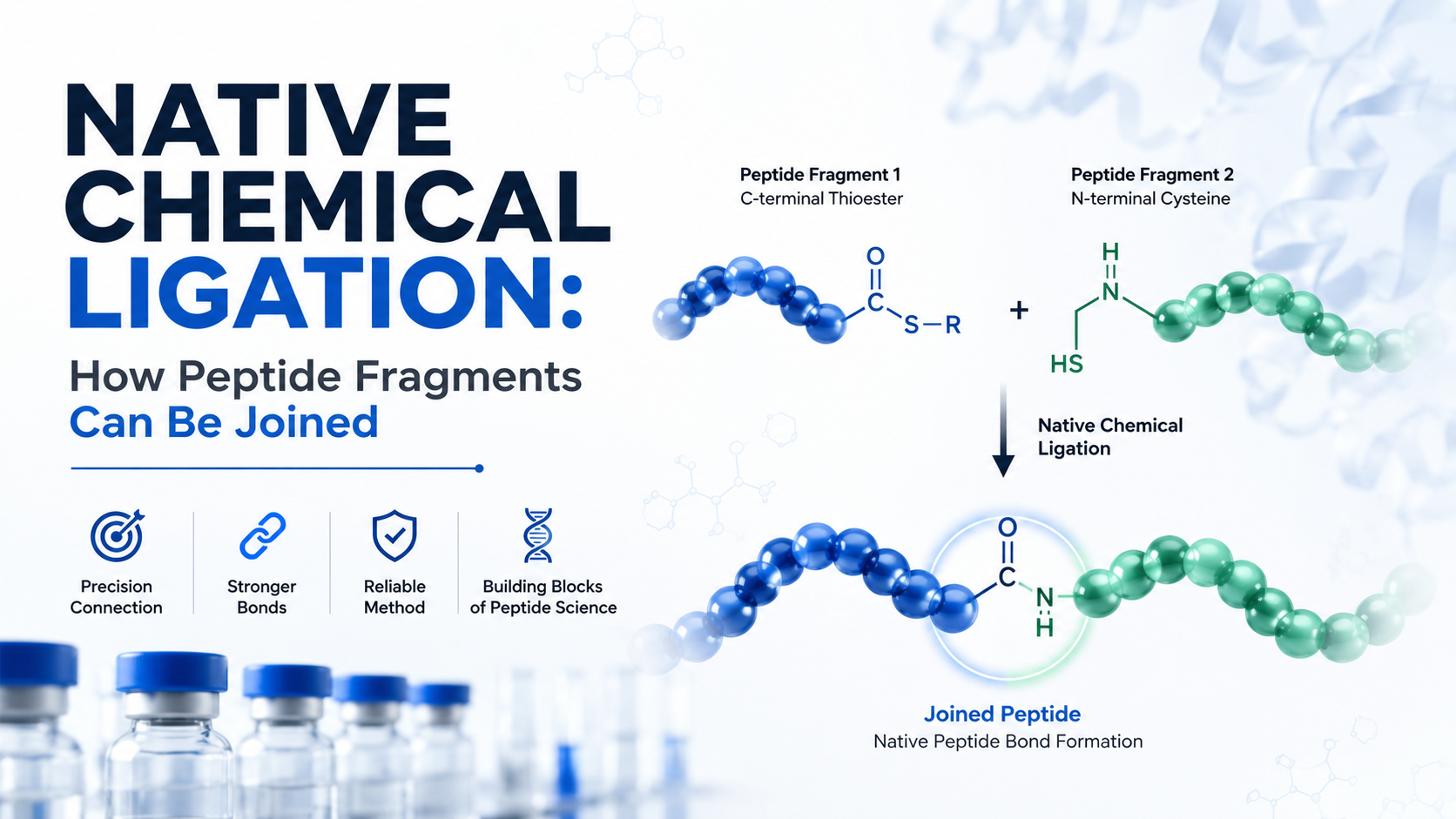
Long peptide sequences can be difficult to prepare as one uninterrupted chain. As the number of synthesis steps increases, incomplete reactions and accumulated side products can make purification more demanding.
Native chemical ligation, often abbreviated as NCL, provides a way to assemble a larger sequence from smaller peptide fragments. The reaction is designed to connect two unprotected segments while creating a standard peptide bond at the joining site.
1. What Native Chemical Ligation Uses
The classical reaction uses one peptide fragment with a C-terminal thioester and a second fragment that begins with cysteine. Under suitable conditions, the two segments react selectively even though many other functional groups remain unprotected.
The process first forms a sulfur-linked intermediate. An intramolecular rearrangement then converts that intermediate into the native amide bond found in an ordinary peptide backbone.
2. Why Fragment-Based Assembly Matters
Dividing a long sequence into shorter fragments can simplify synthesis and purification. Each segment can be evaluated separately before the ligation step, giving researchers more control over a complex assembly plan.
- Shorter fragments may be easier to synthesize and purify
- Different segments can be characterized before assembly
- Selected labels or nonstandard residues can be introduced into one fragment
- Multiple ligation steps can be planned for larger targets
- Chemical and recombinant fragments can be combined in some workflows
3. Selectivity Does Not Remove Every Challenge
Native chemical ligation is highly useful, but the reaction still depends on sequence and process conditions. Fragment solubility, thioester reactivity, cysteine availability, pH, additives, concentration, and competing side reactions can all influence performance.
Some peptide fragments are difficult to dissolve or may aggregate during the reaction. For that reason, a method that works for one sequence may require adjustment before it is applied to another.
4. Extending the Ligation Site
Classical native chemical ligation requires cysteine at the junction, but later developments expanded the range of usable sites. Strategies involving cysteine-like surrogates, desulfurization, and related ligation chemistry can produce junctions that correspond to other amino acids after the reaction is complete.
These extensions increase flexibility, but they also add analytical and process steps that must be documented clearly.
5. How the Product Can Be Evaluated
- Chromatography to separate the ligated product from starting fragments
- Mass spectrometry to support molecular identity
- Peptide mapping to examine the ligation region
- Monitoring of residual starting materials and reaction-related forms
- Comparison with expected retention and mass information
A successful mass match alone does not describe the complete sample. Separation data, reaction conversion, impurity profiles, and method conditions provide the context needed to interpret the result.
6. The Main Takeaway
Native chemical ligation is a fragment-assembly strategy that has expanded what can be prepared through chemical peptide and protein synthesis. Its value comes from selective bond formation, but reliable interpretation still depends on sequence-specific development and suitable analytical confirmation.
At Azzurri Wellness, clear educational content begins with explaining the method, its purpose, and its limitations.
References
- Agouridas V, El Mahdi O, Diemer V, et al. Native Chemical Ligation and Extended Methods: Mechanisms, Catalysis, Scope, and Limitations. Chemical Reviews. 2019;119(12):7328–7443.
- Conibear AC, Watson EE, Payne RJ, Becker CFW. Native chemical ligation in protein synthesis and semi-synthesis. Chemical Society Reviews. 2018;47(24):9046–9068.
- Johnson ECB, Kent SBH. Insights into the mechanism and catalysis of the native chemical ligation reaction. Journal of the American Chemical Society. 2006;128(20):6640–6646.
- Huang DL, Guo WC, Shi WW, et al. Enhanced native chemical ligation by peptide conjugation in trifluoroacetic acid. Science Advances. 2024;10(29):eado9413.
Disclaimer: This article is provided for general educational information only. It does not provide medical advice, product-use instructions, or guarantees regarding any individual material.