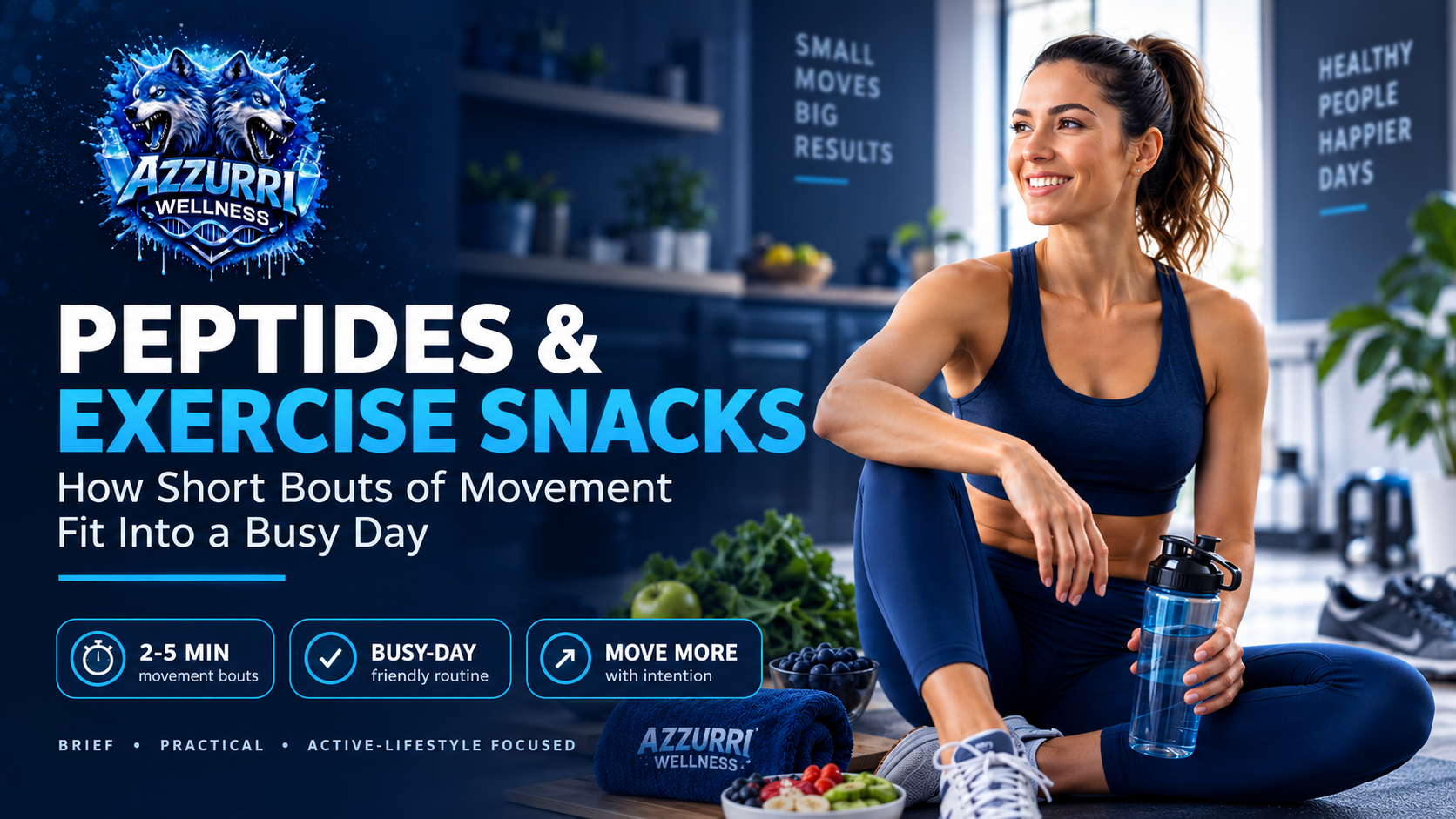
Busy schedules can make traditional workouts difficult to fit into everyday life. Work, travel, family responsibilities, and other commitments often compete for the same limited time.
This has led researchers to examine a simple idea: instead of relying only on one long workout, can short and intentional bouts of physical activity be spread throughout the day?
These brief bouts are often called “exercise snacks.” They are different from a full training session and different from ordinary movement such as walking around the office or completing household tasks. For health-conscious individuals interested in active living and peptide science, exercise snacks provide another way to think about building movement into a realistic wellness routine.
What Are Exercise Snacks?
Exercise snacks are short, intentional bouts of physical activity performed at different points throughout the day.
Research protocols vary, but exercise snacks may involve only a few minutes of activity. Examples explored in research include stair climbing, brisk walking, cycling, bodyweight movements, and other short forms of structured exercise.
The main idea is convenience. A large uninterrupted block of time may not always be necessary to create an opportunity for purposeful movement.
How Are Exercise Snacks Different From Everyday Movement?
Exercise snacks and everyday movement can both contribute to an active day, but they are not exactly the same.
Everyday movement may include standing, walking between rooms, carrying groceries, cleaning, or moving around at work. These activities often happen naturally as part of normal life.
Exercise snacks are generally more intentional. A person deliberately chooses to complete a short period of physical activity, even if it lasts only a few minutes.
Why Researchers Are Interested in Short Bouts
Limited time is a common challenge for people trying to maintain a consistent activity routine.
Exercise snacks are being studied because short bouts may be easier to fit around work and other responsibilities than a traditional workout.
Recent research has reported encouraging findings for certain fitness outcomes in some physically inactive adults. However, results can vary according to activity type, intensity, frequency, duration, and the population being studied.
Exercise snacks should therefore be viewed as an emerging movement strategy rather than a universal replacement for traditional exercise.
What Can an Exercise Snack Look Like?
Exercise snacks do not necessarily require complicated equipment or a gym environment.
- A short brisk walk
- A few minutes of stair climbing
- A brief stationary-bike session
- A short bodyweight movement routine
- A few minutes of repeated sit-to-stand movements
- A brief movement break between desk tasks
The activity should match individual ability, experience, environment, and comfort level.
Short Activity Can Fit Around Work
One practical advantage of exercise snacks is that they can be placed around an existing schedule.
A person might choose a short movement break before work, between meetings, after lunch, or later in the afternoon.
This creates multiple opportunities to move without requiring the entire day to revolve around one training session.
Exercise Snacks and Sedentary Time
Many modern jobs involve long periods of sitting. Short activity breaks can provide a simple reason to stand up and move.
For someone who spends much of the day at a desk, a brief planned movement period may help create a more active daily routine.
The objective does not need to be maximum intensity. The focus can simply be on creating realistic opportunities for movement.
Where Peptide Science Fits In
Peptides are short chains of amino acids involved in many forms of biological signaling.
Different peptide families are studied in connection with different biological pathways, including metabolism, cellular communication, energy regulation, body composition, and recovery-related biology.
Exercise snacks and peptide science should not be treated as interchangeable. Exercise snacks are a movement strategy, while peptide research examines specific areas of biological signaling.
For health-conscious individuals, peptide information is best considered within a broader wellness framework that includes movement, balanced nutrition, hydration, sleep, and recovery.
Short Does Not Automatically Mean Easy
Some exercise-snack research involves moderate or vigorous activity. A short duration does not automatically make an activity appropriate for every person.
Intensity should match individual fitness and experience. Someone beginning a new activity routine may prefer comfortable movement rather than trying to copy an advanced protocol.
Exercise Snacks Can Complement Longer Workouts
Exercise snacks do not need to replace traditional workouts.
A person can use short activity bouts during busy periods while still participating in walking, resistance training, cycling, sports, or other structured activities during the week.
Different forms of movement can complement each other within the same lifestyle.
Consistency Over Complexity
A wellness routine does not need to be complicated to be sustainable.
One reason short activity bouts can be appealing is their simplicity. When a movement habit requires little preparation, it may fit more naturally into everyday life.
Consistency is often easier when a routine works with a person's schedule rather than against it.
Simple Ways to Create Movement Opportunities
- Take a brief walk after finishing a meeting.
- Use stairs when practical.
- Add a short movement break after a long desk session.
- Walk for a few minutes after lunch.
- Use a short bodyweight routine during an afternoon break.
The exact routine does not need to look identical every day. The goal is to create sustainable opportunities for movement.
The Bigger Wellness Picture
Exercise snacks are only one part of an active lifestyle.
Balanced nutrition, hydration, regular movement, quality sleep, appropriate recovery, and realistic routines all contribute to long-term consistency.
Peptide science can be another area of wellness education, but it should not replace the foundational habits that support active living.
Final Thoughts
You do not always need a large block of free time to add movement to your day.
Short, intentional bouts of activity can provide another practical option for busy schedules. Current research suggests exercise snacks may support certain fitness outcomes, while also showing that results depend on the activity, intensity, frequency, and individual.
For health-conscious individuals interested in peptide science and active living, the broader message is simple: movement can take many forms, and the most sustainable routine is usually one that fits real life.
References
- Rodríguez MA, Quintana-Cepedal M, Cheval B, et al. Effect of exercise snacks on fitness and cardiometabolic health in physically inactive individuals: systematic review and meta-analysis. British Journal of Sports Medicine. 2026;60(2):133-141.
- Jones MD, Clifford BK, Stamatakis E, Gibbs MT. Exercise Snacks and Other Forms of Intermittent Physical Activity for Improving Health in Adults and Older Adults: A Scoping Review. Sports Medicine. 2024;54(4):813-835.
- World Health Organization. WHO Guidelines on Physical Activity and Sedentary Behaviour. Geneva: World Health Organization; 2020.
Educational information only. This content is not medical advice and is not intended to diagnose, treat, cure, or prevent any medical condition. Physical-activity and wellness decisions should be adapted to individual needs and discussed with an appropriately qualified professional when needed.