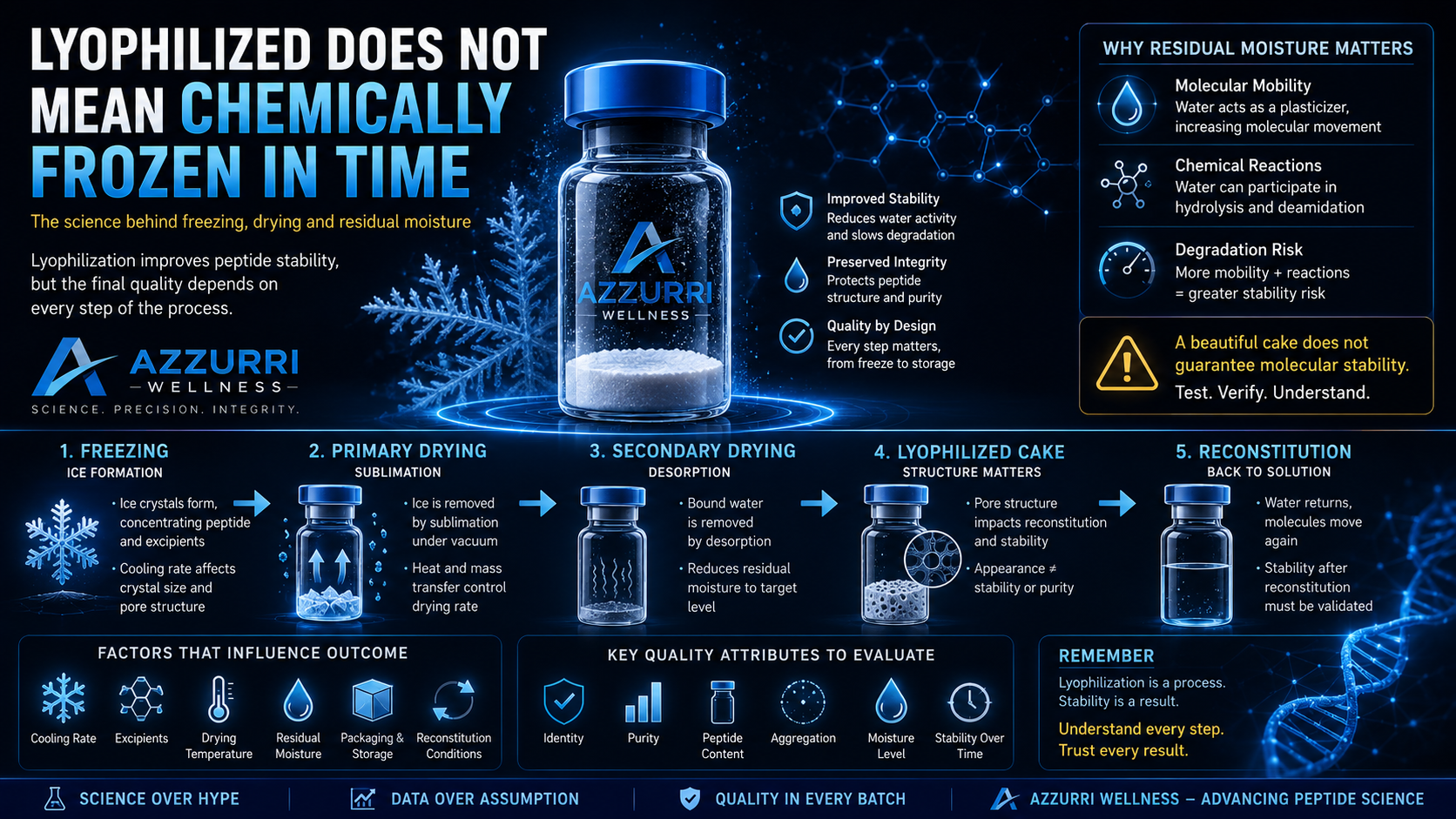
Lyophilized peptides are often recognized by the dry cake or powder visible at the bottom of a sealed vial. Because the material appears dry and unchanged, it can be tempting to assume that all chemical activity has stopped.
That assumption is incorrect.
Lyophilization can improve the storage stability of peptides that are less stable in aqueous solution, but it does not make them permanently resistant to degradation. The final result depends on the peptide sequence, formulation, freezing history, drying cycle, residual moisture, excipients, packaging, and storage conditions.
A 2025 study using a model PEGylated peptide formulation showed that changes in cooling and crystallization rates affected pore structure, residual moisture, desorption behaviour, cracking, and cake shrinkage. Some analytical attributes, including peptide assay and monomer content, remained comparatively consistent under the conditions tested. The findings illustrate that lyophilization quality cannot be judged from appearance or one analytical result alone.
The central principle is:
Lyophilization slows selected degradation pathways by changing the physical environment around a peptide. It does not eliminate every pathway or guarantee indefinite stability.
What is lyophilization?
Lyophilization, commonly called freeze-drying, is a controlled dehydration process generally divided into three major stages:
Freezing Primary drying Secondary drying
During freezing, most of the water becomes ice while peptide molecules and other dissolved substances become concentrated within the remaining unfrozen regions.
During primary drying, chamber pressure is reduced and heat is carefully supplied so that ice is removed through sublimation—the direct conversion of ice into water vapour without first becoming liquid water.
During secondary drying, additional water that did not form bulk ice is removed through desorption. This stage reduces the final residual-moisture content of the dried formulation. Classical experimental work on pharmaceutical freeze-drying established the importance of heat and mass transfer during sublimation and demonstrated that secondary-drying kinetics depend strongly on temperature and process conditions.
Each stage affects the structure and properties of the final material.
Why remove water from a peptide formulation?
Water can promote or support several peptide-degradation processes, including:
Hydrolysis Deamidation Oxidation Molecular mobility Aggregation Excipient–peptide reactions
Removing most of the water can slow many of these processes. However, lyophilized products normally retain some residual moisture, and chemical reactions may still proceed within the dried matrix.
Research involving an asparagine-containing model peptide found that increased moisture accelerated deamidation in lyophilized polymer formulations. The investigators concluded that residual water could increase molecular mobility, alter the reaction environment, and participate in the subsequent formation of hydrolytic degradation products.
Therefore, “dry” is not the same as “chemically inactive.”
Stage 1: Freezing and ice formation
Freezing is not merely a preparation step before drying. It establishes much of the microscopic structure through which water vapour must later travel.
As ice forms, dissolved substances are excluded from the growing ice crystals and become concentrated in the unfrozen fraction. This process is known as freeze-concentration.
The unfrozen regions may contain concentrated:
Peptide Buffer salts Sugars Surfactants Counterions Other excipients
This temporary concentration can expose the peptide to conditions that differ greatly from the original liquid formulation.
Ice nucleation and crystal growth
Ice formation begins with nucleation. Once nuclei form, ice crystals grow through the formulation.
The size, number, and shape of the crystals depend on variables such as:
Cooling rate Nucleation temperature Crystallization rate Fill volume Vial geometry Formulation composition Annealing conditions
When ice is later removed during primary drying, the spaces previously occupied by the crystals become pores. Those pores influence how easily water vapour can move through the dried layer.
Larger ice crystals generally produce larger pores, while smaller crystals tend to produce a finer pore network. However, the relationship between freezing conditions, drying time, moisture removal, and product stability is product-specific rather than universal.
What the recent model-peptide study found
Schaal and colleagues examined different cooling and crystallization rates during continuous spin-freeze-drying of a 52-amino-acid PEGylated model peptide formulation.
They measured:
Peptide assay Monomer content Residual moisture Pore structure Primary-drying duration Cake cracking Cake shrinkage
Peptide assay, monomer content, and primary-drying duration remained relatively consistent across the evaluated conditions. In contrast, freezing parameters significantly changed pore structure, residual moisture, secondary-drying behaviour, and cake appearance. Samples with smaller pores had lower residual moisture in that particular system, which the researchers associated with greater available surface area for moisture desorption.
The result should not be converted into a universal rule that smaller pores are always superior. The authors specifically described their findings as product-specific.
The broader lesson is that:
Freezing conditions may change physical quality attributes even when selected chemical measurements appear unchanged.
Annealing
Annealing involves holding a frozen formulation at a selected temperature before primary drying.
In experimental pharmaceutical systems, annealing has been shown to increase ice-crystal size, reduce freezing-related drying-rate variability, and substantially increase primary-drying rates under appropriate conditions. However, its effects depend on formulation composition and temperature relative to the frozen system’s physical transitions.
Annealing can improve one process characteristic while changing another. It must therefore be developed for the particular formulation rather than added automatically to every cycle.
Stage 2: Primary drying
The purpose of primary drying is to remove the ice created during freezing.
The freeze-dryer lowers chamber pressure and supplies carefully controlled heat. Under these conditions, ice sublimes into water vapour. The vapour travels through the porous dried layer and is collected on a colder condenser surface.
Primary drying is often the longest portion of the cycle.
Balancing heat and product temperature
Heat is needed to drive sublimation, but supplying too much heat can raise product temperature beyond the physical limit of the frozen formulation.
Depending on the formulation, excessive temperature may result in:
Collapse Meltback Shrinkage Loss of pore structure Uneven drying Increased reconstitution time Changes in product appearance
Supplying too little heat can make the process unnecessarily long and inefficient.
Primary drying is therefore a heat-and-mass-transfer problem. The process must provide enough energy for sublimation while maintaining the formulation within its acceptable temperature range. Experimental microbalance studies by Pikal and colleagues helped establish how temperature, pressure, dry-layer resistance, and sublimation behaviour interact during pharmaceutical freeze-drying.
The dried layer becomes a barrier
As sublimation progresses, an increasingly thick dry layer forms above the remaining frozen region.
Water vapour must travel through this dry layer to escape. Its resistance depends partly on:
Pore dimensions Pore connectivity Cake thickness Formulation composition Degree of collapse Freezing history
This is why freezing and primary drying cannot be optimized independently. The ice structure created during freezing becomes the pore structure that controls mass transfer during drying.
How is the end of primary drying determined?
Primary drying ends when the bulk ice has been removed. Ending the stage too early may leave ice within the product when temperatures are raised for secondary drying.
Possible monitoring approaches include:
Product-temperature measurement Pressure-rise testing Comparative pressure gauges Tunable diode laser absorption spectroscopy Process modelling Other process analytical technologies
No single monitoring method is ideal for every equipment configuration or formulation.
Stage 3: Secondary drying
Primary drying removes ice, but not all water in a formulation existed as ice.
Some water remains associated with the peptide, excipients, and amorphous matrix. Secondary drying is used to remove a portion of this more strongly associated water through desorption.
During secondary drying:
Shelf temperature is generally increased The chamber remains under reduced pressure Remaining water gradually desorbs from the solid matrix Residual moisture moves toward its final target range
Experimental studies have shown that temperature has a major influence on secondary-drying kinetics. Chamber pressure may also influence the process, although its effects can differ from those observed during primary drying.
Secondary drying is not simply “extra time”
A longer drying cycle does not automatically produce a better product.
Excessive secondary drying may:
Waste processing time and energy Alter the amorphous matrix Increase exposure to heat Remove water that contributed positively to structural stability Affect some formulations adversely
Insufficient secondary drying may leave too much residual moisture, which can support chemical degradation or physical instability.
The correct endpoint is therefore not “as dry as technically possible.” It is a product-specific residual-moisture range supported by stability and process data.
Residual moisture: why the target matters
Residual moisture is the water remaining after the lyophilization cycle.
It may be measured using methods such as:
Karl Fischer titration Gravimetric techniques Spectroscopic approaches Thermogravimetric analysis
Karl Fischer titration was used in the recent model-peptide study to evaluate differences created by spin-freezing conditions.
How residual water can increase degradation
Water can affect a dried formulation through at least three overlapping mechanisms.
- Plasticization
Water can act as a plasticizer, lowering the glass-transition temperature and increasing molecular mobility.
When molecules can move more easily, reactive groups may encounter one another more frequently.
- Solvent or medium effects
Even limited water may alter local polarity, ionization, hydrogen bonding, and the chemical environment surrounding a peptide.
- Chemical participation
Water may act directly as a reactant in hydrolysis or in reactions following formation of intermediates.
In the model-peptide study by Lai and colleagues, greater water content increased deamidation and shifted the distribution toward hydrolytic aspartate and isoaspartate products. Their results showed that moisture could affect both the speed of degradation and the types of degradation products formed.
Is lower moisture always better?
Not necessarily.
Some formulations require a controlled amount of water to maintain a favourable solid-state structure. Excessive drying may sometimes:
Alter stabilizing molecular interactions Change excipient structure Increase brittleness Affect reconstitution Produce unexpected instability
The ideal moisture range must be established experimentally for the exact peptide, excipients, container, and storage condition.
ICH guidance identifies moisture level as an important attribute for lyophilized products but also emphasizes that a stability-indicating profile must use multiple product-specific methods.
Molecular mobility in a dried peptide formulation
A lyophilized cake may appear completely solid, but its molecules are not necessarily immobile.
Many dried formulations contain an amorphous glassy matrix. Molecular movement within this matrix is considerably slower than in solution, but it is not zero.
Mobility is influenced by:
Temperature Residual water Glass-transition temperature Excipient composition Crystallization Storage time Physical ageing
When storage temperature moves closer to or above the glass-transition region, molecular mobility can increase. This can accelerate degradation or allow the matrix to relax, shrink, crystallize, or otherwise reorganize.
The Lai peptide study linked faster deamidation to water- and glycerol-related changes in matrix mobility, while also finding a separate chemical role for water.
This is why residual moisture and storage temperature must be interpreted together.
The role of excipients
Peptides are rarely lyophilized without other formulation components.
Excipients may be included to:
Stabilize the peptide during freezing Replace peptide–water interactions during drying Form a protective glassy matrix Control pH Provide isotonicity after reconstitution Improve cake structure Support reconstitution Reduce surface-related stress Act as bulking agents
Common categories include:
Sugars such as sucrose or trehalose Bulking agents such as mannitol Buffers Surfactants Amino acids Salts Lyoprotectants
Sugars such as sucrose and trehalose are often investigated as lyoprotectants because they can form an amorphous matrix and interact with polar regions of peptides or proteins during dehydration.
However, the same excipient does not stabilize every molecule equally.
A classic formulation study involving freeze-dried human growth hormone found that formulation variables substantially affected process-related damage and shelf stability. The investigators monitored methionine oxidation, asparagine deamidation, and irreversible aggregation, demonstrating that formulation selection must address multiple degradation pathways.
Bulking agents
Bulking agents can help create a mechanically strong and visually acceptable cake, particularly when the amount of peptide is small.
Some bulking agents may crystallize during freezing or drying. Crystallization can improve cake structure but may reduce the ability of that excipient to remain part of an amorphous protective matrix.
The formulation must therefore balance:
Structural appearance Peptide protection Residual moisture Thermal behaviour Drying efficiency Reconstitution
An excipient that produces an elegant cake does not necessarily provide the best chemical stability.
Cake appearance: useful, but not proof of stability
A lyophilized cake may be assessed for:
Shape Colour Uniformity Shrinkage Cracking Collapse Meltback Powdering Detachment from the vial Visible particles after reconstitution
Appearance is an important quality attribute, but it cannot establish peptide identity, purity, content, monomer level, or long-term stability.
In the 2025 model-peptide study, different crystallization rates produced differences in cracking and shrinkage while peptide assay and monomer measurements remained comparatively consistent. This demonstrates that physical appearance and molecular measurements can move independently.
The reverse problem is also possible: a cake may look attractive while chemical degradation has occurred.
A visually elegant cake could still contain:
Oxidized peptide Deamidated peptide Hydrolytic fragments Aggregates Excess residual moisture Reduced peptide content Degraded excipients
ICH guidance treats cake appearance, moisture, dissolution time, identity, purity, and degradation products as separate parts of a broader stability-indicating evaluation.
Cake appearance is evidence about physical presentation—not a complete certificate of molecular stability.
Reconstitution
Reconstitution adds a specified liquid to the lyophilized material so that it returns to a solution or suspension.
Important reconstitution attributes may include:
Time required for dissolution Clarity Colour Visible particles pH Concentration Peptide recovery Aggregation Chemical stability after reconstitution Why pore structure affects reconstitution
A highly porous cake generally allows liquid to enter more readily than a dense or collapsed structure. However, reconstitution also depends on:
Peptide solubility Excipient composition Fill volume Surface wetting Degree of collapse Aggregation Reconstitution liquid Mixing conditions
Fast dissolution is convenient, but it does not prove that the peptide has retained its identity or purity.
Stability after reconstitution is different
The stability of the dry product and the stability of the reconstituted solution are separate questions.
After water is added:
Molecular mobility increases sharply Hydrolysis can become more relevant Oxidation pathways may change Aggregation behaviour may change Surface adsorption may increase Microbiological considerations may become relevant
ICH Q5C states that the stability of a freeze-dried product after reconstitution should be demonstrated for the stated conditions and maximum storage period.
Therefore, a long supported shelf life for a sealed lyophilized vial does not automatically establish a similar period after reconstitution.
Why an attractive cake does not prove product quality
A proper quality assessment must answer more than “Does the vial look good?”
Depending on the peptide and intended application, relevant testing may include:
Quality attribute Possible analytical approach Appearance Visual inspection or imaging Residual moisture Karl Fischer titration Identity Mass spectrometry or peptide mapping Chromatographic purity RP-HPLC or LC–MS Aggregation Size-exclusion chromatography Peptide content Validated assay Reconstitution time Timed dissolution test Particles Visible and subvisible particle analysis Solid-state properties DSC, X-ray diffraction or spectroscopy Stability Real-time, accelerated and stress testing
ICH Q5C states that there is no single parameter that fully profiles the stability of a biological or polypeptide product. Instead, the analytical profile should detect changes in identity, purity, potency where relevant, physical appearance, moisture, and degradation products.
Why lyophilization data cannot be transferred automatically
A successful cycle developed for one peptide may not work equally well for another.
Relevant differences include:
Amino-acid sequence Molecular size PEGylation or other modification Concentration Charge and hydrophobicity Aggregation tendency Buffer composition Excipient selection pH Fill volume Vial dimensions Stopper configuration Freezing behaviour Collapse temperature Moisture target
Even a small formulation change can alter freezing, crystallization, pore formation, drying resistance, and stability.
The model-peptide spin-freezing authors explicitly cautioned that their relationships between freezing conditions, pore structure, moisture, and cake quality were specific to the formulation studied.
Storage and handling instructions should therefore be supported by data for the exact peptide, formulation, package, and manufacturing process.
The Azzurri Wellness perspective
Lyophilization should not be presented as a simple guarantee of quality.
A responsible evaluation considers the complete chain:
Formulation → Freezing → Ice formation → Primary drying → Secondary drying → Residual moisture → Packaging → Storage → Reconstitution
Transparent product information should connect analytical results to a specific batch and should distinguish among:
Cake appearance Peptide identity Chromatographic purity Peptide content Aggregation Moisture level Storage stability Reconstituted stability
The most accurate message is:
Lyophilization can improve peptide stability, but the quality of the final material depends on how the product was formulated, frozen, dried, packaged, stored, and tested.
Frequently asked questions Does lyophilized mean completely dry?
No. Lyophilized products usually contain some residual moisture. The appropriate amount must be determined for the specific formulation and supported by process and stability data.
Is a solid cake more stable than a powdery cake?
Not automatically. Cake structure can provide information about process performance, but chemical stability must be evaluated separately using appropriate analytical tests.
Does a perfect-looking cake prove high peptide purity?
No. Visual appearance cannot confirm molecular identity, chromatographic purity, peptide content, or absence of degradation.
What is removed during primary drying?
Primary drying removes ice primarily through sublimation under reduced pressure and controlled heat.
What is removed during secondary drying?
Secondary drying removes additional unfrozen or adsorbed water through desorption. Temperature is an important driver of this stage.
Is the lowest possible residual moisture always best?
No. Too much moisture may promote mobility and chemical degradation, while excessive drying may adversely affect some formulations. The target must be product-specific.
Can storage instructions for one lyophilized peptide be used for another?
Not reliably. Peptide sequence, formulation, residual moisture, packaging, and degradation pathways may differ.
Does stability continue unchanged after reconstitution?
No. Adding water creates a different physical and chemical environment. Post-reconstitution stability should be established separately.
References Schaal, Z., Van Bockstal, P. J., Lammens, J., Lenger, J. H., Funke, A. P., Schneid, S. C., Svilenov, H. L., & De Beer, T. (2025). Optimization of continuous spin-freeze-drying: The role of spin-freezing on quality attributes and drying efficiency of a model peptide formulation. European Journal of Pharmaceutical Sciences, 204, 106963. DOI: 10.1016/j.ejps.2024.106963. Lai, M. C., Hageman, M. J., Schowen, R. L., Borchardt, R. T., Laird, B. B., & Topp, E. M. (1999). Chemical stability of peptides in polymers. 2. Discriminating between solvent and plasticizing effects of water on peptide deamidation in poly(vinylpyrrolidone). Journal of Pharmaceutical Sciences, 88(11), 1081–1089. DOI: 10.1021/js9802289. Pikal, M. J., Shah, S., Senior, D., & Lang, J. E. (1983). Physical chemistry of freeze-drying: Measurement of sublimation rates for frozen aqueous solutions by a microbalance technique. Journal of Pharmaceutical Sciences, 72(6), 635–650. DOI: 10.1002/jps.2600720614. Pikal, M. J., Shah, S., Roy, M. L., & Putman, R. (1990). The secondary drying stage of freeze drying: Drying kinetics as a function of temperature and chamber pressure. International Journal of Pharmaceutics, 60(3), 203–217. DOI: 10.1016/0378-5173(90)90074-E. Pikal, M. J., Dellerman, K. M., Roy, M. L., & Riggin, R. M. (1991). The effects of formulation variables on the stability of freeze-dried human growth hormone. Pharmaceutical Research, 8(4), 427–436. DOI: 10.1023/A:1015834724528. Searles, J. A., Carpenter, J. F., & Randolph, T. W. (2001). Annealing to optimize the primary drying rate, reduce freezing-induced drying rate heterogeneity, and determine T′g in pharmaceutical lyophilization. Journal of Pharmaceutical Sciences, 90(7), 872–887. DOI: 10.1002/jps.1040. International Council for Harmonisation. ICH Q5C: Stability Testing of Biotechnological/Biological Products.