What Is Elamipretide?
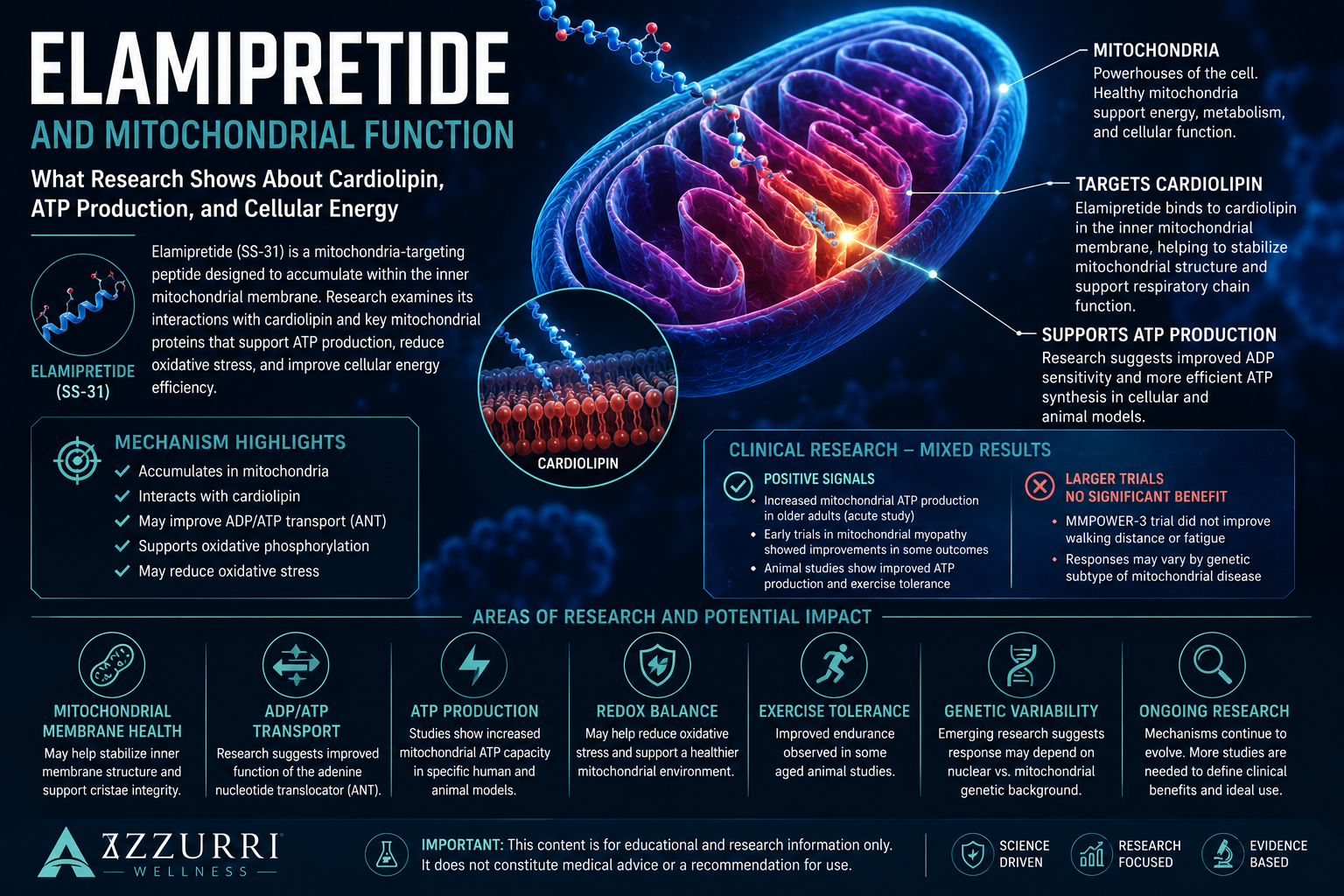
Elamipretide, also known in research literature as SS-31, is a small synthetic peptide designed to selectively accumulate within mitochondria.
Unlike mitochondrial-derived peptides that are naturally encoded by mitochondrial DNA, elamipretide is a synthetic mitochondria-targeting peptide.
Its biological interest comes largely from interactions with structures and proteins inside the inner mitochondrial membrane.
Research has investigated elamipretide in relation to mitochondrial membrane organization, oxidative phosphorylation, ATP production, redox balance, and cellular-energy efficiency.
Why Mitochondrial Function Matters
Mitochondria produce ATP through a process called oxidative phosphorylation.
This process depends on highly organized structures within the inner mitochondrial membrane.
What Can Happen When Mitochondrial Function Is Impaired?
- Reduced ATP production
- Altered oxygen utilization
- Increased oxidative stress
- Changes in cellular signaling
- Reduced metabolic flexibility
Mitochondrial dysfunction has been investigated in aging, skeletal-muscle decline, inherited mitochondrial disorders, and numerous chronic conditions.
Elamipretide research asks whether selectively targeting mitochondrial machinery can influence aspects of cellular-energy production.
What Is Cardiolipin?
One of the molecules frequently discussed in elamipretide research is cardiolipin.
Cardiolipin is a specialized phospholipid found primarily in the inner mitochondrial membrane.
Functions Associated With Cardiolipin
- Mitochondrial membrane structure
- Organization of respiratory-chain proteins
- Cristae architecture
- Electron transport
- ATP production
Because cardiolipin is closely associated with proteins involved in oxidative phosphorylation, researchers have investigated whether stabilizing interactions within this membrane environment may influence mitochondrial efficiency.
Reviews of elamipretide describe the peptide as interacting with cardiolipin and potentially influencing mitochondrial membrane organization.
Elamipretide May Act Through More Than Cardiolipin
The proposed mechanism appears to be more complicated than a simple cardiolipin interaction.
Experimental studies have also found interactions between elamipretide and mitochondrial proteins involved in ADP and ATP transport.
Research in aging muscle has examined interactions with the adenine nucleotide translocator, commonly abbreviated as ANT.
What Does ANT Do?
ANT transports ADP and ATP across the inner mitochondrial membrane.
Mitochondrial energy production requires a continual supply of ADP. ADP enters mitochondria, where it can be converted into ATP.
ATP is then transported back into the cell where it can power biological processes.
Elamipretide and ADP Sensitivity
Aging mitochondria may become less responsive to ADP.
Reduced ADP sensitivity can limit how effectively mitochondria increase ATP production when cellular energy demand rises.
Experimental research has reported improved mitochondrial ADP sensitivity following elamipretide exposure in aged muscle models.
Researchers linked part of this effect with improved function involving ANT.
Why ADP Sensitivity Matters
Efficient ADP sensing helps mitochondria match ATP production with cellular demand.
This is particularly important in tissues with high energy requirements, including:
- Skeletal muscle
- Heart muscle
- Brain tissue
- Kidneys
Understanding this mechanism helps explain why elamipretide has been studied across several different organ systems.
Elamipretide and ATP Production
ATP production is one of the most important biological outcomes investigated in elamipretide research.
A randomized, double-blind, placebo-controlled human study examined elamipretide in older adults with relatively poor skeletal-muscle mitochondrial function.
Researchers measured mitochondrial ATP production directly in muscle.
The study found an immediate increase in mitochondrial energetic capacity following elamipretide compared with placebo.
However, the effect was no longer detectable seven days later, and the study did not find a significant improvement in muscle fatigue resistance.
Biological Outcomes Are Not the Same as Functional Outcomes
This finding illustrates an important principle in research.
Improving a mitochondrial laboratory measurement does not automatically produce an immediate improvement in physical performance.
Oxidative Stress and Redox Balance
Another major area of elamipretide research involves mitochondrial oxidative stress.
Mitochondria naturally produce oxidants during normal metabolism.
When redox balance becomes disrupted, cellular proteins can undergo chemical modifications that influence their function.
Animal research in aged skeletal muscle has reported changes involving mitochondrial ATP production and redox balance following elamipretide exposure.
Some experimental models have also reported improvements in exercise-related outcomes.
These findings are scientifically interesting but cannot automatically be translated into equivalent effects in humans.
Research in Primary Mitochondrial Myopathy
Elamipretide has also been investigated in people with primary mitochondrial myopathy, a group of inherited disorders affecting mitochondrial energy production.
Early clinical studies produced encouraging signals.
A randomized dose-escalation study reported changes in six-minute walking performance after several days of treatment.
A later randomized crossover trial also found suggestive results, although its primary six-minute walk endpoint did not reach statistical significance.
These early findings supported progression into a larger phase 3 study.
What MMPOWER-3 Found
The large MMPOWER-3 phase 3 trial evaluated elamipretide in people with primary mitochondrial myopathy.
The study did not demonstrate significant improvement compared with placebo in its main six-minute walk or fatigue outcomes.
Why Negative Clinical Results Matter
Negative results are an important part of scientific research.
Promising biological mechanisms and encouraging early trials do not always produce significant effects in larger studies.
Several factors may influence clinical trial results:
- Patient populations may be biologically heterogeneous
- Outcome measures may not capture every relevant change
- Genetic subtypes may respond differently
- Treatment duration may influence outcomes
- Mitochondrial disease mechanisms vary between individuals
Could Genetic Subtypes Matter?
Follow-up analysis of MMPOWER-3 suggested that genetic differences may influence response.
Some analyses reported different outcomes between mitochondrial-DNA and nuclear-DNA disease groups.
Certain patients with nuclear-DNA variants affecting mitochondrial-DNA maintenance appeared to show different responses than the broader trial population.
Why These Findings Need Caution
These findings are considered hypothesis-generating rather than definitive.
Post hoc subgroup results generally need to be tested in dedicated, prospective clinical studies before strong conclusions can be made.
Still, they demonstrate an important principle: not every mitochondrial disorder has the same biological cause.
Emerging Research Is Refining the Mechanism
More recent experimental work continues to refine how elamipretide may influence mitochondrial function.
Research has investigated interactions between fatty-acid oxidation enzymes and electron-transport-chain complexes.
This supports a broader view of elamipretide's proposed mechanism.
Rather than functioning through only one mitochondrial component, it may influence several protein and membrane interactions involved in energy transfer and redox regulation.
Why ATP Is Not the Same as Performance
One important lesson from elamipretide research is that improved mitochondrial ATP production does not automatically mean improved physical performance.
Human research has shown changes in mitochondrial ATP-related measurements without equivalent improvements in fatigue resistance.
Likewise, larger clinical studies have produced mixed results for walking performance and fatigue.
Physical Performance Depends on Many Systems
- Muscle mass
- Cardiovascular function
- Nerve function
- Joint health
- Neuromuscular coordination
- Overall physical conditioning
Mitochondrial energy production is therefore only one part of a much larger physiological system.
What Current Research Does Not Establish
Current evidence does not establish that elamipretide:
- Reverses human aging
- Guarantees increased energy
- Improves athletic performance in healthy individuals
- Eliminates mitochondrial dysfunction
- Treats every mitochondrial disorder
- Produces permanent ATP increases after a single exposure
- Improves fatigue in every population
- Works identically across genetic subtypes
Clinical research has produced both positive biological findings and negative primary trial outcomes.
A scientifically balanced interpretation should include both.
Why Elamipretide Research Matters
Elamipretide is scientifically important because it represents a different strategy in peptide research.
Rather than primarily signaling through a cell-surface receptor, the peptide is designed to target mitochondria directly.
Areas Studied With Elamipretide
- Inner mitochondrial membrane biology
- Cardiolipin interactions
- ADP and ATP transport
- Oxidative phosphorylation
- Redox balance
- Mitochondrial aging
- Genotype-specific mitochondrial dysfunction
Its clinical history also provides a useful example of the gap that can exist between promising biological mechanisms and measurable clinical outcomes.
Final Takeaway
Elamipretide is a mitochondria-targeting peptide studied for its effects on mitochondrial membrane biology, energy production, oxidative stress, and ATP-related pathways.
Human research has shown that a single exposure can temporarily influence skeletal-muscle mitochondrial ATP-production capacity in older adults, while experimental studies suggest effects involving ADP transport, ANT function, redox balance, and other mitochondrial processes.
At the same time, large clinical trials have not consistently demonstrated improvements in functional outcomes such as walking ability and fatigue.
That mixed evidence is scientifically valuable.
It shows that improving mitochondrial biology at the cellular level does not automatically translate into predictable whole-body benefits.
Elamipretide therefore remains an important research tool for understanding how mitochondrial membranes, ATP production, redox balance, and genetic differences contribute to cellular-energy function.