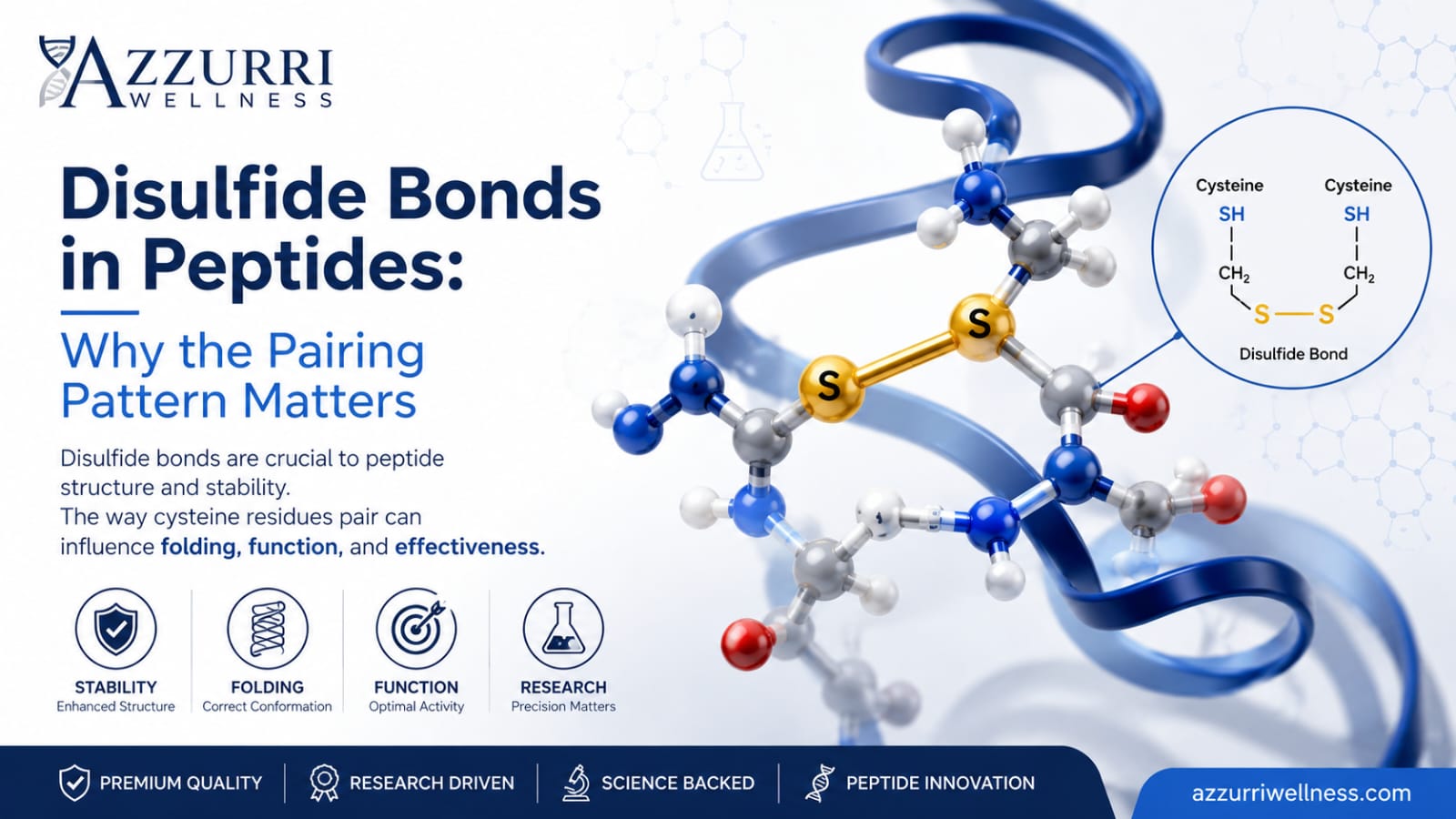
Some peptides contain two or more cysteine residues that can connect through disulfide bonds. These sulfur-sulfur links can help stabilize a particular three-dimensional arrangement, but the presence of the correct number of bonds does not automatically confirm that the correct cysteine pairs have formed.
When several cysteines are present, multiple pairing patterns may be possible. The resulting forms can share the same molecular mass while differing in connectivity and shape, which makes disulfide analysis an important part of structural characterization.
1. How a Disulfide Bond Forms
A disulfide bond forms when two cysteine thiol groups are oxidized and linked together. The reaction can occur during controlled chemical synthesis, oxidative folding, recombinant production, or later processing under suitable conditions.
The balance between oxidizing and reducing conditions, pH, temperature, concentration, solvent, and sequence context can influence how quickly bonds form and whether reshuffling occurs.
2. Correct Bond Count Is Not the Same as Correct Pairing
A peptide with four cysteines may form two disulfide bonds, but there can be more than one way to pair those residues. Different pairings are known as disulfide isomers.
Because disulfide isomers can have identical elemental composition and molecular mass, routine intact-mass analysis may not distinguish them. A sample can therefore match the expected mass while still containing an alternative connectivity pattern.
3. Oxidative Folding Is a Controlled Process
For some sequences, the peptide backbone folds while disulfide bonds form and rearrange. Conditions must allow the system to move away from incorrectly paired intermediates and toward the intended structure.
- Redox conditions can affect bond formation and reshuffling
- Peptide concentration can influence intermolecular versus intramolecular reactions
- Temperature and pH can change folding rates
- Protecting-group strategy can direct selected cysteine pairings
- Sequence and solvent conditions can influence aggregation
4. Directed and Stepwise Approaches
When a peptide contains several disulfide bonds, chemists may use orthogonal protecting groups to reveal selected cysteines in stages. This allows one pair to form before another, reducing the number of competing combinations.
Stepwise strategies can improve control, but each deprotection and oxidation step introduces additional process variables that require monitoring.
5. How Disulfide Pairing Can Be Investigated
- Enzymatic digestion followed by LC-MS peptide mapping
- Comparison of reduced and non-reduced samples
- Chromatographic separation of disulfide isomers
- Selective reduction or alkylation studies
- Nuclear magnetic resonance or other structural methods when suitable
Disulfide mapping aims to identify which cysteine residues are connected. Sample preparation must be carefully controlled because reduction, exchange, or scrambling during analysis can create misleading results.
6. What Clear Documentation Should Include
- The number and position of cysteine residues in the sequence
- The oxidation or folding conditions used
- Whether the sample was analyzed under reduced and non-reduced conditions
- The method used to assign cysteine pairings
- Controls used to evaluate scrambling during preparation
- The batch or sample identifier linked to the result
7. The Main Takeaway
Disulfide bonds can contribute to peptide structure, but correct characterization requires more than counting sulfur-sulfur links. The pairing pattern, folding conditions, and analytical method all matter when interpreting the final profile.
At Azzurri Wellness, better understanding comes from documenting both the measured result and the conditions that produced it.
References
- Annis I, Hargittai B, Barany G. Disulfide bond formation in peptides. Methods in Enzymology. 1997;289:198–221.
- Bulaj G. Formation of disulfide bonds in proteins and peptides. Biotechnology Advances. 2005;23(1):87–92.
- Hidaka Y, Shimamoto S. Folding of peptides and proteins: role of disulfide bonds, recent developments. Biomolecular Concepts. 2013;4(6):597–604.
- Bulleid NJ, Ellgaard L. Multiple ways to make disulfides. Trends in Biochemical Sciences. 2011;36(9):485–492.
Disclaimer: This article is provided for general educational information only. It does not provide medical advice, product-use instructions, or claims regarding the suitability of any individual material.