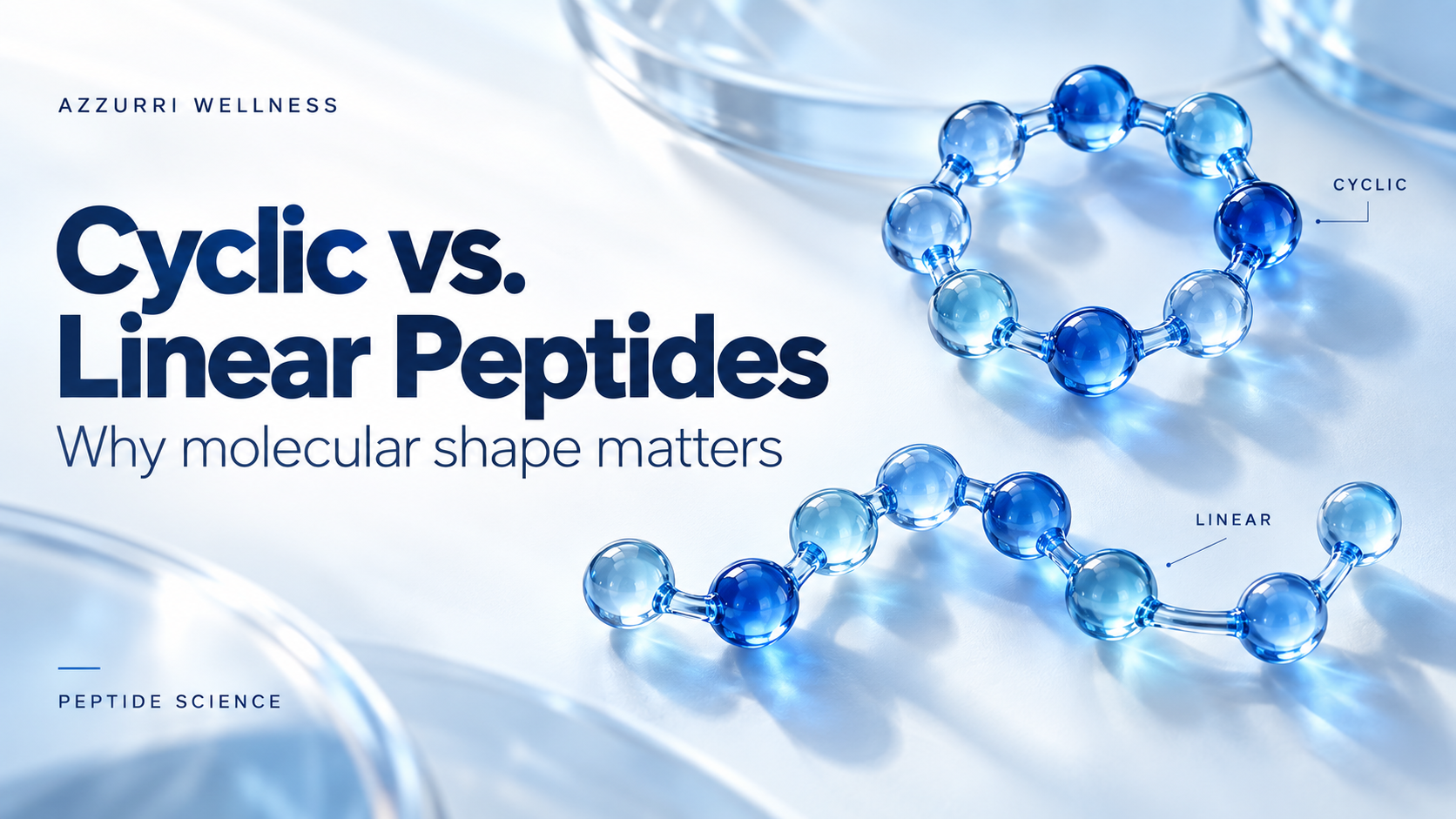
Peptides are often described by the amino acids they contain. That is a useful starting point, but a sequence alone does not explain every aspect of a molecule's behavior. The way the chain is connected also matters.
The distinction between cyclic and linear peptides helps explain why researchers pay attention to molecular architecture. Joining parts of a peptide into a ring can change its flexibility, resistance to breakdown, and ability to cross biological barriers. The outcome depends on the individual molecule, so “cyclic” should never be treated as a universal quality rating.
What Is a Linear Peptide?
A linear peptide has an open amino-acid chain rather than a ring-closing connection. Its backbone has two ends, conventionally called the N-terminus and C-terminus. Those ends may be chemically modified without turning the molecule into a cyclic peptide.
The word “linear” describes connectivity. It does not mean the molecule always looks like a straight line. An open chain can bend and adopt different three-dimensional arrangements. Think of an unfastened necklace: the connection pattern stays open even when the necklace curves or folds.
What Is a Cyclic Peptide?
A cyclic peptide contains a ring formed by a connection between parts of the molecule. Scientists can create that connection in several ways. End-to-end cyclization joins the backbone termini, while other approaches connect side chains or a side chain to one end of the backbone. These architectures are not identical. [1]
A side-chain connection can create a ring while leaving a portion of the peptide outside it. Some designs contain more than one ring. Therefore, knowing that a peptide is cyclic is only the beginning: ring size, connection chemistry, sequence, and any remaining free ends all matter.
Cyclic vs. Linear Peptides at a Glance
| Feature | Linear peptides | Cyclic peptides |
|---|---|---|
| Connectivity | Open chain without a ring-closing connection. | One or more connections create a ring. |
| Chain ends | Two backbone ends, which may be modified. | End-to-end closure joins the ends. Other ring types can leave ends available. |
| Flexibility | Often has more freedom to change conformation. | Ring closure can restrict the available conformations. |
| Stability and permeability | Depend on sequence, modifications, and environment. | May improve with cyclization, but require direct measurement. |
Why Can Cyclization Change Stability?
Enzymes can break peptide bonds, and the accessibility of those bonds affects how a molecule behaves in a biological environment. Closing a ring changes the structure that enzymes encounter. Depending on the design, this can make the peptide more resistant to enzymatic breakdown.
A 2023 study examined oxytocin and related peptide structures in models relevant to the colon. Native oxytocin's disulfide-linked ring improved stability compared with a linear derivative. However, alternative modifications did not all provide the same additional protection. The details of the chemical design mattered. [2]
Notice the scope of that finding. Resistance to enzymes in a particular model does not establish a universal shelf life or storage temperature. When reading “more stable,” ask: stable in what environment, measured by which method, and compared with which molecule?
Does a Ring Make a Peptide Enter Cells More Easily?
It can, but not automatically. Cell entry is a separate question from surviving enzymatic breakdown. A molecule can remain intact and still cross a membrane poorly.
In a 2025 study, researchers compared related linear and cyclic oligomeric depsipeptides. End-to-end cyclization improved passive permeability within the series they tested, while molecular size also influenced the results. Depsipeptides contain ester linkages as well as amide linkages, so this experimental series should not be treated as a stand-in for every peptide. [1]
Other researchers have investigated reversible bicyclization, using two rings to improve delivery and stability in selected experimental designs. Such work shows how deliberately engineered structures can address a delivery problem. It does not establish that every ring-containing peptide reaches every cell or tissue. [3]
Why Researchers Sometimes Use Reversible Rings
A structure that helps a molecule reach a cell may differ from the structure needed once it arrives. In research on reversible cyclization, scientists designed peptides to form a ring outside cells and release an open-chain form under intracellular reducing conditions. One study used this strategy to develop a peptide inhibitor targeting a PDZ domain. [4]
This is a useful example of design serving a specific purpose. The ring was part of a delivery strategy. The open-chain form still had a role. Describing one architecture as universally superior would miss the reasoning behind the experiment.
Why Cyclic Does Not Automatically Mean Orally Effective
Oral delivery requires more than a single favorable molecular property. A peptide must survive relevant digestive conditions, reach the intestinal surface, and cross biological barriers in sufficient amounts. Formulation also matters. The colonic structure study highlights how stability and tissue permeability can respond differently to chemical modifications. [2]
For a reader evaluating a headline, the key distinction is between a promising laboratory measurement and evidence that a complete oral formulation works in people. A ring in a molecular diagram cannot close that evidence gap.
How to Read a Study Comparing Peptide Structures
Start with these questions before focusing on the largest percentage in the abstract:
- Were the linear and cyclic molecules closely matched, or did several features change?
- Where was the ring formed, and what kind of bond created it?
- Did the researchers measure degradation, membrane passage, target activity, or a clinical outcome?
- Were the experiments conducted in a simplified assay, tissue, animals, or people?
- Does the conclusion stay within the conditions actually tested?
These questions help you distinguish a useful design principle from an overly broad claim. They also make it easier to compare two papers that use the same word, “cyclization,” for different chemical approaches.
Frequently Asked Questions
Are linear peptides always straight?
No. Linear refers to an open connection pattern, not a permanently straight three-dimensional shape.
Are cyclic peptides always better?
No. The useful structure depends on the research objective. A modification can help one property without improving every other property.
Can you identify a cyclic peptide from its short name?
Not reliably. Check the structural diagram and chemical description, including the position and type of ring-closing bond.
Continue exploring molecular structure and research terminology in the Azzurri Wellness educational blog.
This article explains research concepts. Molecular structure alone does not establish a product's safety, effectiveness, or suitability for human use.
References
- End-to-End Backbone Cyclization Enhances Passive Permeability of bRo5 Oligomeric Depsipeptides with Nonlinear Size Dependence (2025).
- Impact of Peptide Structure on Colonic Stability and Tissue Permeability (2023).
- Enhancing the Cell Permeability and Metabolic Stability of Peptidyl Drugs by Reversible Bicyclization (2017).
- Intracellular Delivery of Peptidyl Ligands by Reversible Cyclization: Discovery of a PDZ Domain Inhibitor that Rescues CFTR Activity (2015).