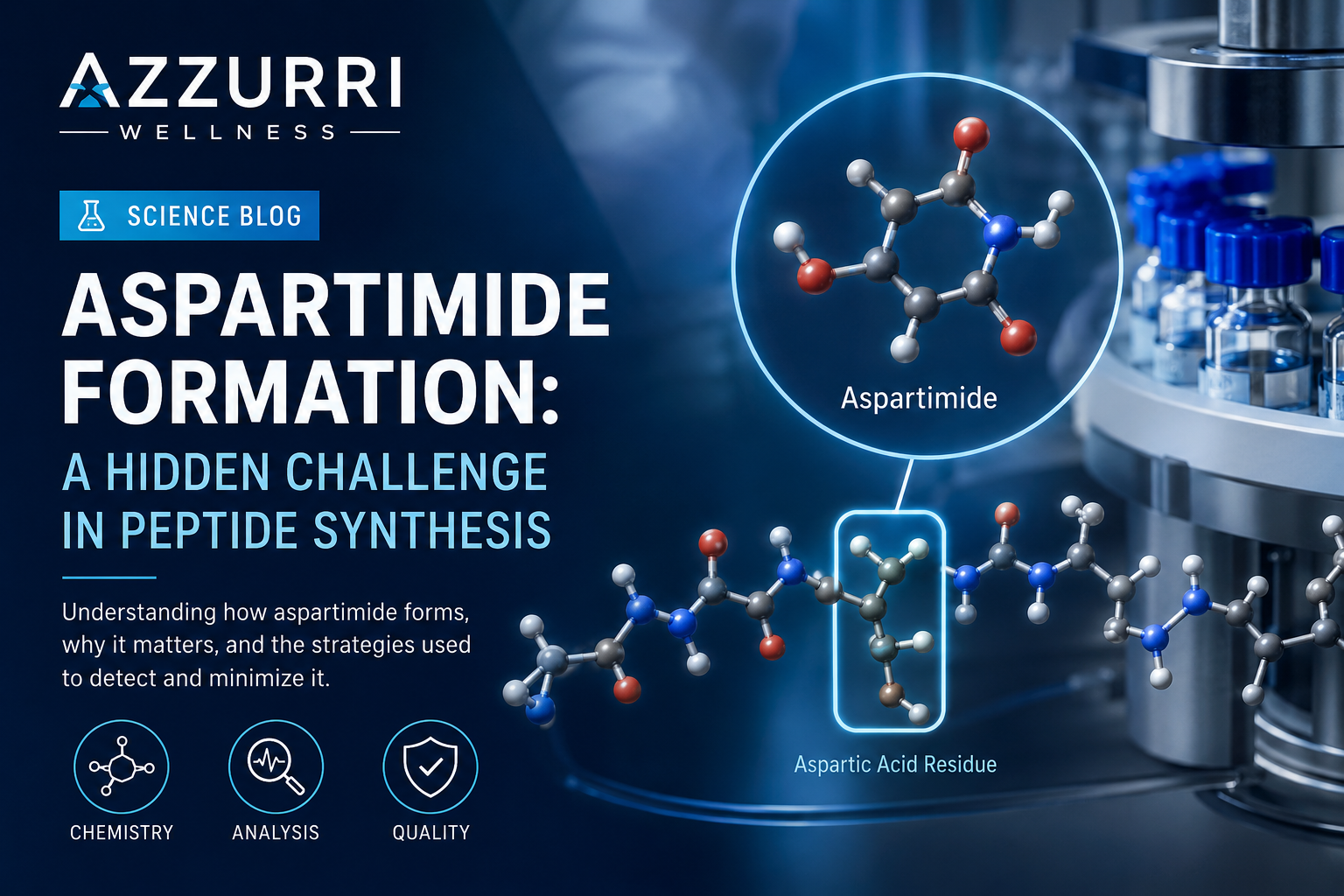
Peptide synthesis involves a sequence of carefully controlled chemical steps. Even when the intended amino-acid sequence is clear, side reactions can create additional forms that complicate purification and analysis. One well-known example is aspartimide formation.
Aspartimide is a cyclic intermediate associated with certain aspartic-acid-containing sequences. It is especially relevant in Fmoc-based solid-phase peptide synthesis, where repeated exposure to basic conditions can encourage the reaction.
1. How Aspartimide Can Form
During synthesis, the peptide backbone and side chains are temporarily protected while new amino acids are added. Under suitable conditions, the backbone nitrogen next to an aspartic-acid residue can react with the protected side chain and form a five-membered cyclic structure.
The likelihood of this reaction depends on sequence context, protecting groups, base exposure, temperature, reaction time, and solvent conditions. Some neighboring residues make the sequence more susceptible than others.
2. Why It Creates an Analytical Challenge
Aspartimide may reopen through more than one pathway. This can create the intended peptide alongside related products, including beta-linked forms or stereochemical variants. Because these forms can have similar masses, a simple molecular-weight check may not fully distinguish them.
Chromatographic behavior, fragmentation patterns, and carefully selected reference materials may be needed to understand which forms are present.
3. Approaches Used to Reduce Formation
- Selecting side-chain protecting groups that are less prone to cyclization
- Using backbone-protecting strategies in susceptible sequences
- Reducing unnecessary exposure to basic reagents
- Adjusting coupling and deprotection conditions
- Monitoring the process during development rather than only testing the final material
No single prevention strategy is suitable for every peptide. The sequence, manufacturing scale, and compatibility of the protecting-group system must all be considered.
4. What Clear Documentation Should Include
- The sequence region identified as potentially susceptible
- The protecting groups and synthesis conditions used
- The analytical method used to detect related forms
- How peaks or impurities were assigned
- Any process changes used to reduce formation
- The batch or sample identifier connected to the result
5. The Main Takeaway
Aspartimide formation shows why peptide characterization requires more than confirming the expected mass. Side reactions can create closely related forms that require suitable separation, identification, and process understanding.
At Azzurri Wellness, clear scientific information means explaining both the result and the chemistry behind it.
References
- Kong MJW, van den Braak TJHP, Neumann K. Aspartimide Formation and Its Prevention in Fmoc Chemistry Solid Phase Peptide Synthesis. ChemBioChem. 2025;26(18):e202500490. View source
- Flora D, Mo H, Mayer JP, Khan MA, Yan LZ. Detection and control of aspartimide formation in the synthesis of cyclic peptides. Bioorganic & Medicinal Chemistry Letters. 2005;15(4):1065–1068. View source
- Cao L, Elashal HE, Link AJ. Kinetics of Aspartimide Formation and Hydrolysis in Lasso Peptide Lihuanodin. Biochemistry. 2023;62(3):695–699. View source
Disclaimer: This article is provided for general educational information only. It does not provide medical advice, product-use instructions, or guarantees regarding any individual material.